Friday, February 15, 2013

Longshore Workers Fighting Corp Attacks


Aggressive Employers Challenge Longshore 

Workers on Both Coasts

 1 0
 
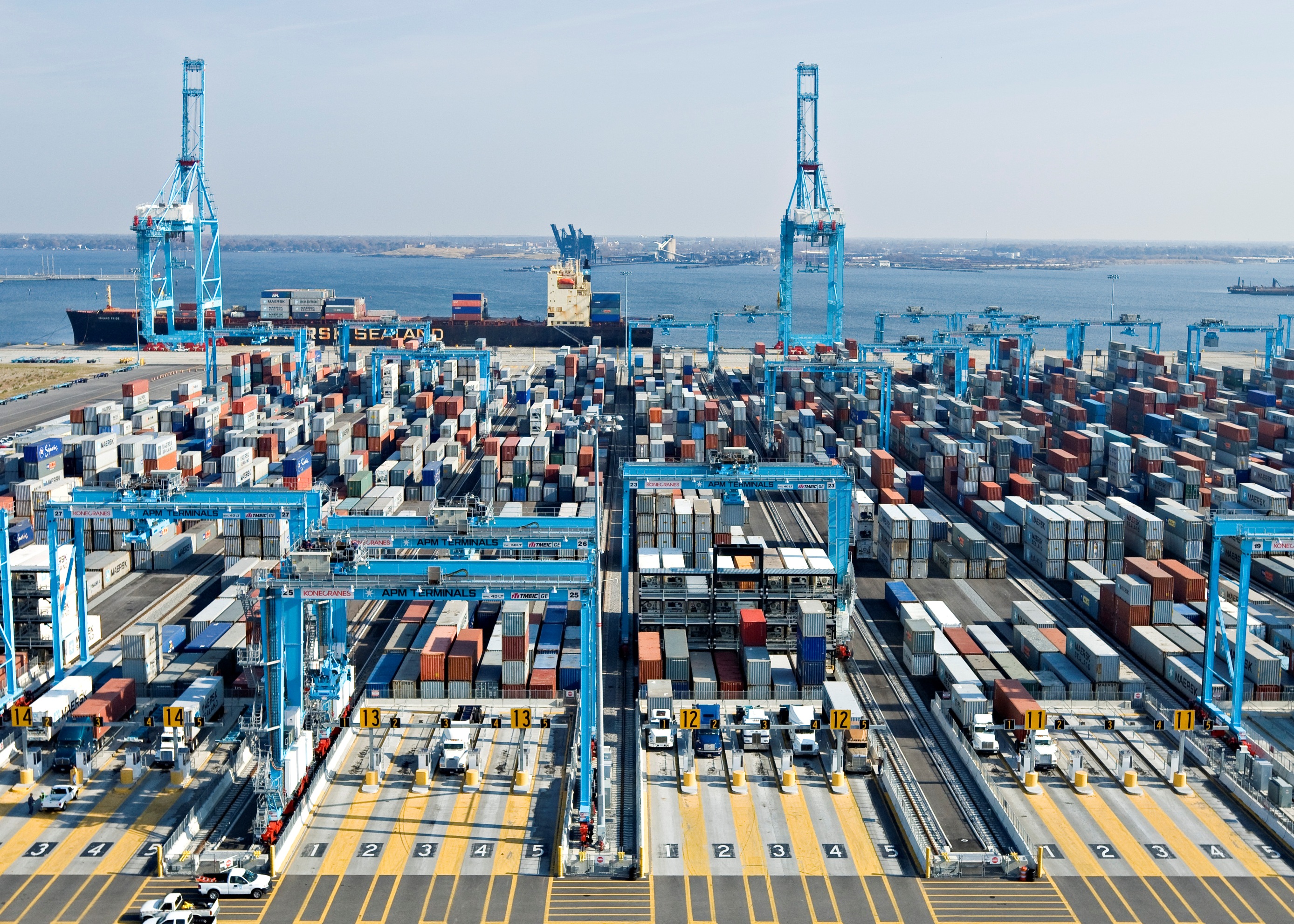
Automation, like the remotely-operated yard cranes in Norfolk, Virginia, is a growing concern for longshore workers on both coasts. Photo: APM Terminal.
With their pivotal position in the global supply chain, dockworkers are often considered the standard-bearers of on-the-job power. But on both coasts, this union stronghold is under stepped-up employer pressure.
Terminal operators and shippers are pushing leaner staffing, challenging longstanding work rules, and introducing job-displacing technology. They are also driving a wedge between standards for longshore workers handling containerized cargo and for those who do everything else on the docks.
The union response has been uneven, after the widespread disruptions and civil disobedience workers used during a heated battle in Longview, Washington, in 2011-2012.
Port clerks in Southern California have just voted to reject the settlement that sent them back to work in December after an eight-day strike. East Coast longshore workers, who narrowly avoided a strike in the final days of 2012, are weighing whether to accept a controversial deal reached earlier this month. And West Coast grain handlers also opted not to strike in late December, even though employers declared impasse and imposed a contract workers had roundly rejected.

Clerks Strike

The steady drip of outsourcing drove 600 clerical workers, members of Longshore Union Local 63’s Office Clerical Unit (ILWU), out on an eight-day strike in the ports of Los Angeles and Long Beach November 27.
After more than two years working under an expired contract, their strike provoked the biggest disruption in West Coast container traffic since the employers’ 2002 coastwide lockout.
Picket lines quickly spread across both ports, eventually idling close to 10,000 additional longshore workers at 10 of the 14 terminals. Over $400 billion worth of container shipments—nearly a third of all such shipments into the U.S.—pass through the two ports each year on their way from far-flung factories to retail shelves.
At its peak the strike had 13 ships anchored offshore, waiting to discharge cargo, while another 18 were re-routed to other ports.
The clerical workers handle invoicing and billing records and schedule on-site customs inspections. Outsourcing has moved 50 of their bargaining unit jobs to non-union office workers away from the ports, from Colorado to Costa Rica.
After eight days of high-stakes negotiations, including federal mediation and an eleventh-hour intervention by Los Angeles mayor Antonio Villaraigosa, strikers returned to work December 5 with new limits on outsourcing.
But clerical workers have reportedly rejected the agreement. No one from the union could be reached for comment, but there is speculation that details of final contract language, settled after the return to work, fed the “no” vote.

Back East

Meanwhile, the East Coast Longshore union (ILA) announced a six-year agreement with port operators February 2. The deal capped tense negotiations marked by two contract extensions, federal mediation, and a narrowly averted strike in late December.
A 200-person committee will convene March 12-14 to review the proposal and either recommend it to members or send negotiators back to the table.
Reports indicate the six-year deal includes backloaded raises—no raises in the first half of the agreement, then one dollar each year for the final three years.
The deal also restores a controversial cap on the “container royalty,” an annual productivity dividend paid to longshore workers based on tonnage moving through containerized ports. The dividend was established with the introduction of containerized shipping in the 1960s to compensate for the huge loss of longshore jobs. ILA members won removal of the cap in their 2009 negotiations. Now it’s back.
“People are upset,” noted Mark Bass, president of ILA Local 1410 in Mobile, Alabama. “There were certain things the ILA promised to stand on, to bring everybody up.”
According to Bass, workers are also concerned the modest increase in the employers’ contribution to benefit funds—a extra $1 per hour worked over the life of the agreement—isn’t nearly enough to shore up local pension, holiday, and vacation funds, which are in poor shape after the financial collapse and continued recession.
Ken Riley, president of Local 1422 in Charleston, South Carolina, and national vice president, shares this concern. “In our local we always say you’re only one accident, or one diagnosis, away from a pension.” he said. “That’s why we’ve done a lot of education, particularly with younger members, so folks understand that improving pension benefits is not just for folks about to leave the industry.”
But Riley also pointed to some advances in the current agreement, including a faster progression to top pay—from nine years down to six—and a first-ever coastwide agreement on automation.

Automation

The automation deal formalized future negotiations over the introduction of new technology, and will channel displaced workers into other ILA jobs. Employers also agreed, in principle, that jobs created by new technology will be in the ILA’s jurisdiction.
“It won’t give us 100 percent protection,” Riley noted, “but we did pretty well.” The automation deal is similar to the one struck by West Coast longshore workers and employers after the coastwide lockout in 2002.
Automation has been a growing concern in the ILA since the world’s largest shipping company, AP Moller-Maersk, opened a semi-automated container terminal in Norfolk, Virginia in August 2007. The move introduced remotely operated yard cranes, controlled through a combination of GPS technology, cameras, and computers. The rail-mounted cranes stack the huge containers seven high and eight wide, delivering them to trucks or rail cars. Six cranes can be operated by one operator from a computer booth inside the terminal.
A similar system is being developed in Bayonne, New Jersey, part of the East Coast’s biggest port system, surrounding New York City. And in Jacksonville, Florida, port authorities have already approved construction of a fully automated terminal operated by the shipping giant Hanjin.
The union won protections against the outsourcing of skilled chassis repair and maintenance—a key issue for International President Harold Daggett, whose home local performs this work in the East Coast’s busiest port system, New York and New Jersey.
As bargaining now shifts to local issues in each port, concern remains high over employer proposals for drastic cuts to staffing levels and crew sizes, particularly in New York and New Jersey.

Grain Strain

The West Coast Longshore union and the Pacific Northwest Grain Handlers Association are at a stalemate. The two sides were locked in tense negotiations late last year, with the ILWU trying to maintain longstanding master contract standards for the 3,000 longshore workers who handle grain along the Puget Sound and Columbia River.
Longshore workers in the region move nearly 30 percent of all U.S. grain exports, including half the nation’s wheat shipments.
The conflict came to a head December 18 when employers declared impasse and pushed the four ILWU locals to vote on their “last, best, and final” offer. Grain workers rejected the proposal by 94 percent. But two of the association employers—Columbia Grain and United Grain—imposed the new terms anyway on December 27, hoping to provoke a strike.
“It’s simple: they want to break the union,” said Leal Sundet, the ILWU Coast Committeeman leading grain negotiations. “But we’ve been here 80 years and we’re not going anywhere.”
According to Sundet, these employers have taken full advantage of the high prices—and hefty profit margins—accompanying this year’s low harvest, spending several months, and millions of dollars, preparing for a showdown with the ILWU. Grain operators fortified terminal entrances in anticipation of aggressive picket lines and installed new surveillance technology to limit the effectiveness of work-to-rule strategies.
The companies had out-of-town replacement workers and three non-union tugboats—complete with armed security and additional Coast Guard protection—on hand in case longshore workers walked off the job.
Rather than strike, the ILWU chose to report to work under the newly imposed conditions, and is considering unfair labor practice charges against the two companies while trying to hammer out a better deal separately with TEMCO, a joint venture between global agribusiness companies CHS and Cargill. Terminals for the fourth employer, Louis-Dreyfus Commodities, have been shuttered for construction, but the company continues to participate in negotiations.
The union remains tight-lipped about TEMCO negotiations, but it is unclear how a settlement—even one protecting master contract standards—can be spread to the two hard-line employers.
Last year’s pitched battle in Longview, Washington, over 25 jobs cast a long shadow over bargaining. ILWU members squared off with grain giant EGT after the company announced it would operate its new state-of-the-art terminal with a different, compliant union. The ILWU finally reached an agreement after months of picketing and direct action that included occupation of the grain terminal, a blockaded train shipment, and scores of arrests.
Despite the militancy, the EGT contract loosened work rules and staffing standards compared to the master grain contract. Now employers are pushing to spread these concessions, such as regular 12-hour shifts, bypassing seniority, and greater flexibility to use supervisors for bargaining unit work.
These developments only raise the stakes for the master contract negotiations coming up in 2014, covering 15,000 West Coast longshore workers. For generations these ILWU members have set the bar for militancy, on-the-job organization, and top-notch contracts. Employers clearly are gearing up to loosen labor’s grip on a key chokepoint in their global supply chain. Look for fireworks in June next year.
Mark Brenner is the Director of Labor Notes. He can be reached at mark@labornotes.org

Wednesday, February 13, 2013

CA State Senate Hearing 'Ban on Fracking'


Advocates Make Case for Fracking Ban at Senate Hearing

Sacramento, Calif.— Today, as the Senate Natural Resources and Water Committees conduct a hearing on the regulation of fracking at the State Capitol, representatives from several environmental, health and consumer advocacy organizations call on Governor Jerry Brown and the California Division of Oil Gas and Geothermal Resources (DOGGR) to place a ban on fracking – the dangerous process of blasting water, chemicals and sand at extreme pressures into deep underground rock to release oil and gas. Combined, the organizations have collected more than 75,000 petition signatures urging Governor Brown to ban fracking in California.
“The Monterey Shale’s estimated 15 billion barrels of oil would only supply our nation’s energy needs' for three to four years, but fracking and its resulting toxic waste would have a devastating impact on California’s air, water and communities for generations,” said Adam Scow, California Campaigns Director for Food & Water Watch. “It’s time for Governor Brown to ban fracking and focus on building California’s clean energy future.”
Last week, the EPA reported that emissions from drilling, including fracking, and leaks from transmission pipes totaled 225 million metric tons of carbon-dioxide equivalents during 2011, second only to power plants for stationary sources. These findings demonstrate the threat that fracking poses to California’s already problematic air quality and climate change.
“Fracking threatens to pollute California’s environment and crush our efforts to fight climate change,” said Kassie Siegel, director of the Center for Biological Diversity’s Climate Law Institute. “Disclosing what fracking chemicals are used won’t mean much if those toxins contaminate our air and water. The best way for lawmakers to protect our state is by prohibiting this inherently dangerous form of oil and gas extraction.”
Nationwide, fracking and its resulting toxic wastewater, has developed an extensive track record of spills, accidents, leaks and pollution. The industry itself estimates that 6 percent of wells that have been fracked fail, putting our soil and waterways directly at risk.
“Fracking is an environmental nightmare for California,” said Dan Jacobsen, Legislative Director for Environment California. “It uses and pollutes millions of gallons of water, destroys beautiful places and keeps us addicted to dirty and dangerous fossil fuels. It’s time to ban fracking in California now.”
Evidence is also mounting about health problems in communities near fracking sites. Karuna Jaggar, executive director of the national breast cancer education and advocacy organization Breast Cancer Action (BC Action) based in San Francisco said, “fracking involves a cocktail of toxic chemicals, many of which we know are harmful to our health and have been linked to breast cancer. We need Gov. Brown to take a stand against the inherently toxic process of fracking to protect all Californians from the known – and unknown – health risks, such as breast cancer.”
Advocates and experts will testify during the public comment period of todays hearing and will be available for interviews.
 

Tuesday, February 12, 2013

Corp Tax Dodger Exposed by US Uncut


David Cote, chairman and chief executive of Honeywell, speaks during The Economist's Buttonwood Gathering in New York October 24, 2012. (photo: Reuters)

Running the Tax Dodgers Out of Town

By Carl Gibson, Reader Supported News
12 February 13

f Donald Trump started going on tour marketing a campaign to "fix the housing crisis" that involved evicting tenants of section 8 housing to incorporate into his own real estate empire, he would rightly be laughed off of the stage and ridiculed relentlessly for his greedy, predatory behavior against the most vulnerable. The same thing happened to Honeywell CEO David Cote this week.
Cote is one of the leading voices of the "Fix the Debt" campaign, which argues that the federal deficit needs to be addressed before anything else, and that deficit reduction should primarily come from Social Security and Medicare beneficiaries. Fix the Debt has already been exposed as a front group for the world's richest war profiteers to protect their billion-dollar Pentagon contracts, and the world's worst corporate tax dodgers to protect their egregious loopholes and gimmicks in the US tax code.
Honeywell is a leading tax dodger and war profiteer, having secured $1.5 billionin defense contracts in 2012, and paying a minus .7% federal income tax rate between 2008 and 2010. Honeywell is sitting on an impressive $39.8 billion in assets and is the 33rd largest recipient of tax dollars out of the top 100 military contractors. So it's pretty ballsy for a CEO of a corporation that got money back from Uncle Sam instead of paying taxes, to insist that retirees and the disabled pay down the national debt before he loses any of his billions.
Cote took his message to Manchester, New Hampshire, on Monday, February 11th, and was shut down by grannies and veterans. Just minutes into Cote's speech, activists with the Flip the Debt campaign and US Uncut New Hampshire began loudly informing the audience about Honeywell's obscenely low tax rate and handing out information to other attendees, while disabled workers and elderly retirees ceremoniously handed Cote their Social Security checks. One attendee was heard saying, "I only get $1200 a month to live on, but you need another yacht."
The tide is turning against tax dodgers. Bernie Sanders has been vocal about ending offshore tax havens, citing Verizon's $705 million refund from the IRS despite making $11 billion in profits during 2010. Bill Clinton recently used his ex-president bully pulpit to call on corporations to repatriate their trillions in offshored profits. And while his Republican colleagues are balking at the coming March sequester austerity package they themselves created in the debt ceiling farce of 2011, Rep. Dave Camp is warming up to the idea of taxing derivatives (he wants to use the revenue gained to reduce top tax rates, but it's a start).
As we universally reject austerity, we have to simultaneously champion progressive alternative solutions to the budgetary problems we face. One solution is theBalancing Act, championed by Rep. Keith Ellison (D-MN) of the progressive caucus. His plan would offset the 10-year, $948 billion, in across-the-board cuts that the sequester requires with closing loopholes and deductions exploited mainly by corporations and the super rich. Ellison's plan would close the carried interest loophole used by Mitt Romney, the corporate jet loophole, offshore loopholes, as well as ending fossil fuel subsidies and other numerous gifts in the tax code for those who have more than enough to pay the difference.
Awareness of the unfair tax code that relieves burden from those who have the most and shifting it to those who can barely scrape by has spread all over America, and Congress will soon have no choice but to acknowledge it. And in the midst of this new awakening, laughable greed-inspired campaigns like Fix the Debt are fading into the realm of irrelevance and obscurity.
Keep up with US Uncut! 
Web: usuncut.org 
Twitter: twitter.com/usuncut 
FB: http://www.facebook.com/usauncut


Carl Gibson, 25, is co-founder of US Uncut, a nationwide creative direct-action movement that mobilized tens of thousands of activists against corporate tax avoidance and budget cuts in the months leading up to the Occupy Wall Street movement. Carl and other US Uncut activists are featured in the documentary "We're Not Broke," which premiered at the 2012 Sundance Film Festival. He currently lives in Manchester, New Hampshire. You can contact Carl at carl@rsnorg.org, and listen to his online radio talk show, Swag The Dog, at blogtalkradio.com/swag-the-dog.

Monsanto Giant Monopolizes Corn, Soy and US Courts

ORG_NAME
Join | Donate | Act


New CFS Report Exposes Devastating Impact of Monsanto Practices on U.S. Farmers
Today, one week before the Supreme Court hears arguments in Bowman v. Monsanto Co., the Center for Food Safety (CFS) and Save our Seeds (SOS) launched our new report, Seed Giants vs. U.S. Farmers.

The report investigates how the current seed patent regime has led to a radical shift to consolidation and control of global seed supply and how these patents have abetted corporations, such as Monsanto, to sue U.S. farmers for alleged seed patent infringement.

Seed Giants vs. U.S. Farmers also examines broader socio-economic consequences of the present patent system including links to loss of seed innovation, rising seed prices, reduction of independent scientific inquiry, and environmental issues.

Among the report’s discoveries are several alarming statistics:


  • As of January 2013, Monsanto, alleging seed patent infringement, had filed 144 lawsuits involving 410 farmers and 56 small farm businesses in at least 27 different states.
  • Today, three corporations control 53 percent of the global commercial seed market
  • Seed consolidation has led to market control resulting in dramatic increases in the price of seeds. From 1995-2011, the average cost to plant one acre of soybeans has risen 325 percent; for cotton prices spiked 516 percent and corn seed prices are up by 259 percent.
Additionally, Seed Giants vs. U.S. Farmers reports a precipitous drop in seed diversity that has been cultivated for millennia. As the report notes:  86% of corn, 88% of cotton, and 93% of soybeans farmed in the U.S. are now genetically-engineered (GE) varieties, making the option of farming non-GE crops increasingly difficult.

While agrichemical corporations also claim that their patented seeds are leading to environmental improvements, the report notes that upward of 26 percent more chemicals per acre were used on GE crops than on non-GE crops, according to USDA data.

At the launch of the report via teleconference today, experts from the Center for Food Safety and Save our Seeds were joined by Mr. Vernon Hugh Bowman, the 75-year-old Indiana soybean farmer who, next week, will come up against Monsanto in the Supreme Court Case.  When asked about the numerous comparisons being drawn between his case and the story of David and Goliath, Mr. Bowman responded, “I really don’t consider it as David and Goliath. I don’t think of it in those terms. I think of it in terms of right and wrong.”

In December of 2012, the Center for Food Safety and Save Our Seeds submitted an amicus brief to the Supreme Court on behalf of Mr. Bowman, which supports the right of farmers to re-plant saved seed. Arguments in the case are scheduled for February 19th.

Download the report here: http://www.centerforfoodsafety.org/wp-content/uploads/2013/02/Seed-Giants_final.pdf 
 

JOBS, JOBS, Education, No Cuts to SS, Medicare


Portrait, Robert Reich, 08/16/09. (photo: Perian Flaherty)

Mr. President: Invest in America's Future

By Robert Reich, Robert Reich's Blog
12 February 13

art of the President's State of the Union message and of his second term agenda apparently will focus on public investments in education, infrastructure, and basic R&D.
That's good news. But how do we fund these investments when discretionary spending is being cut to the bone in order to reduce the budget deficit?
Answer: By treating public investments differently from current spending.
No rational family would borrow to pay for a vacation but not borrow to send a kid to college. No rational business would borrow to finance current salaries but not to pay for critical new machinery.
Yet that's, in effect, what the federal government does now. The federal budget doesn't distinguish between borrowing for current expenditures that keep things going, and future investments that build future productivity. All borrowing is treated the same.
A rational federal budget would treat them differently. It would allow additional borrowing for public investments whenever the expected return on those investments is higher than the cost of the borrowing. And it wouldn't borrow a dime if the return on the investment is less than the borrowing costs.
Granted, such public returns can be hard to measure. But well-developed tools exist for doing so.
Consider infrastructure. Too many roads are potholed, bridges unsafe, public transport systems outdated, pipelines bursting, and schools literally falling apart. Studiesshow a public return on infrastructure investment to average $1.92 for every public dollar invested.
Obviously these investments must be done well and carefully. No bridges to nowhere. But our infrastructure is crumbling. Our future standard of living depends on it being repaired and upgraded.
To take another example, studies show the return on early childhood education to be between 10 and 16 percent, with 80 percent of the benefits going to the general public. At-risk children with access to intensive pre-education are more likely to graduate from high school and attend college, and have full and productive lives.
But only a handful of our children have access to it. If we treated such investments as they should be treated, we'd make substantial investments in early childhood education.
Public investments in basic research and development are also dropping, both in absolute terms and as a percent of GDP - even though the returns have been substantial.
The idea that gave birth to Internet search engines came from the National Science Foundation. The lithium-ion battery that powers iPhones and electric cars was developed by federally-sponsored materials science research.
Some say we don't need to worry about public investments because private investments will fill any shortfall.
That's simply wrong.
Capital markets are now global. Money sloshes across borders in search of the highest return anywhere.
That means, increasingly, private investments follow public investment.
The only way to ensure private investors will continue to invest America, and support the high living standards we want, is for Americans to be highly productive. This requires public investments in education, infrastructure, and basic R&D to keep us productive and make us even more productive in the future.
The federal budget doesn't reveal any of this, and the current debate over budget deficits further obscures it.
We need a public investment budget - separate from the current expenditure budget - that clarifies what we're investing in, and allows us to keep borrowing for such investments whenever the return justifies it.


Robert B. Reich, Chancellor's Professor of Public Policy at the University of California at Berkeley, was Secretary of Labor in the Clinton administration. Time Magazine named him one of the ten most effective cabinet secretaries of the last century. He has written thirteen books, including the best sellers "Aftershock" and "The Work of Nations." His latest is an e-book, "Beyond Outrage." He is also a founding editor of the American Prospect magazine and chairman of Common Cause.
 

Saturday, February 9, 2013

BREAK UP TOO BIG TO FAIL BANKS


Washington Post Columnist George Will wants to break up the big banks?  (photo: AP)
Washington Post Columnist George Will wants to break up the big banks? (photo: AP)

Time to Break Up the Big Banks

By George F. Will, The Washington Post
09 February 13

George Will? Yes, today we bring you a story from George Will. It may never happen again, but today he is right. SMG/RSN
ith his chronically gravelly voice and relentlessly liberal agenda, Sherrod Brown seems to have stepped out of "Les Miserables," hoarse from singing revolutionary anthems at the barricades. Today, Ohio's senior senator has a project worthy of Victor Hugo - and of conservatives' support. He wants to break up the biggest banks.
He would advocate this even if he thought such banks would never have a crisis sufficient to threaten the financial system. He believes they are unhealthy for the financial system even when they are healthy. This is because there is a silent subsidy - an unfair competitive advantage relative to community banks - inherent in being deemed by the government, implicitly but clearly, too big to fail.
The Senate has unanimously passed a bill offered by Brown and Sen. David Vitter, a Louisiana Republican, directing the Government Accountability Office to study whether banks with more than $500?billion in assets acquire an "economic benefit" because of their dangerous scale. Is their debt priced favorably because, being TBTF, they are considered especially creditworthy? Brown believes the 20 largest banks pay less when borrowing - 50 to 80 basis points less - than community banks must pay.
In a sense, TBTF began under Ronald Reagan with the 1984 rescue of Continental Illinois, then the seventh-largest bank. In 2011, the four biggest U.S. banks (JPMorgan Chase, Bank of America, Citigroup and Wells Fargo) had 40 percent of all federally insured deposits. Today, the 5,500 community banks have 12 percent of the banking industry's assets. The 12 banks with $250?billion to $2.3?trillion in assets total 69?percent. The 20 largest banks' assets total 84.5?percent of the nation's gross domestic product.
Such banks have become bigger, relative to the economy, since the financial crisis began, and they are not the only economic entities to do so. Last year, the Economist reported that in the past 15 years the combined assets of the 50 largest U.S. companies had risen from around 70 percent of GDP to around 130 percent. And banks are not the only entities designated TBTF because they are "systemically important." General Motors supposedly required a bailout because a chain of parts suppliers might have failed with it.
But this just means that the pernicious practice of socializing losses while keeping profits private is not quarantined in the financial sector.
To see why TBTF also can mean TBTM - too big to manage - read "What's Inside America's Banks?" in the January/February issue of the Atlantic. Frank Partnoy and Jesse Eisinger argue that banks are not only bigger but also "more opaque than ever." And regulations partake of the opacity: The landmark Glass-Steagall Act of 1933, separating commercial banking from investment banking, was 37 pages long; the 848 pages of the 2010 Dodd-Frank law may eventually be supplemented by 30 times that many pages of rules. The "Volcker rule" banning banks from speculating with federally insured deposits is 298 pages long.
There is no convincing consensus about a correlation between a bank's size and supposed efficiencies of scale, and any efficiencies must be weighed against management inefficiencies associated with complexity and opacity. Thirty or so years ago, Brown says, seven of the world's 10 largest banks were Japanese, which was not an advantage sufficient to prevent Japan's descent into prolonged stagnation. And he says that when Standard Oil was broken up in 1911, the parts of it became, cumulatively, more valuable than the unified corporation had been.
Brown is fond of the maxim that "banking should be boring." He suspects that within the organizational sprawl of the biggest banks, there is too much excitement. Clever people with the high spirits and adrenaline addictions of fighter pilots continue to develop exotic financial instruments and transactions unknown even in other parts of the sprawl. He is undecided about whether the proper metric for identifying a bank as "too big" should be if its assets are a certain percentage of GDP - he suggests 2 percent to 4 percent - or simply the size of its assets (Richard Fisher, president of the Federal Reserve Bank of Dallas, has suggested $100 billion).
By breaking up the biggest banks, conservatives will not be putting asunder what the free market has joined together. Government nurtured these behemoths by weaving an improvident safety net and by practicing crony capitalism. Dismantling them would be a blow against government that has become too big not to fail. Aux barricades!

Friday, February 8, 2013

Obama Suit vs Junk Bond Raters


Why the Government’s Lawsuit Against Standard & Poor’s Matters

Before we begin, let’s take a moment to ponder the absurdity of a system in which
a) for-profit corporations are allowed to call themselves “agencies”;
b) the government – that is, us – gives these for-profit companies given trillion-dollar influence over the financial system; and
c) they’re paid by the financial institutions whose work they’re rating – institutions who will take their business elsewhere if their products aren’t rated highly .
We gave these “agencies” all this power, along with a huge financial incentive to rate garbage as if it were roses. Then we, in the form of government regulators, looked the other way. And now we’re shocked – shocked! – that these for-profit companies were behaving … well, like for-profit companies.
There’s an extremely strong case for fraud in the government’s new lawsuit against Standard & Poor’s. The lawsuit says that Standard & Poor’s lied to the SEC in order to be certified as a credit rating agency, and that it lied to investors about the objectivity and thoroughness of its reviews. It also alleges that S&P knew that some of the mortgage-backed securities it rated “AAA” were, in fact, lousy investments, and did it to keep the bank’s business.
Body of Evidence
There’s a lot of compelling evidence in the lawsuit. Much of it is taken from the Senate’s Permanent Subcommittee on Investigations, chaired by Sen. Carl Levin, which we reviewed in detail in “The Rating Game” and “Poor Standards.”
One email exchange shows that an analyst was pressured by S&P to improve a rating for their “customer,” and when the analyst offered a somewhat higher score he was “I don’t think that will be enough to satisfy them.” When another analyst asked to look at some files for a review,which is the standard way of doing things, he was told that his request was “TOTALLY UNREASONABLE!”
S&P isn’t just ethically challenged. It’s also lousy at what it does. When it downgraded US debt in 2011, for example, the Treasury Department found a $2 trillion error in S&P’s calculations. S&P simply deleted the error from their report, then wrote up a completely different rational for their downgrade – one that relied on unmeasurable and intangible considerations. To the trained eye that suggests they’d already picked a number and they were now making up reasons to justify it.
A billion here or there is one thing. But a trillion? That’s just plain sloppy.  As long as that kind of workmanship is driving our financial system, this lawsuit is important. Here are five takeaways from this action:
1. Ratings agencies are very important – and very broken.
Ratings agencies are given enormous responsibility and enormous power. Some investments are required by law to invest in only “AAA” financial products. Others, like many pension funds, have made the decision to stick to these (supposedly) safe investments exclusively.
S&P and other ratings agencies took banks’ money in return for rating their mortgage-backed securities “AAA.” Many of those securities were a form of organized fraud that was perpetrated on investors. These securities were such an easy way to earn money that they drove the housing bubble: Banks didn’t want to know if a borrower was a bad risk, because they could just bundle the loan with a lot of other equally doubtful ones and sell them all off to unwary investors.
That’s a guaranteed way to make money – for a while – as long as the rating agencies were guaranteed to give these worthless investments a “AAA” rating.  And they were. That places the rating agencies at the heart of the financial crisis, the recession, and all the loss that resulted from those events.
That’s as important, and as broken, as it gets.
2. The naysayers are wrong. There’s a very strong case against S & P.
S & P’s attorney, Floyd Abrams, took to the court of public opinion to defend his client on CNBC. Abrams argued that everybody believed these mortgage-backed securities were good, including Treasury Secretary Hank Paulson and the Federal Reserve.
But Standard & Poor’s sells a technical service. It isn’t paid all that money to repeat the conventional wisdom. And yet, within a year Standard & Poor’s was forced to downgrade many of these “AAA” investments to junk status. Apparently one of their key lines of defense will be: We weren’t crooked, just incompetent.
Besides, it isn’t true that “everybody” believed these investments were strong. Did Standard & Poor’s conduct any research into the work of the many economists who publicly said there was a housing bubble, as it continued to give these investments a “AAA” rating? I think we know the answer to that one.
The “incompetence” defense also fails to address the many emails and internal documents showing that sales, not accuracy, was the organization’s prime concern.
Abrams flirts with, but doesn’t embrace, the right-wing argument that this lawsuit is driven by revenge against S&P for downgrading the Federal debt. But that downgrade didn’t weaken the government’s ability to get cost-free loans, so there was no harm. And that was two years ago, which would make this a very delayed act of revenge.
Abrams and S&P are also trying to defend its actions on First Amendment grounds, claiming that they’re journalists.  Other agencies have tried this defense. But journalists aren’t “agencies.” They’re not given the authority to rate something, with billion-dollar implications. If these agencies were journalists, they’d have no product to sell.
A skeptical piece about the lawsuit from Peter J. Henning and Steven M. Davidoff in the New York Times also misses the mark. They write:
“The government will have to prove that ratings were in fact faulty, and published intentionally so as to deceive investors in the securities. In response, S.& P. could simply argue that the company was just as blinded by the financial crisis as anyone else, and that questionable e-mails are simply the work of lower-level employees who were not involved in the decision-making.”
This is Abrams’ “nobody saw it coming” argument. But that’s not what the government is alleging. The lawsuit shows that S & P claimed to have internal quality control standards, objectivity, and rigid methodology, that it made those claims in order to make money – and that it knew these claims weren’t true.
The issue isn’t whether S&P was as “blinded” as everyone else. The issue is whether it lied when it claimed to have better vision.
3. Political pressure works.
This lawsuit might never have been filed if it had not been for the hard work of Sen. Levin’s Subcommittee.
And it might not have been filed, or the government might have settled for a smaller fine, if there hadn’t been so much public demand for a tougher stand against those who brought down the economy.
Finally, there’s a case where the government wouldn’t settle for peanuts. That’s a pleasant surprise. It also shows that political pressure – whether from elected officials or the public at large – works.
4. Civil cases are important.
Republican Senator Charles Grassley, who has made some surprisingly good stands on banking issues, was dismissive because this is a civil suit and not a criminal prosecution. But this suit is already important, because it’s brought many important facts to the public’s attention. And it’s put the agencies on notice that there will be consequences for putting profits over performance.
And a civil suit seems like the right place to start. We’ve certainly hammered the Justice Department time and time again over its refusal to bring criminal cases against Wall Street bankers. That was, and is, outrageous.  But the burden of proof’s a little different here. What makes the lack of banker prosecutions so outrageous is the fact that the banks have paid hundreds of billions in fines for fraud — then committed the same kinds of fraud again.
Those settlements have created an enormous body of evidence regarding bankers’ crimes.  That’s not true in this case. Not does this lawsuit preclude criminal cases in the future. Hopefully they’ll be coming.
5. We need to dismantle the entire “credit ratings agency” system.
In the end, however, the real lesson is this: The entire system of “credit rating agencies” is broken. The Franken Amendment, which initially took away the most egregious salesmanship in the process, was downgraded to a requirement that the SEC conduct a study into rating agencies and make recommendations.
The SEC study found a lot of flaws, but the SEC has yet to take action. Instead the proposed set of regulations required by Dodd-Frank is being slow-walked to death.
That means nothing’s really changed: Credit rating agencies are still paid by the ultra-wealthy institutions they rate. Agency employees still have a revolving-door relationship with the banks, and so do the people who supervise the agencies.
Until the profit motive is removed from the agency process, the system will remain broken. In the meantime this lawsuit is at least a hopeful sign, and a step in the right direction.