Wednesday, May 14, 2014

No Safe Place - NSA Cracks All Codes

Glenn Greenwald on Secret NSA Program to Crack Online Encryption

(Image: <a href=" http://www.shutterstock.com/cat.mhtml?page_number=1&position=10&safesearch=1&search_language=en&search_source=pic_recommended&search_type=keyword_search&searchterm=encryption&sort_method=popular&sort_version=4_0&source=search&timestamp=1378734320&tracking_id=9D3BshDrOjA919LJUDHttg&page=1#id=128620799&src=9D3BshDrOjA919LJUDHttg-1-10 "> via Shutterstock </a>)(Image: via Shutterstock).A new exposé based on the leaks of Edward Snowden has revealed the National Security Agency has developed methods to crack online encryption used to protect emails, banking and medical records. "Encryption is really the system that lets the Internet function as an important commercial instrument all around the world," says Glenn Greenwald of The Guardian, which collaborated with The New York Times and ProPublica on the reporting. "It’s what lets you enter your credit card number, check your banking records, buy and sell things online, get your medical tests online, engage in private communications. It’s what protects the sanctity of the Internet." Documents leaked by Snowden reveal the NSA spends $250 million a year on a program which, among other goals, works with technology companies to "covertly influence" their product designs. "The entire system is now being compromised by the NSA and their British counterpart, the GCHQ," Greenwald says. "Systematic efforts to ensure that there is no form of human commerce, human electronic communication, that is ever invulnerable to their prying eyes."

TRANSCRIPT:
This is a rush transcript. Copy may not be in its final form.
Juan González: The Guardian, The New York Times and ProPublica have jointly revealed the National Security Agency is successfully waging a long-running secret war on encryption, jeopardizing hundreds of millions of people’s ability to protect their privacyThe New York Times writes, quote, "The NSAhas circumvented or cracked much of the encryption, or digital scrambling, that guards global commerce and banking systems, protects sensitive data like trade secrets and medical records, and automatically secures the e-mails, Web searches, Internet chats and phone calls of Americans and others around the world." Security experts say the NSA program "undermine[s] the fabric of the internet." The revelations are based on documents from the NSA and its British counterpart, GCHQ, leaked by former NSA contractor Edward Snowden.

Amy Goodman: The documents also showNSA spends $250 million a year on a program which, among other goals, works with technology companies to covertly influence their product designs. The NSA has also been deliberately weakening the international encryption standards adopted by developers. And according to the documents, a GCHQ team has reportedly been working to develop ways into encrypted traffic on the "big four" service providers, named as Hotmail, Google, Yahoo and Facebook. The spy agencies insist that the ability to defeat encryption is vital to their core missions of counterterrorism and foreign intelligence gathering.

Well, for more, we’re joined by Democracy Now! video stream by Glenn Greenwald of The Guardian, co-author of the new article, "US and UK Spy Agencies Defeat Privacy and Security on the Internet." Glenn Greenwald first published Edward Snowden’s revelations about the NSAsurveillance programs and continues to write extensively on the topic.

Glenn, welcome back to Democracy Now! We haven’t spoken to you since your partner, David Miranda, was held at Heathrow for nine hours, the airport in Britain, and we want to get to that. But first, talk about the significance of this latest exposé that both The Guardian, The New York Timesand ProPublica have published today.

Glenn Greenwald: First of all, I think there’s significance just in the partnership itself. It’s very unusual for three media organizations to work so closely on a story of this magnitude. And that happened because the U.K. government tried forcibly toThe Guardian from reporting on these documents by pressuring The Guardian editor-in-chief in London, Alan Rusbridger, to destroy the hard drives of The Guardian which contained these materials, which is why they ended up making their way to The New York Times and ProPublica. So I think it clearly backfired, now that there are other media organizations, including probably the most influential in the world, The New York Times, now vested in reporting on the story.

The significance of the story itself, I think, is easy to see. When people hear encryption, they often think about what certain people who are very interested in maintaining the confidentiality of their communications use, whether it be lawyers talking to their clients, human rights activists dealing with sensitive matters, people working against oppressive governments. And those people do use encryption, and it’s extremely important that it be safeguarded. And the fact that the NSA is trying to not only break it for themselves, but to make it weaker and put backdoors into all these programs makes all of those very sensitive communications vulnerable to all sorts of people around the world, not just the NSA, endangering human rights activists and democracy activists and lawyers and their clients and a whole variety of other people engaged in sensitive work.

But encryption is much more than that. Encryption is really the system that lets the Internet function as an important commercial instrument all around the world. It’s what lets you enter your credit card number, check your banking records, buy and sell things online, get your medical tests online, engage in private communications. It’s what protects the sanctity of the Internet. And what these documents show is not just that the NSA is trying to break the codes of encryption to let them get access to everything, but they’re forcing the companies that provide the encryption services to put backdoors into their programs, which means, again, that not only the NSA, but all sorts of hackers and other governments and all kinds of ill-motivated people, can have a weakness to exploit, a vulnerability to exploit, in these systems, which makes the entire Internet insecure for everybody. And the fact that it’s all being done as usual with no transparency or accountability makes this very newsworthy.

Juan González: But, Glenn, going back to the mid-1990s in the Clinton administration, when the government tried to establish these backdoors into communications on the Internet, there was a public debate and a rejection of this. What has happened since then now in terms of howNSAoperates?

Glenn Greenwald: Right, it’s interesting. If you go back to the mid-'90s, that debate was really spawned by the attack on Oklahoma City, which the Clinton administration—on the Oklahoma City courthouse by Timothy McVeigh, which the Clinton administration immediately exploited to try and demand that every single form of computer security or human communication on the Internet be vulnerable to government intrusion, that it all—that there be no encryption to which the governments didn't have the key. And as you said, a combination of public backlash and industry pressure led to a rejection of that proposal, and the industries were particularly incensed by it, because they said if you put backdoors into this technology, it will make it completely vulnerable. If anyone gets that key, if anybody figures out how to crack it, it will mean that there’s no security anymore on the Internet.
And so, since the NSA and the U.S. government couldn’t get its way that way, what they’ve done instead is they resorted to covert means to infiltrate these companies, to pressure and coerce them, to provide the very backdoors that they failed to compel through legislation and through public debate and accountability. And that is what this story essentially reveals, is that the entire system is now being compromised by the NSA and their British counterpart, the GCHQ, systematic efforts to ensure that there is no form of human commerce, human electronic communication, that is ever invulnerable to their prying eyes. And again, the danger is not just that they get into all of our transactions and human communications, but that they are making it much easier for all kinds of other entities to do the same thing.

Amy Goodman: Glenn Greenwald,The Guardian piece, you write, "The NSA spends $250m a year on a program which, among other goals, works with technology companies to 'covertly influence' their product designs." How does the NSA do this?

Glenn Greenwald: So, one of the things that happens here is that a lot of these large technology companies sell products, expensive products, to their users based on the claim that these products will safeguard the privacy of people’s activities online or online communication through encryption. At the same time, these companies are working directly with the U.S. government andNSA, either cooperatively or because they’re getting benefits from it or through coercion, to make these products vulnerable and insecure, exactly undermining the commitments that they’re making to their users that they will enable and safeguard the privacy of their communications. So it’s really a form of fraud that the—that the technology industry is perpetrating on its users, pretending that they’re offering security while at the same time working with the U.S. government to make sure that these products are being designed in a way that makes them actually vulnerable to invasion. And again, sometimes it’s the fault of the technology companies. They do it because they want good relationships with the U.S. government. They’re profit-motivated. They get benefits from it. But a lot of times there’s just pressure and coercion on the part of a very powerful, sprawling U.S. government that induces these companies to do it against their wishes.

Juan González: And these revelations have some specifics in terms of those who are cooperating. Could you talk about Microsoft and its Outlook email?

Glenn Greenwald: Sure. We actually reported about a month ago an article that focused almost exclusively on Microsoft and the extraordinary collaboration that company engages in withNSA to provide backdoor access to its very programs that they tout to the world as offering safe encryption. If you look at what—if you just go look at Outlook.com, what Microsoft says about its Outlook email server, which is now basically the program where, if you use Hotmail or any other Microsoft service, your email is routed through, they tout Outlook as this really great service that protects people’s communications through this strong encryption. And at the very same time, Microsoft is working in private with the NSA to ensure access by the NSA across all of their platforms, not just Outlook email, but Skype and a whole variety of other services that Microsoft offers to their users to basically ensure that it’s all completely vulnerable to NSA snooping. And again, one of the big problems with it is that when you allow—when you make these programs vulnerable to the NSA, you’re also making them vulnerable to other intelligence agencies around the world or to hackers or to corporate spies or to people who just wish you ill will for any number of reasons. It’s making the entire Internet insecure.

Amy Goodman: After—The Guardian revealed last month that it smashed several computers in its London office after the British government threatened legal action, editor Alan Rusbridger said he agreed to their demand in order to avoid the newspaper’s potential closure. This is what he said.
Alan Rusbridger: We were faced, effectively, with an ultimatum from the British government that if we didn’t hand back the material or destroy it, they would move to law. That would mean prior restraint, a concept that is anathema in America and other parts of the world, in which the state can effectively prevent a news publisher from publishing, and I didn’t want to get into that position. And I also explained to the U.K. officials we were dealing with that there were other copies already in America and Brazil, so they wouldn’t be achieving anything. But once it was obvious that they would be going to law, I would rather destroy the copy than hand it back to them or allow the courts to freeze our reporting.
Amy Goodman: Last month at a White House news briefing, the deputy spokesperson, Josh Earnest, was asked if the U.S. government would ever take similar actions against a media outlet. He said, quote, "It’s very difficult to imagine a scenario in which that would be appropriate." Glenn Greenwald, can you talk about what happened at your paper?

Glenn Greenwald: It should be a major scandal. I mean, the United States and the U.K. run around the world constantly denouncing other countries that aren’t friendly with it for abusing press freedoms or failing to protect them, and yet at the same time both of these countries are engaged in a major assault on journalism when it comes to those who are trying to report on what it is they’re doing. The idea that the U.K. government, at the behest of the highest levels of that government, the prime minister and their top—it’s his top security officials—wentThe Guardian and threatenedThe Guardian's top editor repeatedly and ultimately forced him to destroy hard drives that contained the byproduct of our journalism is the stuff that, you know, the U.K. and the U.S. governments would like you to think happen only in Russia or China or other governments that they love to depict as tyrannical, and yet it's happening in the closest ally of the United States.

And, of course, in the United States itself, there is a major war on the news-gathering process with the prosecution of whistleblowers, the people who serve as sources for journalists, the theories they flirted with to criminalize the process of journalism, with the criminal and grand jury investigation of WikiLeaks or the filing of an affidavit accusing a Fox News journalist of being a co-conspirator in felonies because he worked with his source.

You really see these two governments working hand in hand to create this climate of fear in which even the largest media organizations, like The New York Times, whose celebrated reporter Jim Risen is being threatened with jail, or The Guardian, a 220-year-old newspaper, one of the most influential in the world, being threatened in the most thuggish and abusive ways to stop their reporting. And The Guardian had to take very extreme measures to evade those threats, including providing substantial numbers of documents to The New York Times and ProPublica to make sure that if they were ordered to destroy all of their sets, that there would be copies existing elsewhere in the world so that this material could continue to be reported.

Juan González: Glenn, what do you think needs to happen, given these continuing revelations aboutNSA especially, but our government in general, being virtually out of control in terms of its surveillance of communications of—not only of Americans, but around the world? Do you think that the impact of all of these revelations is going to move, hopefully, Congress to act in a stronger way to control these activities?

Glenn Greenwald: I do. I think the impact of all of this reporting is often underappreciated, in part because the changes in public opinion are often imperceptible. They happen somewhat incrementally, and we don’t immediately notice the shifts. But certain polls that have been released since we began our reporting show some very radical changes in how Americans think about threats to their privacy. They now fear government assault on their civil liberties more than they fear the threat of terrorism, something that has never happened, at least since the 9/11 attacks.

But I also think it’s important to appreciate just how global this story has resonated. There are countless countries around the world in which there are very intense debates taking place over the nature of U.S. surveillance, the value of Internet freedom and privacy. There are all kinds of pressure movements to demand that those people’s governments take serious action against the United States to protect the Internet from these kind of intrusions. You see an incredibly unprecedented, really, coalition of people across the spectrum in Congress banding together against NSA spying, insisting that they will continue to engage in reform movements, something that transcends partisan divisions or ideological divisions. It’s causing serious diplomatic tensions between the United States and allies in Germany, here in Brazil and other countries around the world, that will continue, as more reporting happens, on a country-by-country basis, as we partner with more and more media organizations around the world. So I think absolutely this has had a huge impact not just on the way that people think about surveillance and the NSA surveillance program, but, as importantly, the way they think about President Obama, the credibility of the United States government in terms of the claims it makes, one after the next of which have proven to be false, and, more generally, the role of the United States and its closest allies, including the U.K., in the world, and how much defiance and challenge they actually need.

Amy Goodman: You know, you could, in an odd way, talk about how Syria is linked to these revelations. President Obama is pursuing a pro-strike strategy with Syria right now in Russia, as opposed to talking about, you know, using this moment at the G-20 summit to push for diplomacy. He was already isolated from Putin, angry at Putin because Putin gave temporary asylum to Ed Snowden, so he cancels his bilateral meeting with Putin, which could have been used to make a deal around Syria, since he’s the major sponsor of Syria. You also have, with the G-20, President Obama trying to get these countries to support a strike, but he’s up against—you could say, against a wall BRICS, meaning BRICS, you know, the BRICS nations—Brazil, Russia, India, China and South Africa—who, it’s been revealed, that the NSA has been spying on, so there’s not a lot of friendliness there. Can you talk about your more recent—the piece you did before this one, around Brazil, which has caused a furor in your country, the country where you live right now, where we’re speaking to you?

Glenn Greenwald: Sure. We’ve been doing a lot of reporting in Brazil, in the same way that Laura Poitras, who lives in Germany because she’s afraid to edit her own film on U.S. soil because she thinks it will be seized, the footage will be, because it’s aboutNSA, the way that she’s been teaming with Der Spiegel to report on U.S. spying on Germans. I’ve been teaming with British media outlets—Brazilian media outlets to report on what’s being done in Brazil and, more generally, to Latin America.

And the stories that we started off with were about indiscriminate mass collection of the communications, data and voice and Internet emails, of literally tens of millions of Brazilians, literally stealing from the Brazilian telecommunications system all of this data on the part of the NSA, on behalf of a government over which Brazilians exercise no accountability, for which they don’t vote, to which they—and which owes them no obligation. That already created a huge scandal in Brazil. And the reporting talked about how that’s being done more broadly in Latin America, which made that scandal spread.

And then, with the report that we did last week that Dilma herself, the president of Brazil, Dilma Rousseff, had been a very personal, specific target, along with the Mexican president, where her personal communications had been analyzed and intercepted and listened to, created an enormous furor here. It caused the Brazilian government to threaten to cancel a state dinner, which is a huge matter between the U.S. and Brazil, the only state dinner that I believe the White House is having this year, to threaten to cancel large contracts. And now, this Sunday, on the same program, which is the largest, most-watched program in Brazil, we’re going to have another report that I think is even bigger, about what the NSA is doing in terms of spying on Brazilian citizens.

And so, you know, I think that one of the things that’s happening here is that, at the very least, if theNSA wants to construct a massive spying system that literally has as its goal the complete elimination of privacy around the world, that people around the world ought to at least be aware that that’s taking place, so that they can have democratic and informed debates about what they want to do about it, about how they want to safeguard their privacy, just like Americans are entitled to know that the U.S. government is collecting all of their personal communications data, as well.

Juan González: And, Glenn, I want to ask you about something closer to home, ask you about what happened to your partner, David Miranda, when he was detained last month by the British government at London’s Heathrow Airport for nine hours under a British anti-terrorism law. He faced repeated interrogation and had his belongings seized, including thumb drives carrying information you used in your reporting NSA surveillance. Speaking on his return to Brazil, Miranda said he was subjected to psychological violence.
David Miranda: [translated] A Brazilian that travels to a country like this and is detained for nine hours in this way, it, I think, breaks a person, you understand? You break down completely and get very scared. They didn’t use any physical violence against me, but you can see that it was a fantastic use of psychological violence.
Juan González: Glenn, could you talk about—about this incident?

Glenn Greenwald: Sure. I mean, first of all, what David was talking about there was the fact that they didn’t just detain him the way you sometimes get regularly detained at an airport when you visit another country for a few minutes or for even an hour to get secondarily screened. He was told right from the beginning that he was being detained under the Terrorism Act of 2000, which means that he was being detained under a law the purpose of which is to investigate people for ties to terrorism. And although it might be a little bit difficult for American citizens or for British citizens to understand, for people around the world who have seen what the U.S. and the U.K. governments do in the name of terrorism—they disappear people, they kidnap them, they torture them, they put them into cages for years at a time without so much as charges or even a lawyer—it’s an—not to mention the bombs they drop and the children they kill with drones—it’s an incredibly intimidating thing to be told that you’re being detained by a government with the behavioral record of the U.K. under a terrorism law.

The fact that hour after hour after hour went by, when they refused to allow him to speak to me or anybody in the outside world other than a list that they gave him of what they said were their approved lawyers, who they said that he was free to talk to on the phone, and when he told them that he didn’t trust their lawyers, their list or their phones, that he wanted to speak in person with a lawyer sent by me or by The Guardian, and was told that he had no right to a lawyer, no right to outside contact, that’s what he meant by the psychological violence, that he was kept in this small room, repeatedly interrogated hour after hour under a terrorism law, denied the right to his independent lawyers, ones that he trusted, not ones provided by them, and had no idea what was going to be done to him.

The entire day, I was being told by Guardian lawyers in Britain that it was likely that after the nine hours he would be arrested. That’s typically what they do. They barely ever hold anybody for more than an hour, and almost always when they do, it ends with an arrest. Sometimes they arrest them on terrorism charges, sometimes because there’s an obligation under this law to be fully cooperative, meaning answering all their questions fully, not refusing to answer anything, giving them passwords that they ask. If you even remotely refuse any of that, if they perceive that you’re not being cooperative, they will then charge you separately for a violation of that law, then will arrest you and put them in—put the person into the criminal justice system.

All of this, combined with the fact that high-level Brazilian diplomats were unable to find out any information about where he was or what was being done to him, was absolutely designed to send a message—as Reuters reported, by quoting a U.S. official, a message of intimidation to those of us who have been reporting on the GCHQ and the NSA, that if we continue to do so, this is the sort of thing that we can expect. The idea that all they wanted to do was to take his USB drives is ludicrous, for a lot of reasons, including the fact that all kinds of Guardian reporters have flown in and out of Heathrow. Laura Poitras herself flew to London and back out again without incident. They had no idea what he would be carrying. How would they possibly know? But more to the point, if all they wanted to do was take his things, that would have taken nine minutes, not nine hours. They purposely kept him for nine hours, the full amount allowed under that law, because they wanted to be as thuggish and intimidating as possible.

And the fact that he was helping Laura for a week in Berlin with our journalism, that he was carrying material back to me that Laura and I were working on journalistically, doesn’t make what they did better, it makes it worse. It shows how what the U.K. government is doing is specifically targeting the journalism process and trying to be intimidating and to force it to stop. And it’s clear it had no effect. If anything, it backfired, as I said from the beginning that it would. But I think their intent is completely clear to the world.

Amy Goodman: Are you suing? And did David get his equipment back?

Glenn Greenwald: David is absolutely suing. He is pursuing a judgment in the British courts that, as even the author of that law in the U.K. said, it was a completely illegal detention because it was obvious they had no interest in investigating him about terrorism. They never asked him a single question about terrorism. There was obviously no—nobody thought he was connected to a terrorist organization. He was repeatedly questioned about everything but terrorism, including, primarily, our journalism.

He hasn’t gotten any of his belongings back. And one of the things that happened is that the U.K. government just outright lied about what took place that day. They claimed he was carrying a password that allowed them access to 58,000 classified documents. He was not carrying any password that allowed them access to any documents. They actually filed an affidavit the same day they made that claim, saying—asking the court to let them continue to keep his belongings on the ground that all of the material he was carrying was heavily encrypted, that they couldn’t break the encryption, and they only got access to 75 of the documents that he was carrying, most of which are probably ones related to his school work and personal use. But, of course, media outlet has just uncritically repeated what the U.K. government had said, as though it were true. It wasn’t true; it was a pack of lies. But even if it were true, the idea that you’re going to detain somebody under a terrorism law who you think is working with journalists is incredibly menacing, as menacing as anything the U.K. government denounces when other countries do it.

Amy Goodman: Glenn, we want to thank you for being with us. We know you have to leave. Glenn Greenwald is a columnist on civil liberties and U.S. national security issues The Guardian. He’s also a former constitutional lawyer, first published Edward Snowden’s revelations about the NSA surveillance program and continues to write extensively on the topic. His most recent piece, co-authored in The Guardian, "US and UK Spy Agencies Defeat Privacy and Security on the Internet." We will link to that at Democracy Now.org.

Don’t go away. After break, Bruce Schneier, one of the leading experts on security on the Internet, is coming up, and then we’ll speak with Adam Entous of The Wall Street Journal about the Saudi-Syrian rebel connection and what the U.S. has to do with it. Stay with us.


Sunday, May 11, 2014

Retirement Anxiety (From Pension Thefts)

Retirement Is Americans' Top Financial Worry

Middle-aged Americans most concerned about retirement

by Andrew Dugan

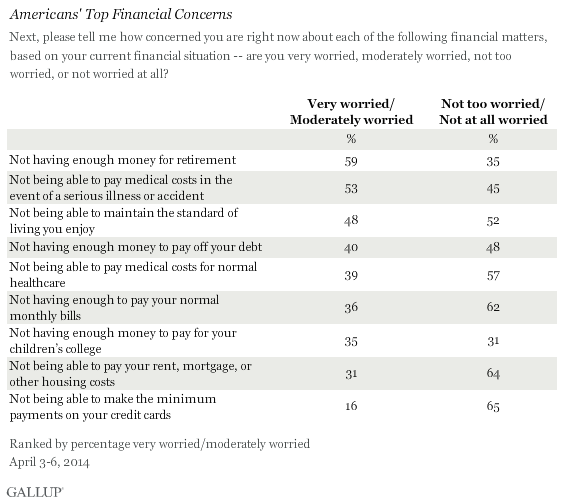
Americans' Top Financial Concerns
WASHINGTON, D.C. -- A firm majority of Americans, 59%, are worried about not having enough money for retirement, surpassing eight other financial matters. A majority of Americans have reported being "very" or "moderately" worried about retirement savings every year since 2001, illustrating that saving for retirement disquiets Americans in both good and bad economic times.
These results are from Gallup's annual Economy and Personal Finance poll, conducted April 3-6 this year.

The next top concern, not being able to pay medical costs in the event of a serious illness or accident, worries 53% of Americans. This is down from a record high of 62% in 2012.

Third on the list of Americans' top financial worries is not being able to maintain the standard of living they enjoy, with nearly half of the country's adults citing this concern. Together, retirement savings, unexpected medical costs, and maintaining one's standard of living typically top the list of the eight financial items that Gallup has tracked annually since 2001. Concerns about all three are down modestly from two years ago, but are still higher than they were before the Great Recession.
Americans' Top Financial Concerns, 2001 to 2014

Notably, four in 10 American adults say they are very or moderately worried about not having enough money to pay off their debt. This is the first time Gallup has included this financial issue. With as much as $1 trillion in outstanding student loan debt circulating in the U.S. today -- not to mention other prevalent types of debt such as credit cards -- debt concerns are clearly weighing on a significant proportion of the country.

Of the nine concerns tested, the bottom two concerns -- not being able to pay one's rent or mortgage, and not being able to make minimum payments on credit card bills -- are those most likely to indicate immediate insolvency. This finding suggests that most common financial problems are related more to savings and future expenditures than day-to-day living.

Middle-Aged Americans Most Worried About Retirement
Personal financial concerns vary significantly across age groups. The top problem for the broadly defined group of middle-aged Americans -- those aged 30 to 64 -- is not having enough money for retirement, in line with previous findings. For this group, about seven in 10 worry about not having enough money for retirement.
Americans' Top Financial Concerns, by Age
Young Americans aged 18 to 29 worry most about paying medical costs in the event of a serious illness or accident (52%), perhaps a result of the comparatively high uninsured rate for younger Americans or the lack of savings typically characterizing that age group. An equal share of 18- to 29-year-olds (52%) say they are worried about being able to maintain their standard of living. And nearly half of 18- to 29-year-olds worry about being able to pay off debt, perhaps a consequence of the massive amount of student loan debt that many young adults carry. Possibly befitting their youth and their longer distance in years from retirement, this group is least concerned about having enough money when they retire compared with other age groups -- despite dire predictions about the future of Medicare and Social Security.

Older Americans, those aged 65 or older, also worry most about being able to pay medical costs in the event of a serious illness or accident, though few in this age group lack health insurance. However, given the formidable cost of protracted, continual medical care that often characterizes older Americans' later years, many senior citizens may feel their health insurance alone cannot handle such a financial burden. Generally speaking, though, senior citizens are much less concerned about most of these financial problems than are their younger counterparts. The majority of older Americans appear to have retirement financing under control; 37% worry about having enough money in their retirement, by far the lowest percentage of any age group. Senior citizens are least concerned about not having enough money to pay for their children's college education (8%) -- presumably because older Americans already faced that challenge.

For Americans across all age groups, the ability to make minimum payments on credit card bills does not generate much concern.

Bottom Line
Retirement may be a time that many working adults look forward to, but it is paradoxically a source of stress in the here and now. A strong majority of Americans, particularly those aged 30 to 64, worry about having enough money for retirement, and this concern has regularly topped the list of Americans' top financial problems. The only other personal financial concern that a majority of Americans are very or moderately worried about is the ability to pay medical costs in the event of a serious accident or illness.

For a country that now has a life expectancy at birth of 78.7 years, retirement savings for post-work years is considered a matter of national importance. These concerns led President Barack Obama to propose a retirement savings account for working adults -- MyRA -- during this year's State of the Union address. It remains to be seen whether this new type of savings plan, which will be available in late 2014, will ultimately alleviate some Americans' concerns about retirement.

Survey Methods
Results for this Gallup poll are based on telephone interviews conducted April 3-6, 2014, with a random sample of 1,026 adults, aged 18 and older, living in all 50 U.S. states and the District of Columbia.
For results based on the total sample of national adults, the margin of sampling error is ±4 percentage points at the 95% confidence level.

Saturday, May 10, 2014

CA State Bank, Not a Rainy Day Fund

Why Jerry Brown’s Rainy Day Fund Is a Bad Idea


    California Gov. Jerry Brown. Photo by charliekjo (CC BY 2.0)


 ByEllen Brown, Web of Debt
This piece first appeared at Web of Debt.

Governor Jerry Brown is aggressively pushing a California state constitutional amendment requiring budget surpluses to be used to pay down municipal debt and create an emergency “rainy day” fund, in anticipation of the next economic crisis.

On the face of it, it is a sensible idea. As long as Wall Street controls America’s finances and our economy, another catastrophic bust is a good bet.

But a rainy day fund takes money off the table, setting aside funds we need now to reverse the damage done by Wall Street’s last collapse. The brutal cuts of 2008 and 2009 shrank the middle class and gave California the highest poverty rate in the country.

The costs of Wall Street gambling are being thrust on its primary victims. We are given the draconian choice of restoring much-needed services or maintaining austerity conditions in order to pay Wall Street the next time it brings down the economy.

There is another alternative – one that California got very close to implementing in 2011, before Jerry Brown vetoed the bill. AB750, a bill for a feasibility study for a state-owned bank, passed both houses of the state legislature but the governor refused to sign it. He said the study could be done by the Assembly and Senate Banking Committees in-house; but 2-1/2 years later, no further action has been taken on it.

Having a state-owned bank can substitute for a rainy day fund. Banks don’t need rainy day funds, because they have cheap credit lines with other banks. Today those credit lines are at the extremely low Fed funds rate of 0.25%. A state with its own bank can take advantage of this nearly-interest-free credit line not only for emergencies but to cut its long-term financing costs in half.

That is not just California dreaming. There is already a highly successful precedent for the approach. North Dakota is the only state with its own state-owned depository bank, and the only state to fully escape the credit crisis. It has boasted a budget surplus every year since 2008, and its 2.6% unemployment rate is the lowest in the country. Contrast that to California’s, one of the highest. 
In a 2009 interview, Bank of North Dakota President Eric Hardmeyer stated that when the dot-com bust caused North Dakota to go over-budget in 2001-02, the bank did act as a rainy day fund for the state. To make up the budget shortfall, the bank declared an extra dividend for the state (its owner),  and the next year the budget was back on track. No massive debt accumulation, no Wall Street bid-rigging, no fraudulent interest-rate swaps, no bond vigilantes, no capital appreciation bonds at 300% interest.

California already has a surfeit of surplus funds tucked around the state, which can be identified in state and local Comprehensive Annual Financial Reports (CAFRs). Clint Richardson, who has made an exhaustive study of California’s CAFR, writes that he has located nearly $600 billion in these funds. California’s surplus funds include those in a Pooled Money Investment Account managed by the state treasurer, which currently contains $54 billion earning a mere 0.24% interest – almost nothing. 

The money in these surplus funds is earmarked for particular purposes, so it cannot be spent on the state budget. However, it can be invested. A small portion could be invested as capital in the state’s own bank, where it could earn a significantly better return than it is getting now. The Bank of North Dakota has had a return on equity ranging between 17% and 26% every year since 2008.

California has massive potential capital and deposit bases, which could be leveraged into credit, as all banks do. The Bank of England just formally admitted in its quarterly bulletin that banks don’t lend their deposits. They simply advance credit created on their books. The deposits remain in demand accounts, available as needed by the depositors (in this case the state).

The Wall Street megabanks in which California invests and deposits its money are not using this massive credit power to develop California’s economy. Rather, they are using it to reap short-term profits for their own accounts – much of it extremely short-term, “earned” by skimming profits through computerized high-frequency program trading. Meanwhile, Wall Street is sucking massive sums in interest, fees, and interest rate swap payments out of California and into offshore tax havens.

Rather than setting aside our hard-earned surplus to pay the piper on demand, we could be using it to create the credit necessary to establish our own economic independence. California is the ninth largest economy in the world, and the world looks to us for creative leadership.

“As goes California, so goes the nation.” We can lead the states down the path of debt peonage, or
we can be a model for establishing state economic sovereignty.

Ellen Brown is an attorney, founder of the Public Banking Institute, and a candidate for California State Treasurer running on a state bank platform. She is the author of twelve books, including the best-selling Web of Debt and her latest book, The Public Bank Solution, which explores successful public banking models historically and globally.

Wednesday, May 7, 2014

Vote By Mail Eliminates GOP Election Tricks

Realistic Solution to End Voter Lines and Intimidation

   By Dina Rasor, Truthout 

2014 0507 rasor main(Image: takomabibelot / Flickr)

This has not been a good decade for voting rights. The US Supreme Court decision that gutted much of the enforcement power of the Voting Rights Act opened up a Pandora's box of Republican energy to suppress voter registration and hinder people's ability to get to the polls. It seems like each state with a Republican governor and legislature has raced to see how difficult they can make it for people of color and poor people to vote.

States have cut voting hours, days of early voting and polling places. They have limited the number of voting machines in high-population areas, leading to ridiculously long lines. They are allowing partisan "election monitors" to show up in the polling area to look for "mischief" among minority voters.

There is also a push to make it harder and harder to register to vote. This hasn't been a homegrown patchwork of efforts by the Republican governors and legislatures. In fact, the notorious American Legislative Exchange Council (ALEC) has a task force that pushes sample legislation to impede certain voters from getting to the polls.

Before the Supreme Court altered the Voting Rights Act, the Department of Justice (DOJ) would have to approve election law changes in certain states before they were allowed to become law. Once the Supreme Court lifted that restriction, the DOJ has to take on the unconstitutionality of these laws through the federal courts – something that can take years of challenges and appeals while the elections they affect just keep being held.

There are now also partisan election monitors afoot, with a Tea Party-based organization called True the Votetraining volunteers to go into polling places and challenge voters' registration. Wisconsin, who used to pride itself on voter turnout, now has passed a law allowing these election monitors to be within a yardstick of voters and poll workers. Rachel Maddow humorously showed, with one of her producers, just how "creepy" that can be.

Some Democrats and others have been working to challenge these new draconian voter restriction laws before elections, and have been raising money and volunteers to do a massive get-out-the-vote effort for future elections. However, they are missing an important potential strategy: voting by mail.

Three states, Oregon, Washington and Colorado, have already moved to all elections being done by mail.  Oregon led the way, starting the process with Phil Keisling, Oregon's secretary of state in the 1990s. I interviewed Mr. Keisling about Oregon's breakthrough efforts and his work in advocating for more states to consider voting only by mail. Keisling has been frustrated that so much effort is being put into getting people to the polls, rather than allowing people to vote in the privacy of their homes.
In Oregon, the mail ballots are sent out to every registered voter 14-18 days before the election. Voters can mail in their ballots anytime after that or go to a ballot drop-off place until 8 PM on election day. Each county must have at least two drop sites for ballots, such as outdoor ballot boxes, or sites in libraries or city buildings. A county can choose to provide drop-off areas as soon as the ballots are mailed to the voters.  Washington State and Colorado have adopted similar methods.

The all-mail voting has proven to be popular in Oregon, and participation is higher than in many polling place-based states.  Even counties in red state Utah are experimenting with all-mail ballots. Based on all the voting horror stories we have witnessed over the past several decades, mail-in voting could lessen or eliminate many of the politically motived voter-access obstacles. In the 2012 national election, too many states had long lines that required the people in them to wait as much as eight hours or more. The get-out-the-vote organizers were telling the people in line that it was a civil rights stance and were helping the elderly and others with food and seats. President Obama, in his 2013 State of the Union speech lauded Desiline Victor, who, at 102 years old, stayed in a line for more than 6 hours to cast her vote.

It is shameful that people have to take a civil rights stance to get access to a voting place.
This is just one area where voting by mail would stop a lot of voter intimidation and harassment in its tracks. Long lines would be a thing of the past. All voters would have to do is fill out their ballot at their leisure, sign the outside of the envelope and drop it in a mailbox, post office or ballot drop before the end of election day.

Avoiding the Monitors
Based on the large amount of money that is being shoved into intimidation efforts like those of True the Vote, it could take years of work in state legislatures to try to keep partisan monitors out of the election cycle. If vote by mail were to become more universal, these groups would have no polling places in which to do their bullying.

• There has been an ongoing controversy over voting machines, punch cards, hanging chads and lack of a paper trail ever since the notorious 2000 Bush/Gore election. Replacing voting machines and attempting to make them hack-proof is also a worry in an electronic age when even using your credit card at a Target store is not safe. The Oregon ballots are straightforward and designed to be counted by a scanning machine with the original ballot being preserved. Universal voting by mail would eliminate expensive voting machines and the problems that have gone with them. There would also not be a lack of machines, so obvious in urban areas, which also leads to long lines.

• Not only have citizens who have voted for years been unable to register to vote due to the requirement of more and more identification, it has also been a problem for voters to have these same IDs at the polling place to vote. Voting by mail has the voter sign their registration to vote and then sign the vote by mail ballot on the outside of the envelope. The state workers then match the signature to the signature on the card. Ironically, this is a safer way to prevent the very small amount of people who ever try to cast a ballot with fake ID, because it is a lot easier to get a fake ID than it is to forge a signature while standing at a polling table.

• There have also been precincts that run out of ballots and have to take provisional ballots, which slows down the voting process. When voting by mail, everyone who is registered to vote automatically gets a ballot, and, if they don't receive one or mess up the one that was sent to them, there is time to request another one from the state before the election.

• Fewer polling places and more isolated polling places have been a problem in areas where some local voting boards are trying to keep people of color and poor people from voting. People who do not have access to cars and reliable public transportation are put at a distinct disadvantage to get to the polls on time.  The United State Postal Service has outlets in even the most rural and otherwise isolated areas, and voting by mail could eliminate much of this problem.

• One of the most drastic changes that has happened over the past few years has been the cutting of early voting days and hours that polls are open. This has caused problems for voters working standard hours to be able to make it to the polls. Voting by mail would allow workers to read up on the issues and candidates for several weeks before the election and drop their ballot off before or after working hours.

Keisling told me that voting by mail could "bypass so much of the debate" on voter suppression and intimidation, and polling stations are like "iceboxes compared to refrigerators" when talking about the security and ease of voting by mail.

He also points out how a large amount of public funding of elections could be saved, while reducing the absurdly long waits at the polls, in an article he wrote for Governing Magazine:
But better polling stations and shorter lines require more money. New voting machines alone would cost $4 billion; more well-trained poll workers, working more days, would cost millions. Well-heeled jurisdictions, likely with the fewest problems, might not blink at such costs. But why force them, along with thousands of cash-strapped local governments, from red-tinged rural communities to blue-dominated urban areas, to redirect scarce resources to improve the polling place experience, when a long-proven, far less costly alternative - voting by mail - is so close at hand?
 Absentee ballots have coexisted with polling places for centuries; more than 30 million voters cast such ballots in 2012. Having all voters receive their ballots through the mail, while often derided as absentee voting on steroids, should be viewed instead through the lens of "universal ballot delivery."
So the question might be: Why aren't we moving toward voting by mail? There are many Republicans who have already worked hard at restricting the vote to smaller and smaller groups of people so it is not surprising to see them rejecting making the vote easier and more universal. But, according to Keisling, there is a surprising amount of tacit resistance among some of the Democratic establishment.

There are several organized efforts that are looking at vote by mail as an answer to the current mess of US elections. The main organized national effort is called the Voting Rights Project, and they discuss vote by mail as one of their ultimate goals.

However, according to Keisling, there are some Democrats and academics who are concerned about security of the ballot and the loss of a "civic sense" of duty by going to a polling booth. Curtis Gans, from the Center for the Study of the American Electorate, American University, is worried that people will lose their privacy for how they vote and could be paid off or coerced to vote for someone else. He wrote in the May 2006 American Prospect (subscription required):
Mail voting and no-excuse absentee voting are the single greatest invitation to fraud and abuse of any aspect of the voting process. They have that dubious honor because they effectively eliminate the universal secret ballot and replace it with a voluntary secret ballot - a ballot that will be secret only if the citizen who possesses it wills it to be secret.
Any citizen in Oregon or who requests a no-excuse absentee ballot can feel free to share it with anyone of their choosing. This, in turn, has led or can lead to:
  • Sharing that ballot with someone who will pay money to see that it is filled out a certain way and then returned in its security envelope to the appropriate place; or buying votes, something that led an election to be declared void in a part of Illinois.
  • Sharing that ballot with one's peers and friends in a living room ballot-signing party for a particular cause or point of view - a pressured ballot, pressure that could easily be resisted behind a closed voting place curtain but would be hard to resist among one's friends and associates.
  • Giving the ballot to someone other than the voter to deliver or mail - which can lead to that deliverer discarding the ballots if he has reason to believe they were not cast the way which the deliverer wanted it to be. This is a particular danger in group settings such as retirement communities or nursing homes, where infirm citizens may either be pressured to cast their ballots a certain way or who may be grateful for assistance in delivering ballots, not knowing that they may not reach their destination.
Phil Keisling, who has been working with other skeptical vote-by-mail progressives, says that if they truly believe that many peoples' votes can be coerced, then you should not allow absentee ballots, which have the same alleged vulnerability. He said:
Name one example of a husband or wife accused (much less convicted) of "ballot coercion" during the 2012 election, among all of the Oregon and Washington voters who case ballots in this system (and the other 26 million who did so via absentee ballots in the other 48 states). And even if, there were one - or twelve - examples, what would we do? To hear opponents say it, we'd need to then abolish all absentee ballots, period.
I have to agree with him because most of our overseas military vote by absentee ballot. Based on what I know about the military, that bureaucracy would, if they thought they could be successful, pressure their troops to vote for someone who would endlessly raise the military budget. But those troops mark their absentee ballot in their barracks or homes, and the peer or military pressure, I believe, would be greater if we set up polling places on bases with soldiers standing in line and surrounded by officers as they vote.

Based on how complicated it would be to conspire to pay people to mark their ballots by mail or collect and/or coerce without people talking and finding out, I cannot imagine altering thousands or even hundreds of mail in ballots to flip an election. I can imagine hundreds or thousands of people discouraged from casting their ballots with hundreds of people in line with hours of waiting or feeling coerced with unfriendly election monitors a yardstick away questioning your citizenship because you don't look like them.

Some claim that there is the security issue of voting through the US Postal Service and your ballot getting lost. The Postal Service can lose items, but that bureaucracy does not have political skin in the game with ballots versus the local election boards, where the board majority is stocked with political appointees from the majority party in the precinct. I can imagine that my ballot would be safer in the hands of the postal service person, who takes them out of the mailbox with all the other mail, versus the election workers, who are overseen by a political local election board. Also, if someone has a concern about the postal service, they also have the option of taking their ballot directly to a voter ballot drop-off that is under the same precinct control that you would have if you were voting in a precinct.

Keisling was instrumental, as Oregon's secretary of state, in setting up the logistics of voting by mail. He says that all systems, the older traditional system and a vote-by-mail system will have vulnerabilities or problems. However, he believes that it is easier to oversee and safeguard the ballot in a vote-by-mail system where ballots go by mail to central locations where the signature on the outside of the ballot is compared to the voter registration signature. He thinks that precinct voting has its own vulnerabilities:
Across thousands of separate precinct sites, the odds of inconsistently applying elections rules - making mistakes, inadvertently disenfranchising people, etc. - is far greater when ballots are processed. In vote by mail, where all signatures are checked and voter information is verified in central locations, there are fewer mistakes and problems, not more.
According to Keisling, this romanticizing of the tradition and civic cohesion of the public polling place is more widespread than many politicians are willing to admit. The arguments remind me of the gauzy reminiscence of Norman Rockwell's early paintings of a homogeneous white America coming together to vote. In fact Rockwell did a painting called Election 1944 that looks like what many Republicans and some Democrats still see as the America they would like to remember and emulate.
The late columnist Carl Rowan didn't see vote by mail that way. He saw it as liberating people who don't look like the people in this Rockwell painting. After the first large-scale, vote-by-mail Oregon vote, he mocked the people who decried the loss of the sacred polling place in a February 11, 1996 column (subscription required):
We're told that it allowed all people to vote without expending the small amount of energy and sacrifice of going to a neighborhood polling place, undermining the notion that "the vote is a precious thing."
This is swallowed by some as the sentimentality of patriotism, but it is, in fact, undemocratic gibberish that ought not override the fact that the Oregon election lifted the percentage of voters to about 65 percent of those eligible, a figure that made democratic participation almost as high as in European countries. It saved Oregon about $1 million. And it produced results that any Republican could applaud.
So we are to deplore this election as a violation of what "the framers" intended? I remember that the framers counted black citizens as three-fifths of a vote. And women as zero percent of a vote. Naturally, neither I nor my wife is much impressed by a reminder of what the framers believed about the semi-slave status of African-American males, or women.
The framers created a situation under which many states could decree that only the propertied could vote. When that idea and "poll tax" requirements were beaten down, polling places were located where millions of poor, ill minority citizens could not get to because they lacked transportation or couldn't leave their jobs.
Voting by mail is a way for our democracy to advance, widen the voting population, and make sure everyone who is registered receives a ballot and an easier way to cast that ballot without lines, humiliation and the prospect of losing work. All systems are going to be vulnerable, and there are going to be problems arising in any system of voting. There will be people who will try to game vote by mail, just like they are now gaming the precinct elections. As with any governmental process, it will be important to fix problems or mistakes as they pop up.

But we know about the problems in the precincts - statistics show that actual voting fraud in very small but the manipulation of the ability to vote has been greatly twisted to benefit a shrinking status quo. We know about the lines, the lack of voter machines, the partisan election monitors who can challenge people that they don't think look like Americans in the precinct system. If voting by mail is truly evil for democracy, then we need to start pulling back the efforts to expand the absentee ballot if you are going to be consistent in the argument that any vote by mail is dangerous.

Implementing the Vote By Mail Solution
Just saying that we all should embrace vote by mail and assuming both political parties will accept it in every state is wishful thinking. However, there is a way to advance the ability to vote by mail down the road, through the longstanding tradition of the absentee ballot. Many states make people have an excuse to be able to use an absentee ballot, but more and more states are moving to no-excuse absentee ballots.

Although my state, California, doesn't look like it will move soon to all vote by mail (all the candidates for secretary of state have declared they are against it), California not only has a no-excuse absentee ballot, but you can request that you permanently receive an absentee ballot for all elections. As more and more people get use to the convenience and privacy of casting their ballot that way, it can lead to the realization that voting by mail is what the public wants.

The bipartisan National Council of State Legislatures has a very useful interactive chart that shows what states have no-excuse absentee ballots and those who require an excuse to get an absentee ballot.

Looking at the chart, there are three states that do all voting by mail, 28 states that allow no-excuse absentee voting (some of these states allow vote by mail under certain circumstances) and 19 states that require an excuse to obtain an absentee ballot. Compared to the work it would take to negate so many of the restrictions that some of these states have put on voting at the polling booth, it would be much easier to work on getting the states with excuse-required absentee ballots to remove that provision and get the states that have a no-excuse absentee ballot to move to the permanent status option for an absentee ballot.

Some of the states that require an excuse for absentee ballots are purple or blue states like Massachusetts, New York, Delaware, Connecticut, Pennsylvania and Rhode Island. These states should be open to allowing no-excuse absentee ballots. Meanwhile, get-out-the-vote efforts in all the states could be geared to encourage people to ask and vote by absentee ballot - just one step away from vote by mail.

As the emphasis in the next election is to get people to vote, it is apparent that it would be much easier to get people to ask for an absentee ballot and remind them to mail it in then to go out with cars to give rides to people to the polls when you can only offer them long lines and pushy poll watchers. As more and more people see the convenience of voting by absentee ballot, there may well be a push to make it a permanent status, and that, in turn, could lead to vote by mail as more people press for that option. Eventually, as more people get away from the old ideal of voting at a polling place, there will be a much more open mind about adopting voting by mail. This will mean that eventually many, if not most, of the states will be encouraging their voters to vote by sending out a ballot to each one of them, instead of discouraging the "wrong" voters to give up by using unfair laws that keep them home.

Based on what I have seen in the courts, especially on election finance laws and the gutting of the Voter Rights Act, I fear that if some of these states' absurd and drastic election precinct laws are challenged in the courts, we might end up with the equivalent of a "Citizens United" ruling by this US Supreme Court on these junk laws put in to intimidate or deter voters out of their basic rights.

The gradual adoption of vote by mail, using the existing absentee ballot structure, may be the fastest and cheapest way to overcome this shameful chapter in our history, where state governments have actively tried to inhibit some of their citizens from voting, for political reasons. To get a universal right to vote, we need universal ballots sent out to the voters with a modern and realistic way to getting their ballots back to the government. The bugs in a vote-by-mail system can be worked out as the system is adopted across the country. Eventually, vote by mail could restore the balance.
Copyright, Truthout. 

Dina Rasor

Dina Rasor is an investigator, journalist and author. Rasor has been fighting waste while working for transparency and accountability in government for three decades. In 1981, Rasor founded the Project on Military Procurement (now called the Project on Government Oversight, or POGO) to serve as a nonprofit, nonpartisan watchdog over military and related government spending. Rasor's most recent book, "Betraying Our Troops: The Destructive Results of Privatizing War," chronicles first-hand accounts of the devastating consequences of privatized war support for troops and the overall war effort in Iraq. She also founded the Bauman & Rasor Group that helps whistleblowers file lawsuits under the federal qui tam False Claims act and has been involved in cases which have returned over $100 million back to the US Treasury.

Wednesday, April 30, 2014

Koch Bros Woo Judges to Cut Union Pensions

Koch Brothers, Major Corporations Sponsor Pension Reform Seminar for Judges

By Chris Young, Center for Public Integrity | Report

2014 0430 gmu.mainGeorge Mason University, Arlington, VA, 2013 (Image: Ron Cogswell / Flickr)
As state courts across the nation prepare to referee numerous public pension reform disputes, a gaggle of interested parties — from major corporations to the Koch brothers — will next week sponsor an expenses-paid conference on public pension reform for judges who may decide the cases' fates.
Conference funders, which include ExxonMobil, Google and Wal-Mart, could benefit from efforts to slash benefits for public employees. Alternative approaches to shore up state budgets would likely require higher corporate taxes, fewer corporate subsidies and reduced government services, all of which would be bad for business.
The three-day gathering in a Charleston, S.C., hotel is hosted by George Mason University's Law & Economics Center.
The "Judicial Symposium on the Economics and Law of Public Pension Reform," according to a George Mason event description, is intended to "comprehensively outline the underlying structure of pension systems, address the differences between public and private pensions and detail the unfunded liabilities and potential bankruptcy issues arising from this crisis."

In all, about three dozen corporations — Ford Motor Co., General Electric Co., ConocoPhillips, drug maker Pfizer and the Dow Chemical Company also among them — are sponsoring the conference. Other funders include trade associations such as the American Petroleum Institute and the U.S. Chamber of Commerce, and conservative foundations such as the John William Pope Foundation and the Charles G. Koch Charitable Foundation.
Dozens of individuals are also helping bankroll the gathering; some state and federal judges themselves are listed sponsors, including Utah Judge Samuel D. McVey and Harris L. Hartz of the 10th U.S. Circuit Court of Appeals.

It's unclear which judges — and how many of them — will be attending the conference, although George Mason's judicial seminars are traditionally open to both state and federal judges. George Mason does not publicly list conference attendees, and federal judges who attend privately funded educational seminars aren't required to publicly disclose which conference they attended until 30 days after it ends.
Henry Butler, executive director of the Law & Economics Center, did not respond to multiple requests for comment.
As the Center for Public Integrity reported last year, George Mason University's Law & Economics Center regularly organizes business-friendly judicial seminars.
The Washington Post recently reported that conference funders provide more than just financial support — they also help coordinate who attends the influential seminars.
Conference agenda
What is clear from the conference's agenda is that attending judges will spend most of their time inside Charleston, S.C.'s Francis Marion Hotel listening to lectures and panel discussions led mainly by advocates of public pension reform. Bill Lurye, general counsel of the American Federation of State, County and Municipal Employees, stands out as one of the only panelists offering a union perspective on the pension debate.
Two of the conference's featured lecturers — Todd Zywicki, a George Mason University law professor, and Eileen Norcross, a senior research fellow at George Mason University's conservative Mercatus Center — co-wrote a 2010 op-ed headlined "How public worker pensions are too rich for New York's — and America's — blood." 

 The column decried unions' efforts to thwart pension reform efforts.
"No one begrudges a secure retirement for police officers, firefighters and other public servants," the authors wrote. "But unless states act now by closing insolvent plans to new hires and reducing the rate of benefit accrual for current employees, they won't be able to shore up enough to guarantee at least some of what's been promised."

Norcross will lead an hour-long afternoon session on Monday titled "Pension Reform Options." In 2011, Norcross testified before the U.S. House Committee on Oversight and Government Reform, where she recommended that states "[f]reeze or reduce the Cost of Living Adjustment, increase the retirement age, increase contributions from workers, and, importantly close the defined benefit plan to new hires."
Zywicki did not respond to requests for comment. Mercatus Center spokesman Kyle Precourt told the Center for Public Integrity in an email that Norcross is "entrenched in research now and not available for media."
For a session on "Legal Questions Raised by Pension Reform," judges will listen to Amy Monahan, a University of Minnesota law professor. Monahan, who did not respond to requests for comment, has published research disputing court rulings that state statutes establishing a pension contract between states and employees cannot legally be broken.

She wrote in a 2012 paper that "changes to future pension accruals should be legally permissible absent clear and unambiguous evidence that the legislature intended to create a contract."
Peter Kiernan, a New York attorney who co-wrote a recent report on public pensions, says arguments like these are exactly what judges will have to grapple with as pension reforms face legal challenges. In some states and cities, reforms have already reached the courts.

Illinois, for example, passed legislation in late 2013 that cut retirement benefits for public employees. Unions have since filed several lawsuits, claiming that the pension changes violate the Illinois Constitution, which explicitly states that contractual pension benefits "shall not be diminished or impaired."

Now the fate of Illinois' pension reform efforts rests in the hands of the courts. How they rule could have nationwide implications.

"If the Illinois Supreme Court says that what the Illinois legislature did is constitutional and legal, then the logjam has been broken," Kiernan said, stressing that judges will be "enormously important" in resolving the pension reform dispute. "And you're going to see all of those states attempt reforms with respect to current employees."
Corporate push for public pension reform
To be sure: Public pensions across the nation are in rotten shape. Depending on who is making the calculations — and how those calculations are being made — state and local pensions nationwide are underfunded by anywhere from nearly $1 trillion to as much as $4 trillion.
Some states and cities are worse off than others. Illinois and New Jersey, two of the worst, are drowning in pension debt. Detroit and other cities, meanwhile, have even filed for bankruptcy in part because their pension shortfalls are so severe.
"Reform is necessary because it is creating an unsustainable burden on taxpayers," said Todd Maisch, executive vice president of the Illinois Chamber of Commerce.
In Illinois, "I don't think you fix the mess without pension reform," he said.

Government officials find themselves left with difficult choices: Raise taxes and cut services to help increase their annual contributions to beleaguered pension funds, change the terms of public employee pensions to help lower the burden on state and local budgets, or do a little of both.

Reform advocates contend that public employees are enjoying lavish retirement benefits that are handcuffing states and bankrupting cities. They argue that states and municipalities should cut pensions for current and future employees. In some cases, that means shifting workers from employee-friendly defined-benefit plans to plans that more closely resemble private-sector 401(k) plans.
Public workers and their unions, too, have cried foul, arguing that their retirement benefits are far from extravagant and that attempts to change the terms of their pensions violate agreements they previously reached with state and local governments.

David Sirota, a liberal writer and commentator, wrote a 2013 report called "The Plot against Pensions," which argued that "conservative activists are manufacturing the perception of a public pension crisis in order to slash modest retiree benefits and preserve expensive corporate subsidies and tax breaks."

While public pensions face a $46 billion annual shortfall, the report found, it is "dwarfed by the $80 billion a year states and cities spend on corporate subsidies."

"We are having a debate over pension shortfalls, calling them an emergency, when in fact they are in aggregate far smaller than what is spent each year on subsidies to business," Sirota told the Center for Public Integrity. "And business likes that imbalance."

Critics of pension reform worry that corporations and conservative lawmakers are winning a public relations battle intended to demonize public pensions while ignoring the broader scope of budget shortfalls.
Hank Kim, executive director of the National Conference on Public Employee Retirement Systems, said he's tired of pension reform advocates claiming that state and local municipalities can only overcome their fiscal problems on the backs of public workers.

"If it's really about 'shared sacrifice,' which is the terminology folks have been using since the Great Recession, it occurs to us that the groups that aren't sharing the sacrifice are the wealthy and the corporations because they're still getting the tax breaks," he said. "You can't be crying poverty when you are still giving away the shop to corporations."

But a combination of higher taxes and poorer services could prompt businesses to move, said Patrick McGuinn, a political science professor at Drew University and author of a February report about the politics of pension reform.
"When you're cutting things like education or health care or investment in transportation or technology, those are things that, to varying degrees, are going to affect corporations," he said.
With so much at stake for businesses, some worry what kind of influence a corporate-funded conference might have on judges whose rulings could resolve the pension debate.
Sirota, for one, said the conference hosted by George Mason's Law & Economics Center is "an effort to lobby judges."

"It's crossing a line that's not supposed to be crossed," he said. "What's next? Is a company going to be able to hire a lobbyist to go lobby a judge in chambers?"
Probably not.

But what's next for judges certainly includes another conference on public pension reform hosted by George Mason's Law & Economics Center. It's scheduled for September in San Francisco.

THERE SHOULD BE A PROTEST AT THE CONFERENCE

Monday, April 28, 2014

New Law Suit for War Crimes vs Bush & Blair

President George W. Bush, right, and British Prime Minister Tony Blair arrive for a joint news conference in the East Room at the White House on Tuesday, June 7, 2005. (Photo: Doug Mills / The New York Times) President George W. Bush, right, and British Prime Minister Tony Blair arrive for a joint news conference in the East Room at the White House on Tuesday, June 7, 2005. (Photo: Doug Mills / The New York Times)
This is part II of a series on Dahr Jamail's trip to the Iraq Commission conference in Brussels. Also see Part I: International Lawyers Seek Justice for Iraqis
Narmeen Saleh and her husband Shawki were detained by US military forces during a violent 2004 raid of their home in Baghdad.
Saleh spent 16 days in prison, where "the interrogations didn't stop for one minute." She was beaten, electrocuted and threatened with rape if she didn't "confess."
"They [US soldiers] tortured and beat me a lot, and when they found out that I was pregnant they told me they would kill the baby in my womb," she was quoted, as her testimony was read at the Iraq Commission conference in Brussels recently. "They then concentrated their beating and electricity on my abdomen area."
Her daughter, who is now 8 years old, has cerebral palsy, and her husband remains in custody of the government of Iraqi Prime Minister Nouri al-Maliki for the bogus charge of "illegally entering Iraq."
This shocking testimony was provided to international lawyers, journalists , and activists converged at a conference titled, "The Iraq Commission," held in Brussels, Belgium, April 16 and 17, with the primary aim of bringing to justice government officials who are guilty of war crimes in Iraq.
The conference represented the most powerful and most current organized movement in the world to hold accountable those responsible for the catastrophic invasion and occupation in Iraq, including UK Prime Minister Tony Blair and former US President George W. Bush, along with others in their administrations.
War Crimes in Iraq
Nawal al-Obaidi, an Iraqi academic and founding trustee of the International Action for Iraqi Refugees NGO, provided somber testimony about how her brother was killed by US forces.
Hazim al-Obaidi left his wife and four children at their home in Mosul to go to work at his grocery store one morning in January 2005.
That same evening, his wife became worried when Hazim had not returned home and began a search.
"The whole family could not sleep that night, wondering what had happened to Hazim and why he did not return back home," his sister Nawal told the audience. "As the curfew was in place, no one could leave the house until the next morning."
The next morning, family members searched the morgues of the main hospital, but to no avail. Two days later, they learned of his burned car.
Eyewitnesses informed the family of the car being attacked by US forces, who "started shooting at him and at his car, until the car exploded." What was left of the severely burned body was removed by family members, then, "to the bewilderment of his family, US troops stopped them after they had collected the body, uncovered it and took photos."
"Hazim was not a "terrorist" or a "Saddamist," al-Obeidi explained. "He was a cheerful family man who was wounded in the Iran-Iraq war and survived the harshness of the sanctions years by selling groceries. Who is going to investigate his killing, compensate his family, and help his children to make sense of their tragedy? Will it be the Iraqi government, or the US-led occupation? Judging by the human rights records of both, the answer is that neither of them will investigate Hazim's killing, or any other. [Hundreds of] thousands of civilians have been killed for no reason. One of them was my brother."
This writer, too, provided testimony: I spoke of several war crimes I witnessed during my reportage from Iraq during the US-led occupation.
In May 2004, I interviewed a man who had just been released from Abu Ghraib prison. Like so many I interviewed from various US military detention facilities who'd been tortured horrifically, he still managed to maintain his sense of humor.
He began laughing when telling of how US soldiers made him beat other prisoners. He laughed because he told me he had been beaten himself prior to this and was so tired that all he could do to beat other detained Iraqis was to lift his arm and let it drop on the other men.
Later in the same interview, when telling of another story, he laughed again and said, "The Americans brought electricity to my ass before they brought it to my house."
Another story I reported to the international lawyers was that of 55-year-old Sadiq Zoman, who was tortured horrifically by US military personnel. I shared documentation of US military doctors, nurses and medics being complicit with that torture.
Sadiq Zoman was detained from his home shortly after the US occupation of Iraq began, but not charged with any crime. (Photo: Dahr Jamail)Sadiq Zoman was detained from his home shortly after the US occupation of Iraq began, but not charged with any crime. (Photo: Dahr Jamail)
Zoman was detained from his home in Kirkuk in a raid by US soldiers that produced no weapons. He was taken to a police office in Kirkuk, the Kirkuk Airport Detention Center, the Tikrit Airport Detention Center and then the 28th Combat Support Hospital, where he was treated by Dr. Michael Hodges, a lieutenant colonel.
Hodges' medical report listed the primary diagnoses of Zoman's condition as hypoxic brain injury (brain damage caused by lack of oxygen) "with persistent vegetative state," myocardial infraction (heart attack) and heat stroke.
After one month in custody, Zoman was dropped off in a coma at the General Hospital in Tikrit by US soldiers.
A comatose Zoman was dropped off by US military personnel at the main hospital in Tikrit. (Photo: Dahr Jamail)A comatose Zoman was dropped off by US military personnel at the main hospital in Tikrit. (Photo: Dahr Jamail)
Zoman's last name was listed as his first name on the report, despite the fact that all of his identification papers were taken during the raid on his home. Because of this, it took his family weeks to locate him in the hospital.
The medical report given by the US military medic did not mention the trauma on the back of Zoman's head. (Photo: Dahr Jamail)The medical report given by the US military medic did not mention the trauma on the back of Zoman's head. (Photo: Dahr Jamail)
Hodges' medical report did not mention the fact that the back of Zoman's head was bashed in, nor that he had electrical burn marks on the bottoms of his feet and genitals, or why he had lash marks across his back and chest.
Zoman's feet had point-burn marks from electrical shocks on the bottoms of his feet and genitals. (Photo: Dahr Jamail)Zoman's feet had point-burn marks from electrical shocks on the bottoms of his feet and genitals. (Photo: Dahr Jamail)
Zoman remains in a coma, and there has been no compensation provided to his now-impoverished family for what was done to him.
Zoman's family has yet to receive any compensation for what US forces did to him. (Photo: Dahr Jamail)Zoman's family has yet to receive any compensation for what US forces did to him. (Photo: Dahr Jamail)
Bringing Justice
Inder Comar, who testified at the commission, is the legal director at Comar Law in San Francisco, California.
"On March 13, 2013, my client, an Iraqi single mother and refugee now living in Jordan, filed a class action lawsuit against George W. Bush, Richard Cheney, Colin Powell, Condoleezza Rice, Donald Rumsfeld and Paul Wolfowitz in a federal court in California," Comar has written about his case.
"She alleges that these six defendants planned and waged the Iraq War in violation of international law by waging a 'war of aggression,' as defined by the International Military Tribunal at Nuremberg, more than sixty years ago," Comar added. (The current complaint can be found here).
Comar's client, Sundus Shaker Saleh, is alleging "crime of aggression" in the San Francisco Federal Court against the aforementioned. "Crime of aggression" emanates from the Nuremberg Trials following World War II and is what Comar is arguing was committed in the Iraq War.
The lawsuit includes all Iraqis who have suffered harm as a result of the war, and Comar's firm is representing Saleh pro bono.
"This could be precedent setting," Comar told the commission. "And this is the first time a US court is looking at a crime of aggression since Nuremberg, since 1945. We're very curious to see how this judge will decide this issue."
Inder Comar is representing an Iraqi woman, who is charging Bush administration officials with "crime of aggression." (Photo: Dahr Jamail)Inder Comar is representing an Iraqi woman, who is charging Bush administration officials with "crime of aggression." (Photo: Dahr Jamail)
US courts have immunized many of the members of the Bush Administration, but Comar thinks his case is different and will not be subject to the same kind of immunity.
"The crime of aggression is part of international law, so we are arguing with good precedent that international law is part of federal law," he said.
Comar's case against Bush is based on the conduct of members of his administration prior to their coming into office, as well as conduct taking place during and after the events of September 11, 2001.
Evidence of premeditation abounds.
Years before their appointment to the Bush administration, Dick Cheney, Donald Rumsfeld and Paul Wolfowitz were vocal advocates of a militant neoconservative ideology that called for the United States to use its armed forces in the Middle East and elsewhere.
They openly chronicled their desire for aggressive wars through a nonprofit called The Project for the New American Century (PNAC). In 1998, Rumsfeld and Wolfowitz personally signed a letter to then-President Clinton urging him to implement a "strategy for removing Saddam's regime from power," which included a "willingness to undertake military action as diplomacy is clearly failing."
On September 11, 2001, Rumsfeld and Wolfowitz openly pressed for the United States to invade Iraq, even though intelligence at the time confirmed that Saddam Hussein was in no way responsible. Richard Clarke, former national coordinator for security, infrastructure protection and counterterrorism, famously told President Bush that attacking Iraq for 9/11 "would be like invading Mexico after Pearl Harbor."
Comar's case states: "Defendants planned the war against Iraq as early as 1998; manipulated the United States' public to support the war by scaring them with images of 'mushroom clouds' and conflating the Hussein regime with al-Qaeda; and broke international law by commencing the invasion without proper legal authorization."
By comparison, more than 60 years ago, American prosecutors in Nuremberg, Germany, convicted Nazi leaders of the crimes of conspiring and waging wars of aggression. They found the Nazis guilty of planning and waging wars that had no basis in law and which killed millions of innocents.
The plaintiff in the case, Saleh, is thus seeking justice under the Nuremberg principles, as well as US law, for damages she and others like her suffered because of the defendants' premeditated plan to invade Iraq.
Comar detailed to the commission how the premeditation was obvious, showing slides from an article titled "Saddam Must Go," penned by Wolfowitz and Zalmay Khalilzad, as well as others titled, "Overthrow Him," "How to Attack Iraq" and "Bombing Iraq is not enough."
"When we talk about these war criminals, we need to employ the language of pirates in order to engage the basis of universal jurisdiction," Comar added. "Because when pirates go anywhere they have no safe haven from being held accountable for their actions."
Comar told Truthout that he decided to take this case because he was inspired by the Nuremberg judgment.
"That and my client's bravery to want to do this and be committed to her case," he explained. "In law school, I was fascinated by Nuremberg and the trail of facts."
Comar believes strongly in the morality behind the case.
"We have to use every avenue the law provides us to try to do something, and it's amazing that it took a single mother refugee from Iraq to press for justice for a war our leaders continue to want to ignore," he said. "What I'm doing can have a ripple, it might inspire other lawyers, it might cause people to start asking questions about the Bush administration."
According to Comar, his case represents the first time a US judge will hear about a crime of aggression since 1946, "So this case will be looked at internationally. We have to set the stage for other countries to start working to conform to principles of peace."
Comar added that his case in California serves as a template that could be used in every other US state.
Planning for Prosecutions
Sabah al-Mukhtar, the president of the Arab Lawyers Association, chaired the final session of the Iraq commission. The session investigated what the next steps should be toward bringing those responsible for the Iraq invasion and occupation to justice.
(Right to Left) Dirk Adriaensens, cofounder of the Iraq Commission and Brussels Tribunal, Sabah al-Mukhtar, chair of the Iraq Commission, and Michel Chossudovsky, Canadian economist at University of Ottawa. (Photo: Dahr Jamail)(Right to Left) Dirk Adriaensens, cofounder of the Iraq Commission and Brussels Tribunal, Sabah al-Mukhtar, chair of the Iraq Commission, and Michel Chossudovsky, Canadian economist at University of Ottawa. (Photo: Dahr Jamail)
"The delegitimization of major war criminals is complete in terms of the understanding around the world that these successive wars that have been waged are in complete opposition to international law," Dr. Niloufer Bhagwat, professor of comparative constitutional law at the University of Mumbai and vice president of the Indian Lawyers Association in Mumbai testified.
She addressed the fact that there have been no reparations, the sanctions crimes need to be addressed, including the fact that the US government knowingly killed more than 500,000 Iraqi children via malnourishment and disease, and added, "The work we've done here has to be carried from country to country so the political formations adopt our viewpoint, that these wars of aggression can only come to an end when we have an overturning of the political and economic systems."
Professor Gurdial Singh Nijar, a senior practicing lawyer and lead prosecutor of the Kuala Lumpur War Crimes Tribunals on Iraq, believes that the people's tribunals that have been held on Iraq "are becoming an increasingly important tool for recapturing the lost space and jurisprudence over war crimes. We've had three war crimes tribunals and we intend to have more and to introduce this thinking into law schools like the one in which I teach."
He believes the next step toward justice is for countries to exercise universal jurisdiction as a means of charging war criminals.
"Three quarters of UN states have authorized their courts to exercise universal jurisdiction over war crimes, so the stage is actually set," he said. "The challenge then is how to get these countries to institute charges against these war criminals on the basis of credible trials that have been conducted and ended up in convictions, either by peoples' tribunals or otherwise. The next step is to go country to country and begin to file charges in each of these jurisdictions."
Dr. Curtis F. J. Doebbler, an international lawyer who practices law before the International Court of Justice, shared an instance where there has already been some success.
"We suggested, for Syria, and I was in the room with the negotiators, that [US Secretary of State John] Kerry be advised that the use of force could lead to violations of international law, and there could be war crimes," he said. "So I think we're making some inroads."
Lindsey German, the convener of the British antiwar organization Stop the War Coalition, stated in her concluding remarks that Bush and Blair are "by far the most responsible persons for the Iraq war."
She added, "Blair is still the envoy for peace in the Middle East, of all things, for which they obviously didn't check his CV. We have to stress the connections between the wars and the political and economic systems under which we live. We can't have economic justice without bringing justice to the war criminals."
Comar addressed the "banality of militarism" in the United States, said he hopes that the work he is doing "is creating a vaccine for that" and stressed the need for confidence in international law.
"We in the US can work to take power back from the federal system on a state system and begin to incorporate international law into our own laws," he said. "Or maybe we can do this on a city level to criminalize this wrongdoing in a lawful manner so that we have more control. I look forward to sharing my court complaint with any other lawyer. We need to work together to help get people reparations from this war and to prevent the next war."
Dirk Adriaensens, a long-time Iraq activist and cofounder of the Iraq Commission, concluded the commission by calling for concrete proposals that will lead to global court cases regarding Iraq.
"If Inder Comar says that his court case can be replicated in all other 49 US states," he said, "then we can replicate this in every country around the world."