Monday, July 7, 2014

Cooperative Movement Owners Development Fund

Worker-Owners Cheer Creation of $1.2 Million Co-op Development Fund in NYC

  By Rebecca Burns, In These Times | Report

In a victory for new economy advocates, the New York City Council passed a budget last month that will create a $1.2 million fund for the growth of worker-owned cooperative businesses. The investment is the largest a municipal government in the U.S. has ever made in the sector, breaking new ground for the cooperative development movement.

Melissa Hoover, executive director of the U.S. Federation of Worker Cooperatives and the Democracy at Work Institute, hails the New York City Council’s move as “historic.” “We have seen bits and pieces here and there, but New York City is the first place to make an investment at that level,” she says.

New York’s cooperative development fund was the brainchild of a coalition of community groups—including the Federation of Protestant Welfare Agencies, the New York City Network of Worker Cooperatives, the Democracy at Work Institute, Make the Road New York and others—that came together to stage a series of public forums and advocacy days to secure widespread support for the initiative on the City Council. Over the next year, the fund will provide financial and technical assistance in the planned launch of 28 new cooperatives and the continued growth of 20 existing cooperatives, supporting the creation of 234 jobs in total.

While this may just be a drop in the bucket when it comes to the city’s $75 billion total budget, cooperative advocates are hoping New York’s example can help turn the tide in favor of alternative strategies for urban development.

“We’d like to get to a tipping point where [cooperatives] really have a measurable impact on the local economy,” says Hilary Abell, a San Francisco-based co-op development consultant who co-founded the group Project Equity. She notes that while interest in cooperatives has surged, there are still fewer than 5,000 “worker-owners” nationwide. Nevertheless, the model of worker-owned cooperatives has captured the imaginations of many low-income communities of color hit hardest by the Great Recession, she says, creating “a window of opportunity to take this to the next level.”
 
Last month, Abell released a report called “Worker Cooperatives: Pathways to Scale,” which outlines a set of strategies to grow the cooperative movement nationwide. While  there are several promising federal policy initiatives underway—Senator Bernie Sanders (I-Vt.), for example, has introduced a bill that would create an Office of Employee Ownership and Participation within the U.S. Department of Labor, as well as another that would establish a U.S. Employee Ownership Bank—Abell believes that “advocacy for cooperatives may have the greatest momentum at the state and municipal levels.”

Across the country, similar local economic justice coalitions have been seeking to persuade municipal governments and local institutions to throw their resources behind the development of worker-owned co-ops. It’s those resources, many advocates believe, that could take co-ops from a niche movement to a broad-based strategy for creating living-wage jobs and putting economic power in the hands of workers.

To that end, Abell hopes to see more cities follow in New York’s footsteps. In the Bay Area, she tells Working In These Times, local organizers are currently reaching out to local officials for support in scaling up worker-owned cooperatives to the point that they constitute five to 10 percent of the local economy. The coalition is particularly focused on creating jobs for workers of color in the low-income areas of the East Bay , as past experiences have shown that worker-owned co-ops can be particularly effective in redressing racial inequities in the job market. For example, Women’s Action to Gain Economic Security (WAGES), a network of nearly 100 worker-owned cleaning cooperatives in Oakland, has increased members’ incomes by more than 50 percent.

Other hotbeds of co-op development include Richmond, California, where the city has hired its own cooperative developer and is launching a loan fund under the leadership of Green Party Mayor Gayle McLaughlin. In Cleveland, Ohio, the city’s economic development department has worked closely with the Evergreen Cooperatives, a network of worker-owned green cleaning, farming and construction businesses; local hospitals and universities have also thrown their purchasing power behind worker-owned businesses. And as In These Times has reported previously, several unions have made a foray into the co-op business, combining place-based growth with a focus on leveraging changes across industries such as homecare.

Instead of simply appealing to local leaders for support, some activists have sought to build both political and economic power by building electoral campaigns around the issue of cooperative development. No city had secured greater local support for co-ops than Jackson, Miss., a majority African-American municipality where human rights attorney and longtime black radical activist Chokwe Lumumba was elected mayor last year on a platform that included the use of public spending to promote cooperative enterprises. But following Lumumba’s sudden death in February, the movement that brought him to office has been left struggling to implement the vision it had forged.

Local activists say new Mayor Tony Yarber has been tepid in his support for the cooperative development plan developed by Lumumba’s administration, leaving them uncertain as to whether they can count, for example, on city contracts being awarded to local worker-owned businesses. According to Brandon King, a member of the group Cooperation Jackson who also worked on the Lumumba campaign, access to such contracts would have been a huge boon for nascent construction and waste-management cooperatives, as Lumumba’s campaign had estimated that the city would need to spend $1.2 billion over the next 10 to 15 years on infrastructural upgrades and repairs. What often happens, says King, is that contracts go to companies located in wealthier and majority-white suburbs outside of Jackson, with the result that “people in Jackson aren’t really engaged in building their own city.”

Despite the change of course in city government, King says Cooperation Jackson “is still working on building co-ops that are large-scale, and getting as many people engaged in economic democracy as possible.” The movement has a history of black community participation in cooperative enterprises to draw from, King notes. Meanwhile, adds Cooperation Jackson memberIya'Falola Omobola, while the group works to get childcare and urban farming cooperatives off the ground, with or without city support, “We’re going to be ready to mobilize around an appropriate candidate in the next [mayoral] election.”

Noting the particular conditions that have helped secure local support for cooperatives in New York City and Jackson, the Democracy at Work Institute’s Hoover acknowledges that activists are still exploring how these can be replicated elsewhere. But if these cities are successful in retaining long-term support for cooperative growth, they can serve as a jumping-off point for other areas. “Our hope is that these won’t be one-off examples,” Hoover says. “What we need ultimately is a shift among those doing local development: from, ‘Quick, let’s get a Home Depot to come in and create jobs, but they’re low-wage and low-skilled,’ to a deeper and more patient strategy. These places could really start that shift.”

Originally published at InTheseTimes.com 

Rebecca Burns

Rebecca Burns, In These Times Assistant Editor, holds an M.A. from the University of Notre Dame's Kroc Institute for International Peace Studies, where her research focused on global land and housing rights. A former editorial intern at the magazine, Burns also works as a research assistant for a project examining violence against humanitarian aid workers.

Systematic Corporate Irresponsibilty Resulting in Death

Giant Corporations, Giant Failures

  By Richard D Wolff, Truthout | News Analysis
2014 705 gm fw(Image: General Motors, Crime scene via Shutterstock; Edited: EL / TO)
General Motors recently released the report it commissioned from the huge Jenner & Block law firm.

The latter's chairman, Anton Valukas, investigated how and why GM failed - for over 10 years - to recall cars it produced while knowing they had defective ignition switches. The eventual recall of 2.6 million Chevrolet Cobalt cars in February, 2014, followed 13 deaths GM linked to those defective switches (many others were injured, and government officials believe there were more fatalities).

GM's chief executive, Mary Barra, admitted publicly this April what Valukas wrote in his report: GM failed systematically to identify, take responsibility for, and act properly in the face of life-threatening defects in millions of automobiles it sold since 2002. On June 16, 2014, GM recalled an additional 3.16 million defective vehicles across seven of its models. GM's total recalls in North America so far this year exceed 20 million vehicles.

Lessons from so major a failure go far beyond GM leaders promising to fix their internal operations. As the Valukas report documents, many layers of the GM bureaucracy routinely ignored evidence of defective ignition switches and their risks to customers' lives. None of thousands of engineers and executives - even those who had recognized the problem or mentioned it to other GM officials - was able or willing to achieve the recall decision until 2014. Chief executive Barra attributed this failure to a "pattern of incompetence and neglect." Five years ago, GM announced another failure, its own bankruptcy, and got the US government to bail it out with $ 49.5 billion in taxpayers' money. We paid collectively to save a corporation whose chief describes its activities in terms of a "pattern of incompetence and neglect."

Despite such catastrophic failures over the past decade, we permit, and indeed subsidize, the continued operation of GM by the same bureaucracy. To date, a total of 15 engineers and other employees have been dismissed from GM for failures related to the faulty ignition switch. No one was fired because of any explicit responsibility for bankruptcy. GM had a total of 219,000 employees as of 2013.

GM's plunge into bankruptcy shook the entire economy. That same corporation persistently produced and marketed life-threateningly defective vehicles. Yet no serious steps are taken to correct actions that far exceed any reasonable standard for allowing such enterprises to continue. Are we a society that cannot recognize or deal with antisocial behavior when the culprits are large corporations?

Punishing more individuals is not the point. That would change little in the internal corporate system of rewards and punishments that produced GM's behavior. After all, GM leaders all knew the company risked major, punishing damage (loss of sales, profits and market share, law suits from victims, extremely negative publicity, government investigations, etc.) by not recalling vehicles that killed, injured, or endangered people, yet they did it anyway. The market simply did not adequately discipline GM. The corporation believed it could control its markets (by mountains of advertising, via political influence at federal, state and city levels, using massive, costly legal maneuvers, and so on).

Running the firm into bankruptcy and selling unsafe vehicles happened because GM saw both series of actions as more advantageous and less dangerous to them than other options (from earlier recalls, to sharply reduced payouts to executives and shareholders, to public discussion of mass-transportation alternatives to producing cars and trucks). In such calculations, GM is not atypical among large corporations. That is why damaging the environment; bureaucratic oppression (the "suck-up-and-kick-down" system); moving jobs to low-wage countries; producing poor quality outputs; paying their top executives and shareholders huge amounts and deepening the divide between rich and poor; crippling public revenues by shifting operations to foreign tax havens; and so many other antisocial consequences flow from those corporations.
 
The major lesson of GM's failures is that we cannot afford to leave such corporations in charge of producing the goods and services we all depend on.
 
Similarly, can we allow that system to keep purchasing our major parties and politicians to secure its immunity from real accountability? The answer is that we can and should do better than a system so obviously failing.

What is to be done? One basic problem is the link between jobs and incomes. The layers of GM bureaucracy looked the other way, did not pursue what they knew, avoided making waves inside the company etc. because they feared for their jobs and incomes. Especially in an economy with high unemployment and job insecurity, acting in socially responsible ways becomes too risky personally. If employees knew that their companies' failures would not necessarily jeopardize their personal incomes, we could expect far more socially responsible behavior from many more of them.

If government guaranteed personal incomes even when individuals had to move from one job or enterprise to another, those individuals could better face and fix the failures where they work. Making families' incomes depend on their jobs pressures job-holders not to rock the corporate boat even when they know they should. We ought to disconnect our citizens' incomes from their particular jobs (national discussions of this idea have increasingly engaged the Swiss and others in Europe over recent years).

Another lesson from GM's failures is the need to broaden the community of people making key economic decisions. If the citizens of Detroit had had real participatory power over GM decisions, GM might have kept more facilities there and thereby avoided urban collapse. If GM customers had more institutionalized participation in corporate decisions, concerns about faulty ignition switches might have gained hearings sooner and so saved lives and avoided vast financial losses.

Here lies yet another argument to shift from private, capitalist corporations (governed by major shareholders and the boards of directors they select) to cooperative enterprises (governed democratically by workers, surrounding communities, and customers/consumers).

Such cooperatives would democratize enterprises in ways likely to make their economic decisions far more socially responsible.

Richard D Wolff

Richard D. Wolff is Professor of Economics Emeritus, University of Massachusetts, Amherst where he taught economics from 1973 to 2008. He is currently a Visiting Professor in the Graduate Program in International Affairs of the New School University, New York City. He also teaches classes regularly at the Brecht Forum in Manhattan. Earlier he taught economics at Yale University (1967-1969) and at the City College of the City University of New York (1969-1973). In 1994, he was a Visiting Professor of Economics at the University of Paris (France), I (Sorbonne). His work is available at rdwolff.com and at democracyatwork.info.

Saturday, July 5, 2014

An Iraqi Woman's View

Who are the Real Barbarians?

Another (Unwelcome) Liberation of Iraq

by HAIFA ZANGANA
It goes without saying, that very little space has been available in the Corp Media, whether Arabic or international, for Iraqi voices that challenge the dominant rhetoric about the situation in Iraq.
Under the dark shadow of US “War on Terror”, the crimes and massacres of 11 years of Iraq invasion, occupation, the killing of hundreds of thousands of  Iraqis  and the daily oppression carried out by a sectarian kleptomaniac regime, have been covered up, not just by a garb of democracy, but also by the Corp Media reduced yet to a fight against terrorist organisation called Islamic State of Iraq and Syria ( ISIS),  supported by ( take your pick) either one or all the following countries, no matter how bizarre the notion is: Saudi Arabia, Qatar , and Israel  not forgetting Turkey . 
Once again, as in 2003 feverish drumming up for war, desperate Iraqis who are trying to defend themselves against a ruthless regime that uses the pretext of combating terrorism as a ploy to silence critical voices have been sidelined, not to be heard and not to be seen. In the Arab countries, joining the choir of exaggerating the role of ISIS in Iraq and elsewhere became the bleach to clean the bloody hands of those responsible of invading, occupying and laying the fertile ground for endless acts of terrorism including state terrorism.
Today, Thousands of Iraqis are fleeing their homes. So far this year, an estimated 1.2 million Iraqis have been displaced by fighting, including from Anbar, and Ninewa, west and Northern governorates.  (Maliki's) ...carrying out airstrikes in Mosul  and Tikrit as well as extrajudicial executions of detainees by the regime’s forces and militias in Tal ‘Afar, Mosul and Ba’quba, in northern Iraq have raised fears of a large scale vengeful attacks leading to a large  scale humanitarian crisis.
Meanwhile, an international competition is on the way between US, Russia and Iran to supply the regime with weapons.  Russia has already sent five Sukhoi fighter jets, the first of 25 warplanes expected to be delivered soon,  the US has sent Special Forces, Apache attack helicopters and drones as part of the top up in U.S. military presence, and the fact that Iraq has been, for many years now, a battlefield to settle scores on nuclear programme between US and Iran will only lead to an endless bloodshed reaching far beyond the region where the politically correct whispers about the Maliki’s  regime  “violations of human rights” in annual governments’ reports, are seen as adding salt to injuries.
In this hysterical atmosphere of supplying arms while tainting everything happening in Iraq by ISIS, which is by no mean comparable to the nearly 1 Dreaming_of_Baghdadmillion strong army and security forces, and especially to the Special Forces (inherited from the occupation, trained by the US and now attached directly to Maliki’s office), it is worth remembering how the current eruption of fighting begun.
It begun with a few hundred people demonstrating in both Anbar and Nineveh, in December 2012, at the news of rape of women detainees at the hands of the Iraqi security forces under Maliki’s command as Commander in Chief. 
Within few days the protests morphed into a genuine mass movement and a vigil which lasted for over a year. The demand for the release of 4500 women detainees, some of whom have been tortured, raped or threatened with rape gained a wide support, igniting a gradual escalation.  Other demands focused on release of prisoners and the repeal of section 4 in the Terrorism Act which allows the arrest of anyone without a warrant and without submitting him/ her to courts and  to abolish or suspend the Justice and Accountability Law which have been used to target political dissidents labelling them Ba’athist. 
The Maliki's regime’s response was to brand the demonstrators terrorists (ISIS was not born yet).  A campaign of arrests and assassination of vigil’s leaders was followed and amid world silence 50 demonstrators were massacred in Huweija, north of Iraq.  With every arrest, torture and killing, with every act of humiliation and marginalisation, the prospect of justice diminished.  
The Council for Iraqi Revolutionaries (GMCIR),  the Iraqi National army, and council of tribal rebels in Al-Anbar Province, issued statements emphasising the Iraqiness of the uprising, condemning terrorism, calling out to protect the holy places and not to target them because Al-Maliki’s regime is “trying to use the protection of holy places as a pretext to target the revolution”.   Above all, they reject all kind of (outside) interference in Iraqi affairs.
And while A spokesman for the GMCIR, described ISIS as “barbarians“.
The influential Association of Muslim Scholars in Iraq issued a statement dismissing the new Khilafat declaration, describing it as a step against the interest of Iraq and its unity that will be employed as a pretext to divide the country and harming its people.
Listening to these voices while admitting responsibility about the mushrooming of terrorist’s organisations, in a country that had no link to any before the US led occupation, not airstrikes,  is a must if the US and international community are genuinely interested in the stability of the region and the world.
Haifa Zangana is an Iraqi novelist, artist and activist. Her recent books are “Dreaming of Baghdad” and “City of Widows: An Iraqi Woman’s Account of War and Resistance” and co authored “The Torturer in the Mirror” with Ramsey Clark and Thomas Ehrlich Reifer. She has also published three novels and four collections of short stories and many chapters in books on Iraq and the ME. As a painter and writer she participated in the Eighties in various European and American publications and group exhibitions, with one-woman shows in London and Iceland. She is also a contributor to European and Arabic publications such as The Guardian, Red Pepper, Al Ahram weekly and Al Quds (weekly comment). She contributes to academic conferences on women, gender, resistance and war. Haifa is co-founder of Tadhamun: Iraqi Women  Solidarity, founding member of the International Association of Contemporary Iraqi Studies (IACIS) and advisor for UNDP on “Towards the Rise of women in the Arab world”. Currently she is a consultant at ESCWA.

Sunday, June 22, 2014

Inspiring Wildcat Strikes from 1960s-1970s

For Inspiration, Look to the History Of 
Public Worker Strikes 

June 18, 2014 / by Joe Burns

An illegal national postal wildcat in 1970not approved by union leaders—set contract standards postal workers are still defending today. The government tried to use the military to deliver mail. Photo: San Francisco Bay View. Politicians want to turn the clock back 50 years by restricting the bargaining rights of millions of public workers.

Unions would do well to look back, too, to the great public employee strike upsurge of the 1960s. Today’s unions, in both the public and private sectors, have a lot to learn from this little-discussed period in labor history. Here are seven lessons: Strikes Worked.  Entering the 1960s, public employee unions were weak, engaging in “collective begging” rather than “collective bargaining.” But then public workers rose up in one of the great upsurges in U.S. labor history. Public workers marched on school board meetings. They conducted slowdowns. And they struck, by hundreds of thousands over the next two decades, to win union recognition.

The civil rights movement inspired sanitation workers’ strikes throughout the South. Teachers in Florida and Utah pulled off statewide walkouts. Postal workers struck nationwide, in a wildcat conducted against the wishes of union leaders. Police and firefighters contracted “blue flu” and “red rashes” to demand what private sector workers already had: the right to bargain. This wave of militancy won both contracts and changes in labor law. And in the process, public employee union membership surged from 400,000 in the late 1950s to 4 million by the mid-1970s. Strikes, it’s safe to say, created the public employee labor movement.

The Power of Example
Just as today’s activists look to the 2012 Chicago Teachers strike for inspiration, teachers back then looked to a one-day strike in New York City schools, in 1960. According to one scholar, that single, short strike not only spurred the organization of teachers in New York state but also became “the watershed for teachers’ strikes in the twentieth century.”  Teachers around the country followed the trail blazed by New Yorkers and struck for union recognition, too.   In 1968 teachers struck 112 times—up from zero a decade before. Of course, not every local struggle will start a prairie fire. The Republic Windows factory takeover in 2008 did not prompt an outpouring of plant occupations. But we never know where a particular struggle may lead and how it may give others the courage to act.

MADE TO BE BROKEN 
Don’t Let Repressive Laws Stop You. Today we face a web of legal restrictions specifically constructed to force unions to fight small, pointless battles. Public employee strikes are illegal in most states. Private sector strikers can be permanently replaced with scabs. Simply put, the rules are rigged. Figuring out how to break free of these rules is a practical necessity. Until the late 1960s, public employee strikes were illegal in every jurisdiction in the U.S. Yet when the idea took hold and the context was right, hundreds of thousands of public workers struck anyway, violating state laws and court injunctions. And they generally won—achieving recognition and good contracts, and forcing lawmakers to amend state laws to permit public employee bargaining. Even though strikes remained illegal in the Union strongholds of New York, Ohio, and Illinois, strike levels were high there throughout the ’70s. In fact, one study of 1970 to 1981 found that “70 percent of the most strike-prone states were those where strikes were not legal.” When their union president was jailed during a 1973 strike, striking teachers in Evergreen, Washington, lined up with toothbrushes in hand demanding to be jailed as well. The flustered judge backed down and when the district refused to negotiate, he threatened to jail the school board instead. The Union won a first contract. When lawmakers realized that their laws didn’t prevent strikes, in many states policymakers legalized them, hoping to better control the activity. Union Democracy Matters.

Some say labor can confront giant corporations only by building centralized, vertically structured mega-unions. Union democracy, they say, is a luxury we cannot afford. But labor history gives little support to that proposition. During the 1960s, public workers fought to transform conservative organizations into fighting machines. Members battled at their union conventions to take no-strike clauses out of their constitutions. Public workers flocked to more militant unions—forcing others, such as the National Education Association, to adopt the strike or lose members.

A HUMAN RIGHT
Treat Striking as a Human Right. When the strike-banning Taylor Law was under debate in 1967, three New York City unions held a packed rally in Madison Square Garden, and passed a resolution stating, “No one, no body of legislators or government officials, can take from us our rights as free men and women to leave our jobs when sufficiently aggrieved. “When a group of our members are so aggrieved, then indeed they will strike.” Public employee unionists rejected illogical arguments about why public workers should not be allowed to strike. Better yet, they did not accept that legislators or courts had the right to make that decision; striking was a human right which judges or politicians could not take away. But few in labor today discuss striking as a fundamental right. Instead we look only at the practicalities: whether a strike seems immediately feasible. When it doesn’t, we forget the principle, and accept restrictions on our right to strike and free speech that earlier generations refused to tolerate.

Build Community Alliances
In the late ’60s and early ’70s, striking public workers could draw on allies in the civil rights movement, as did the 1968 Memphis and 1969 Charleston sanitation strikes. Public unions allied with still-powerful private sector unions. They could demand equality with the wages and pensions bargained by their private sector counterparts. But with the waning of the ’60s movements and the organizing climate they helped foster, public employee strikes became harder to win.  Over time, as public employee unions became more successful and private sector unionism declined, politicians began painting public employee strikers as greedy and overpaid. Understanding the economics of public employee strikes became essential to winning them. While the private sector strike aims to put economic pressure on the employer by depriving him of revenue, the purpose of the public employee strike is to exert political pressure. Winning public employee strikes, then and now, depended on a union’s ability to frame the issues, garner community support, and thereby exert political pressure on policymakers to settle.

Don’t Give Up Hope
When we look at today’s restrictive labor laws, it can be hard to see how to break out of the box. But the greatest lesson of the 1960s is that public employees believed in themselves—and dared to win. Joe Burns is a union negotiator/attorney in the airline industry and author of Reviving the Strike. He’s a former public employee and Union president. His new book is Strike Back: Using the Militant Tactics of Labor’s Past to Reignite Public Sector Unionism Today (June 2014). New Yorkers can hear him talk about the book June 25 at 7 p.m. at Bluestockings Books.
 See more at: http://labornotes.org/2014/06/inspiration-look-history-public-worker-strikes

Friday, June 20, 2014

Congress Protects Their Personal Cell Phones

Alan Grayson Hosting “Crypto-Party” In Congress

The Edward Snowden effect. posted on June 19, 2014, at 8:35 a.m.
Mark Wilson / Getty Images
Florida Rep. Alan Grayson is hosting a “crypto-party” on Capitol Hill for colleagues in Congress to learn how to use encryption technology next week, according to an invite sent from an aide in his office.
A Dear Colleague letter sent from Grayson’s office that was forwarded to BuzzFeed reads:
Dear Colleague,
Please join our offices and Access, a nonprofit organization dedicated to defending digital rights and open and secure communications online, for a “crypto party” on Capitol Hill. The event will feature experts who will explain how to protect your security online, how to assess your privacy risks online, encrypt your devices, chat securely, and anonymously browse the Internet.
Bring your personal devices if you would like help using encryption technologies. Refreshments will be provided. We hope you will stop by Rayburn 2200 on Monday, June 23 starting at 9:00 a.m. to learn more.
The event is being co-hosted by Grayson and by California Rep. Zoe Lofgren, both Democrats.
Crypto-parties are a do-it-yourself encryption movement founded in 2011 by an Australian internet activist named Asher Wolf. The parties, which involve groups of people getting together to learn encryption, usually host journalists or online activists — seldom politicians.
The event inside the halls of Congress illustrates just how mainstream the use of encryption has become since the revelations about the National Security Agency surveillance disclosed by Edward Snowden showed how widespread the government’s online spying capabilities are. While he was still a contractor for the NSA, Snowden himself hosted a crypto-party in Hawaii in 2012, as reported by Wired. Members of Congress may have good reason to use encryption — the NSA has not denied surveilling them.

Spokespeople for Grayson and Lofgren did not immediately return requests for comment.
“This is the first crypto party we’ve done with U.S. lawmakers,” said Amie Stepanovich, senior policy counsel at Access, the group that will teach encryption at the event. “We’re excited about the opportunity to educate members and their staff on the importance of encryption tools and how to use them.”

Wednesday, June 18, 2014

Tom Hayden on New Iraq Crisis


Ethnic divisions in Iraq, as of 2012. (Photo: The University of Texas at Austin, General Libraries) 
by Tom Hayden
American activist anti-war networks are perfectly right in standing against renewed US intervention in Iraq. So far Obama has been forced by events to send some 275 US troops for embassy protection, while a decision on bombing is being mulled. The confused Congress needs to be called upon to be a counterweight against the hawks who want nothing more than to blame Obama instead of themselves for "losing" Iraq. But there is far more to do. We are deep into the battle over memory.
Wars start and end on the battlefields of memory. The "loss" of China, for example, presaged the McCarthy era of the Fifties. Thousands on the left lost their jobs and were discredited and demonized as enemies of the state. As a result, the Vietnam War began with a climate of anti-communism as its rationale, allowing the administration to babble about "falling dominoes". That war ended in predictable military defeat after hundreds of thousands of American soldiers were killed, maimed or sentenced to lifetime trauma. The dead in Vietnam, Laos and Cambodia were uncountable but in the millions. According to President George H. W. Bush, the early Iraq war was fought to purge what he called "the Vietnam syndrome" because he feared that Americans would turn skeptical towards unwinnable, unaffordable wars. Even today, to cover its Vietnam defeat and shame, our government is poised to be spending millions of dollars on sanitizing our Vietnam memory.
In its fabricated origin, the invasion of Iraq was described as a response to the War on Terrorism, a latter-day Cold War against the sinister new global conspiracy of international terrorism. As in Vietnam, the fate of Iraqi women, children, and religious minorities was offered as propaganda for sadly gullible liberal humanitarians.
Now that Iraq is on the verge of its unexpected collapse, the newly-manufactured myth is that American air strikes, guided by on-the-ground special intelligence units, is desperately needed to stave off the defeat of the corrupt Shiite regime, which thousands of young Americans died to install. The political effect of the myth is to pin the blame on Obama for withdrawing our troops as he promised.
The new myth is plausible for people who prefer hammers because they see every problem as a nail, as Obama noted in his recent speech.  American air strikes certainly could reek bloody carnage on the Shiite [ISIS] forces north of Baghdad. That would inflame the Arab world without changing the steady emergence of a Sunni liberated zone from southern Syria to northern Iraq.
But what if the current ISIS talk of overrunning Baghdad is just overheated rhetoric? There are few if any Sunnis in Baghdad to join the fight. The Shiites already there used massive ethnic cleansing, detention and assassinations to clear the capitol city of its Sunni majority, which means that the advancing ISIS forces will be running into severe Shiite resistance if they over-extend themselves by entering Baghdad. They instead may want to consolidate their mini-Caliphate for now, rather than escalating a sectarian battle on uncertain terms. Armed Shiites from the south are flooding Baghdad at the call of their Grand Ayatollah al-Sistani. They will become a powerful and fanatic bulwark in an urban bloodbath.
US airstrikes would be utter folly if the specter of a further Sunni advance is false and if ISIS does advance to Baghdad, American bombing will have little effect on street to street fighting within an all Shiite city. Entrapping Obama in a foreign policy fiasco would be the real agenda.
If the ISIS fanatics try taking the fight to Bagdad, US strikes might marginally disrupt their supply lines, but the resulting scene could be like the 1968 Tet Offensive. To this day, the US propaganda narrative is that North Vietnam and the Vietcong forces "lost" the Tet Offensive militarily; in fact they dealt a fatal blow to the myth that the US was winning the war. After Tet, the Saigon regime began disintegrating from within while American anti-war opinion emboldened the Congress to sever funding from the outside. Many historians believe that Henry Kissinger simply wanted a "decent interval" of two years between the withdrawal of American troops, the return of American POWs, and the predictable collapse of the Saigon government.
Similarly, it seems, Obama wants that same "decent interval" before Iraq is left on its own to deal with its sectarian disease. The American people agree that we have shed enough blood and lost enough revenue in that country. The US government may simply want to protect its great power reputation while blaming Iraqis for the coming disaster "after all we have done for them." Is that the narrative we want as a legacy? 
The US had no business invading Iraq in the first place. We toppled Saddam's dictatorship using a fabricated 9/11 rationale, which plunged Iraq into a sectarian civil war inside the war with the United States. We left behind a vengeance-driven Shiite regime aligned with Iran. Now the related sectarian war in Syria is enlarging into a regional one between Sunnis and Shiites across borders. The original blame for this disaster is on the Bush administration, but also on all those who succumbed to a Superpower Syndrome, which claimed we could redesign the Middle East. There is no reason whatsoever to justify further loss of American lives or tax dollars on a conflict that we do not understand and that started before the United States was born.
Anti-war voices need to be amplified to help Obama stave off the most irrational forces during this crisis. We need to construct a narrative that blocks the hawks from blaming Obama for "losing" Iraq, and turns the focus on the neo-conservatives, Republicans, and Democratic hawks who took this country and that sorrowful region into a sea of blood. Most of those hawks remain comfortably in power, unscathed and immune, even occupying high positions in this administration.
For evidence that the very neo-conservatives who caused the first Iraq debacle are now resurgent, there is Robert Kagan's New Republic article, "Superpowers Don't Get to Retire", which reportedly has struck a sensitive nerve in the White House. Kagan, representing what the Times calls "one of America's first families of interventionism", is leading the intellectual charge against Obama's alleged surrender of the American sword. Kagan is married to the State Department's Victoria Nuland, recently caught in a telephone conversation plotting regime change in the Ukraine. Now the Kagan circle is a Trojan horse inside Obama's national security establishment trying to rebrand themselves as "liberal interventionists" and become advisers to Hillary Clinton. Any hope of Obama's to co-opt and quiet their voices has failed. The neo-cons are what John Dean once called a cancer on the presidency.
The primal fear among these rebranded neo-conservatives is not so much a Sunni insurgency, but the risen families of the dead and wounded, on all sides, who increasingly ask who exactly led them into an unwinnable, unaffordable war. The duty-driven bravery of those families' lost sons and daughters stands in direct contrast to shameless privilege of those elites who sent them into harm's way.
As this immediate crisis unfolds, we must act to strip away certain delusions. The thinking of progressive anti-war critics will have to blend with Obama's centrist desire to avoid irrational military interventions so he can address nation-building at home. In the slogan of the late Tim Carpenter, "Health Care, Not Warfare."
Some positions of the anti-Obama Left are too extreme to be helpful. For example, there are many in the anti-war movement who refused to believe that the US actually withdrew its troops from Iraq. This notion was meant to refute and discredit any notion that Obama had "ended" the war. Now that the raging debate is over whether to send US troops back, it's hard to argue that they are secretly still there. Instead, we have to defend the Obama withdrawal from Iraq and its fallout, which is rapidly reopening deep divisions in America's political culture.
The far more widespread delusion is that of the neo-liberals and neo-conservatives that America could construct, through force of arms, a democratic and unified Iraqi state in which sectarian divisions would float away in a flood of free enterprise and oil revenue. The truth is that the bloody sectarian struggle long preceded the American invasion, was held in check only by the dictatorship of Saddam Hussein, and was reignited by the US military overthrow of a Sunni-led regime in 2003.
It is profoundly shameful to hear American officials cluck-cluck about the supposed "excesses" of the present Shiite al-Maliki regime, which they themselves installed.  As a result of al-Maliki's ascension, thousands of Sunnis were marginalized, imprisoned, tortured, denied employment and political representation. This latest cycle of tit-for-tat revenge was foretold and could not be forestalled forever. There is no doubt that Iraq was a Sunni-dominated dictatorship under Saddam, but it also had a middle class, higher education, and an economy employing thousands in state-owned enterprises that ranked well overall in the Middle East. Saddam's enemies were very understandably the Shiite population backed by crackpot Republican neo-cons with their faith-based privatization schemes, and elements in the Israeli and American national security circles who long feared an armed Arab nationalism. The latter group's lobbying for the Iraqi Shiites was purely opportunistic. It was based on yet another delusion, that religious Islam could be managed while Arab secular nationalism posed the greater security threat.
One of the leading militants on the road to Baghdad today is Izzat Ibrahim al-Douri, a Baath Party military commander who was on the equally delusional "deck of cards" displayed by the Pentagon public relations officers. Al-Douri stopped last week at the grave of Saddam Hussein before resuming his vengeful ride with jihadists towards Baghdad.
Besides the delusions that blinded us there always was one lucid and Great Power agenda. It was not principally about oil, as Antonia Juhasz, Rachel Maddow and Dennis Kucinich have reasonably claimed. Any Baghdad regime would sell oil to the West, whether or not it was privatized. The deeper agenda was about imposing division and chaos on the Arab world. The dominant Western Arabist and former British intelligence officerBernard Lewis was a leading proponent of dismembering Arab nationalism. He wrote in Foreign Affairs in 1992:
"If the central power is sufficiently weakened, there is no real civil society to hold the polity together, no real sense of common identity...The state then disintegrates...into a chaos of squabbling, feuding, fighting sects, tribes, regions, and parties."
An identical point was made by the very liberal Israeli foreign ministry official, Shlomo Avineri in a Los Angeles Times opinion piece on December 4, 2005, titled "Israel Could Live with a Fractured, Failed Iraq":
"An Iraq split into three semi-autonomous mini-states, or an Iraq in civil war, means that the kind of threat posed by Hussein...is unlikely to rise again."
This is what is presently happening amidst Obama's urgent calls for a government of national unity [one which still would marginalize the Sunnis].  Because of the sectarian war in Syria, the Sunnis of Iraq have gained a massive "rear base" from which to launch their cross-border insurgency. By one estimate in the New York Times, their fighting force is only 3,000 to 5,000 combatants, a tiny fraction of the massive Iraqi army. When and if the blood ever dries, Iraq still will be divided by hate among the Sunnis mainly in the northern provinces, the Kurds in Kurdistan, and Shiites from Baghdad to the south, who themselves may split and revolt against al-Maliki.
From the Bernard Lewis perspective, that would be a "Mission Accomplished". Dismembering Iraq as a coherent Arab state has been the underlying agenda all along while the US officially promoted the delusion of a post-sectarian democracy. Consider this list: at one time or another, the subdivision of Iraq has been advocated by Leslie Gelb of the Council on Foreign Relations, Peter Galbraith, the de facto ambassador to the Kurds, and then-Senator Joe Biden, at least before he became vice-president in 2008. John Yoo, the author of the Bush administration's torture memos and now a University of California law professor, chimed in with a 2005 op-ed titled, "A United Iraq, What's the Point?"
Even in the unlikely event that a new three-way power-sharing agreement emerges in Baghdad, it will continue the dismantling of Iraq as a powerful nation state. In addition, the briefly hopeful Arab Spring of 2011 has ended - at least for now - with the decapitation of the elected Morsi government in Egypt and the derailment of political hope for an entire younger generation in the Middle East.
The real agenda was muttered by Henry Kissinger, commenting on the Iraq-Iran war of the 1980s, "I hope they kill each other...Too bad they both can't lose."[1] Again promised by President Bush when he vowed that, "We will...turn them one against another."[2] And more bluntly stated by a US deputy commander during the sectarian fighting of 2006, "We sit back and watch because that can only benefit us."[3]
Since this real scenario cannot be explained to or even understood by most Americans, the political scapegoating will continue intensify. That's the last battleground where the peace movement must resist the invasion of the American mind.


[1] Barry Lando, Web of Deceit [Other Press], 2007, p. 48
[2] Address to Congress, Sept. 20, 2001
[3] New York Times, Dec. 28, 2006
--
"Behind the 'Madness' in Iraq" was published in an original format on June 13, 2014 on Huffington Post.
Resource: Los Angeles Times Interactive Map of ISIS' expansion from Syria into Iraq

Thursday, June 5, 2014

65 Things Learned from Hero Edward Snowden

June 5, 2014 | By Nadia Kayyali and Katitza Rodriguez

65 Things We Know About NSA Surveillance That We Didn’t Know a Year Ago

It’s been one year since the Guardian first published the Foreign Intelligence Surveillance Court order, leaked by former NSA contractor Edward Snowden, that demonstrated that the NSA was conducting dragnet surveillance on millions of innocent people. Since then, the onslaught of disturbing revelations, from disclosures, admissions from government officials, Freedom of Information Act requests, and lawsuits, has been nonstop. On the anniversary of that first leak, here are 65 things we know about NSA spying that we did not know a year ago:
1. We saw an example of the court orders that authorize the NSA to collect virtually every phone call record in the United States—that’s who you call, who calls you, when, for how long, and sometimes where.
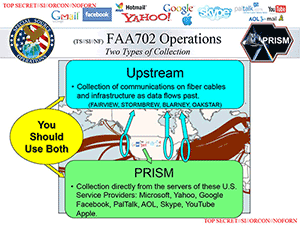
2. We saw NSA Powerpoint slides documenting how the NSA conducts “upstream” collection, gathering intelligence information directly from the infrastructure of telecommunications providers.Prsim/Upstream slide
3. The NSA has created a “content dragnet” by asserting that it can intercept not only communications where a target is a party to a communication but also communications “about a target, even if the target isn’t a party to the communication.”
4. The NSA has confirmed that it is searching data collected under Section 702 of the FISA Amendments Act to access American’s communications without a warrant, in what Senator Ron Wyden called the "back door search loophole."
5. Although the NSA has repeatedly stated it does not target Americans, its own documents show that searches of data collected under Section 702 are designed simply to determine with 51 percent confidence a target’s “foreignness.’”
 6. If the NSA does not determine a target’s foreignness, it will not stop spying on that target. Instead the NSA will presume that target to be foreign unless they “can be positively identified as a United States person.”
7. A leaked internal NSA audit detailed 2,776 violations of rules or court orders in just a one-year period.
8. Hackers at the NSA target sysadmins, regardless of the fact that these sysadmins themselves may be completely innocent of any wrongdoing.
Second LIfe9. The NSA and CIA infiltrated games and online communities like World of Warcraft and Second Life to gather data and conduct surveillance.
10. The government has destroyed evidence in EFF’s cases against NSA spying. This is incredibly ironic, considering that the government has also claimed EFF’s clients need this evidence to prove standing.
11. Director of National Intelligence James Clapper lied to Congress when asked directly by Sen. Ron Wyden whether the NSA was gathering any sort of data on millions of Americans.
12. Microsoft, like other companies, has cooperated closely with the FBI to allow the NSA to “circumvent its encryption and gain access to users’ data.”
13. The intelligence budget in 2013 alone was $52.6 billion— this number was revealed by a leaked document, not by the government. Of that budget, $10.8 billion went to the NSA. That’s approximately $167 per person in the United States.
14. The Foreign Intelligence Surveillance Court has issued orders that allow the NSA to share raw data—without personally identifying information stripped out— with the FBI, CIA, and the National Counterterrorism Center.
15. Pursuant to a memorandum of understanding, the NSA regularly shares raw data with Israel without stripping out personally identifying information about U.S. persons.
16. The Snowden disclosures have made it clear the Obama administration misled the Supreme Court about key issues in ACLU’s case against NSA spying, Clapper v. Amnesty International, leading to the dismissal of the case for lack of standing.
17. The NSA “hacked into Al Jazeera's internal communications system.” NSA documents stated that “selected targets had ‘high potential as sources of intelligence.’”
18. The NSA used supposedly anonymous Google cookies as beacons for surveillance, helping them to track individual users.
pixelated face19. The NSA “intercepts ‘millions of images per day’ — including about 55,000 ‘facial recognition quality images’” and processes them with powerful facial recognition software.
20. The NSA facial recognition program “can now compare spy satellite photographs with intercepted personal photographs taken outdoors to determine the location.”
21. Although most NSA reform has focused on Section 215 of the PATRIOT Act, and most advocates have also pushed for reform of Section 702 of the FISA Amendments Act, some of the worst NSA spying happens under the authority of Executive Order 12333, which President Obama could repeal or modify today.
22. The NSA collected Americans’ cell phone location information for two years as part of a pilot project to see how it could use such information in its massive databases.
23. In one month, March 2013, the NSA collected 97 billion pieces of intelligence from computer networks worldwide, including 3 billion pieces of intelligence from US computer networks.
Tor Logo24. The NSA has targeted Tor, a set of tools that allow Internet users to browse the net anonymously.
25. The NSA program MUSCULAR infiltrates links between the global data centers of technology companies such as Google and Yahoo. Many companies have responded to MUSCULAR by encrypting traffic over their internal networks.
26. The XKEYSCORE program analyzes emails, online chats and the browsing histories of millions of individuals anywhere in the world.
27. NSA undermines the encryption tools relied upon by ordinary users, companies, financial institutions, targets, and non-targets as part of BULLRUN, an unparalleled effort to weaken the security of all Internet users, including you.
28. The NSA’s Dishfire operation has collected 200 million text messages daily from users around the globe, which can be used to extract valuable information such as location data, contact retrievals, credit card details, missed call alerts, roaming alerts (which indicate border crossings), electronic business cards, credit card payment notifications, travel itinerary alerts, and meeting information.
29. Under the CO-TRAVELER operation, the US collects location information from global cell towers, Wi-Fi, and GPS hubs, which is then information analyzed over time, in part in order to determine a target’s traveling companions.
30. A 2004 memo entitled “DEA- The ‘Other’ Warfighter”, states that the DEA and NSA “enjoy a vibrant two-way information-sharing relationship.”DEA Badge
31. When the DEA acts on information its Special Operations Division receives from the NSA, it cloaks the source of the information through “parallel construction,” going through the charade of recreating an imaginary investigation to hide the source of the tip, not only from the defendant, but from the court. This was intended to ensure that no court rules on the legality or scope of how NSA data is used in ordinary investigations.   
32. The fruits of NSA surveillance routinely end up in the hands of the IRS. Like the DEA, the IRS uses parallel construction to cloak the source of the tip.
33. Even the President’s handpicked Privacy and Civil Liberties Oversight Board recommended that the government end Section 215 mass telephone records collection, because that collection is ineffective, illegal, and likely unconstitutional.
34. The NSA has plans to infect potentially millions of computers with malware implants as part of its Tailored Access Operations.
35. The NSA had a secret $10 million contract with security firm RSA to create a “back door” in the company’s widely used encryption products.
36. The NSA tracked access to porn and gathered other sexually explicit information “as part of a proposed plan to harm the reputations of those whom the agency believes are radicalizing others through incendiary speeches.”
37. The NSA and its partners exploited mobile apps, such as the popular Angry Birds game, to access users’ private information such as location, home address, gender, and more.
38. The Washington Post revealed that the NSA harvests “hundreds of millions of contact lists from personal e-mail and instant messaging accounts around the world, many of them belonging to Americans.”
Many of the Snowden revelations have concerned the NSA’s activities overseas, as well as the activities of some of the NSA’s closest allies, such as the its UK counterpart GCHQ. Some of these have been cooperative ventures. In particular, the “Five Eyes”— The United States, New Zealand, Australia, the United Kingdom, and Canada— share citizen data amongst themselves - providing loopholes that might undermine national legislation.
 39. The NSA paid its British counterpart GCHQ $155 million over the last three years “to secure access to and influence over Britain's intelligence gathering programmes.”
40. The Guardian reported: “In one six-month period in 2008 alone, [GCHQ] collected webcam imagery – including substantial quantities of sexually explicit communications – from more than 1.8-million Yahoo user accounts globally.”GCHQ
41. GCHQ used malware to compromise networks belonging to the Belgian telecommunications company Belgacom.
42. Major telecommunications companies including BT, Vodafone, and Verizon business have given GCHQ unlimited access to their fiberoptic cables
43. GCHQ used DDoS attacks and other methods to interrupt Anonymous and LulzSec communications, including communications of people not charged with any crime.
44. GCHQ’s Bude station monitored leaders from the EU, Germany, and Israel. It also targeted non-governmental organizations such as Doctors of the World.
45. The NSA’s partners Down Under, the Australian Signals Directorate, has been implicated in breaches of attorney-client privileged communications, undermining a foundational principle of our shared criminal justice system.
46. Australian intelligence officials spied on the cell phones of Indonesian cabinet ministers and President Susilo Bambang.
47. In 2008, Australia offered to share its citizens’ raw information with intelligence partners.
48. CSEC helped the NSA spy on political officials during the G20 meeting in Canada.
49. CSEC and CSIS were recently rebuked by a federal court judge for misleading him in a warrant application five years ago with respect to their use of Five Eyes resources in order to track Canadians abroad.
Ironically, some of the NSA’s operations have been targeted at countries that have worked directly with the agency in other instances. And some simply seemed unnecessary and disproportionate.  
50. NSA documents show that not all governments are clear about their own level of cooperation with the NSA. As the Intercept reports, “Few, if any, elected leaders have any knowledge of the surveillance.”
51. The NSA is intercepting, recording, and archiving every single cell phone call in the Bahamas.
52. The NSA monitored phone calls of at least 35 world leaders.
53. The NSA spied on French diplomats in Washington and at the UN.
54. The NSA hacked in to Chinese company Huawei's networks and stole its source code.  
55. The NSA bugged EU embassies in both New York and Washington. It copied hard drives from the New York office of the EU, and tapped the internal computer network from the Washington embassies.
56. The NSA collected the metadata of more than 45-million Italian phone calls over a 30 day period. It also maintained monitoring sites in Rome and Milan.
57. The NSA stored data from approximately 500-million German communications connections per month.
58. The NSA collected data from over-60 million Spanish telephone calls over a 30-day period in late 2012 and early 2013 and spied on members of the Spanish government.
59. The NSA collected data from over 70-million French telephone calls over a 30-day period in late 2012 and early 2013.
60. The Hindu reported that, based on NSA documents: “In the overall list of countries spied on by NSA programs, India stands at fifth place.”
61. The NSA hacked into former Mexican President Felipe Calderon’s official email account.
62. The Guardian reported: “The NSA has, for years, systematically tapped into the Brazilian telecommunication network and indiscriminately intercepted, collected and stored the email and telephone records of millions of Brazilians.”
63. The NSA monitored emails (link in Portuguese), telephone calls, and text messages of Brazilian President Dilma Roussef and her top aides.
64. Germany’s intelligence agencies cooperated with the NSA and implemented the NSA’s XKeyscore program, while NSA was in turn spying on German leaders.
65. Norwegian daily Dagbladet reported (Link in Norwegian) that the NSA acquired data on 33 million Norwegian cell phone calls in one 30-day period.”
There’s no question that the international relationships Obama pledged to repair, as well as the confidence of the American people in their privacy and constitutional rights, have been damaged by the NSAs dragnet surveillance. But one year later, both the United States and international governments have not taken the steps necessary to ensure that this surveillance ends. That’s why everyone must take action— contact your elected representative, join Reset the Net, and learn about how international law applies to U.S. surveillance today.