Saturday, August 16, 2014

ISIS May Grab Mecca in Saudi Arabia

Could Saudi Arabia Be the Next ISIS Conquest?

With ISIS on the border, Saudi Arabia is nervous about the terrorist incursion, but remains the source of its greatest support

ISIS is continuing its blitz-like offensive in Iraq, conquering more and more territory. With its sights set on Baghdad and the Shiite shrine cities, the prospect of the capital falling to the terrorist group is causing international panic. And Iraq’s neighbors, particularly Saudi Arabia, could be the next trophy in ISIS’ expanding cabinet.
The extremist Sunni group wants to reestablish the Islamic caliphate, and has made it abundantly clear that its territorial ambitions are not limited to Syria and Iraq. Maps circulating online over the weekend, allegedly from ISIS but whose provenance could not be established, show large swathes of Africa and Asia, as well as the entire Middle East, draped in black, denoting the group’s alleged geographical ambitions.
Saudi ISIS Casualty2
This map was shared widely on social media over the weekend, with other variations showing a push further into Europe. 
With the Iraqi military fleeing their positions and giving way with relative ease to ISIS forces, the terrorist insurgency has poured south into Iraq and reached as far west as Rutba, a town just 70 miles from Iraq’s borders with Jordan and Saudi Arabia. ISIS now controls most of Iraq’s western territory. Since the capture of Rutba, nerves have started to show in Saudi Arabia. 
Both worried Saudis and ISIS supporters tweeted a hashtag translating to #ISISOnSaudiBorder tens of thousands of times within a span of a few hours on Sunday.
Since the capture of Rutba, ISIS supporters online have begun circulating maps showing the group’s proximity to Jordan and Saudi Arabia, hinting at its next likely advance into Saudi territory.
If ISIS were to penetrate the border, the group’s first stop would probably be the Saudi town of Arar, where the Saudi military is stationed. Saudi authorities closed this border crossing during Iraq’s 1990 invasion of Kuwait.

"It is only five and a half hours between Rutba and Arar."

06/22/14 01:08 UTC@31_E1

واقترب الوعد الحق مسيرة خمس ساعات ونصف من #الرطبة ل #عرعر #الدولة_الإسلامية_على_حدود_السعودية
 |  | 
If Saudi Arabia does become the next ISIS target, it may be even easier than the group’s push into Iraq. A groundswell of ideological support combined with wide-reaching corruption could pave the way for ISIS’ penetration into the country. Saudi Arabia, unlike Iraq, is almost 90 percent Sunni. Iraq’s growing resistance to ISIS comes largely via the swelling ranks of a Shiite militia, the Mahdi army, with Shiite fighters returning from Syria to defend their country against the radical Sunni insurgency that is sweeping the nation.
Saudi is also a major source of support for ISIS. Since the latest offensive in Iraq, hashtags translating to #TheAgeOfTheISISConquest and #ABillionMuslimsForTheVictoryOfTheIsis have overwhelming been originating from Saudi Arabia. 
Almost 95 percent of all mentions of the latter hashtag emanated from Saudi Arabia over the last week, by far eclipsing those from Iraq and Syria, where the ISIS is actually operating at present. The geographic distribution of those mentions covers the entire Saudi Arabian territory.

Distribution of geo-tagged pro-ISIS tweets in Saudi Arabia

ISIS Tweet distribution Saudi2
Saudi support for the ISIS traces back to the conflict in Syria. Approximately 1,000 and 2,000 Saudi nationals have been involved in fighting inside Syria, with several hundreds believed to have already returned home. The Saudi government in February issued a royal decree banning Saudis from fighting in foreign conflicts. Both the Syrian and Iranian governments have drawn attention to purported financial links between ISIS and Saudi Arabia in recent weeks. Syrian state media directly accused Saudi Arabia of funding ISIS in an editorial on June 12, while the Iranian leader President Hassan Rouhani made a thinly veiled reference to “Muslim countries that support the terrorists with their petrodollars” in remarks on the website of the Iranian state broadcaster in recent days.
According to some, ISIS already maintains a presence in the country and even has sympathizers in the Saudi military.

“We are not on the border. We are here in Saudi and this is our land."

06/22/14 06:35 UTC@AMTAHD

#الدولة_الإسلامية_على_حدود_السعودية نحن لسنا على الحدود بل نحن هنا في بلاد الحرمين وهذه ارضنا .. http://t.co/lrKG8VkPGq
 |  | 
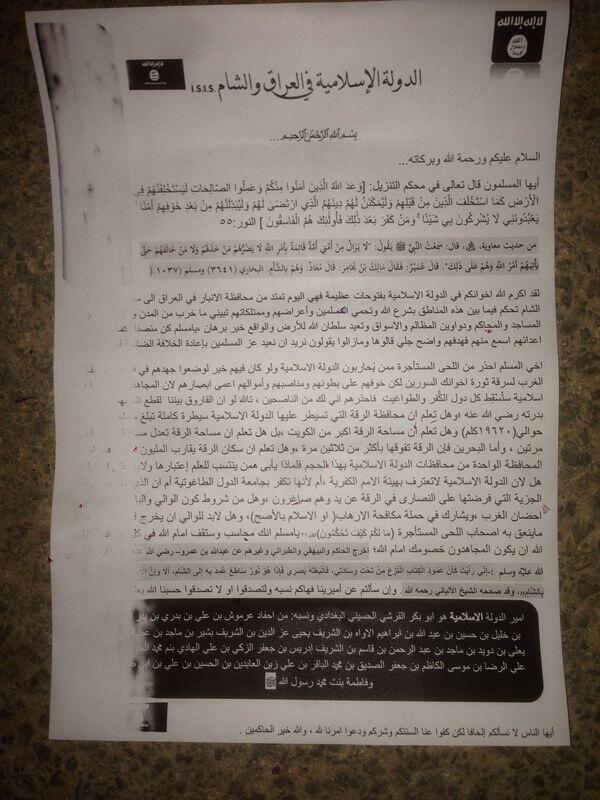
The Saudi armed forces issued a tacit admission in May that ISIS were already operating and recruiting within the kingdom when it called on the public to report any instances of publication or distribution of ISIS pamphlets.

05/18/14 02:36 UTC@SAUDI_ARMY_NEWS

في حالة الأشتباه او وجود من ينشر مثل هذه المنشورات,الرجاء التبليغ على هذا الرقم 990 #داعش_توزع_منشورات_بالسعودية - http://t.co/O6zs4j16RJ
 |  | 
Photos circulated on Twitter in March that purported to show Saudi military officers holding up signs of support for ISIS.

03/16/14 21:31 UTC@1400MSAF

“@AsawirtiMedia: #الدولة_الإسلامية_تخترق_الجيش_السعوديhttp://t.co/bTuzA3budF” #الدولة_الإسلامية_في_العراق_والشام #السعودية #ال_سعود
 |  | 
ISIS supporters have published calls on the organization to continue its advance into the kingdom. The appeal of Saudi Arabia for the terrorist group is clear. As the birthplace of Islam and home to some of the religion’s most holiest sites, the country could become the crown jewel for ISIS.

Friday, August 15, 2014

Progressive Rand Paul Criticizes Ferguson Police

Rand Paul: Ferguson Response Is Example of Over Militarized Police

Friday, 15 Aug 2014 09:51 AM
By Greg Richter
Share:
  Comment  |
   Contact Us  |
  Print  
|  A   A  
The law enforcement response to protests over the fatal shooting of an unarmed black teenager by police in Ferguson, Mo., shows the extent to which local police departments have become too militarized, Sen. Rand Paul writes on Time.com.

"If I had been told to get out of the street as a teenager, there would have been a distinct possibility that I might have smarted off. But, I wouldn’t have expected to be shot," the Kentucky Republican said.

Paul noted that the outrage by the community is understandable, but it isn't an excuse for rioting and looting as has been seen every night since the Saturday killing of 18-year-old Michael Brown Jr.

While the police do have a duty to keep the peace, Paul noted, there is a difference between a police response and a military one.

He blamed "big government" for being at the heart of the problem.

Washington, he said, has "incentivized the militarization of local police precincts" by providing money to help local governments build "what are essentially small armies." They are able to obtain military gear that is beyond the needs of what most consider to be simple law enforcement, he said.

The wars on drugs and terrorism are typically cited as the reason for such things as full riot gear and even tanks, Paul wrote.

Coupled with an erosion of civil liberties and due process, police become judge and jury, he said, citing national security letters, no-knock searches, broad general warrants, and pre-conviction forfeiture.

Americans in general feel targeted by their own government, he said, and considering the racial disparities of the criminal justice system, it isn't surprising for blacks to feel they are especially targeted.

"Anyone who thinks that race does not still, even if inadvertently, skew the application of criminal justice in this country is just not paying close enough attention," he said.

Paul has in recent months worked to end racial disparities in sentencing, partnering with New Jersey Democratic Sen. Cory Booker.

Missouri Gov. Jay Nixon on Thursday appointed Highway Patrol Capt. Ron Johnson to head up operations in Ferguson, a St. Louis suburb, after police were criticized for using tear gas and flash grenades Wednesday night.

Johnson was on the scene early Thursday evening talking to protestors. He told Fox News Channel he didn't expect trouble and would handle the situation "with some conversation and the right approach." He said backups were available if needed.

Johnson and other officers were in normal police uniforms and not riot gear.


Read Latest Breaking News from Newsmax.com http://www.newsmax.com/Newsfront/Ferguson-Missouri-Overmilitarized-police/2014/08/14/id/588880/#ixzz3AUcggx9a
Urgent: Should Obamacare Be Repealed? Vote Here Now!

Gaza Blockade Must End for Peace

Gaza Blockade Hangs Fire in Cairo: Where Is the Antiwar Left?

Friday, 15 August 2014 12:05By Robert Naiman, Truthout | Op-Ed
2014 815 gaza fwProtest against Israeli's killing and occupation in Gaza, July 12, 2014. (Photo: Syeda Amina Trust / Flickr)
The greatest struggle facing the antiwar movement in the United States is the struggle to get people who come to antiwar demonstrations after a war starts to engage politically to prevent the same wars in the future. 

In the case of US policy toward Iran, we created a political movement to support diplomacy with Iran to prevent war in the future. 

But in the case of Gaza, there is no political movement in the United States to support diplomacy to prevent war in the future.

Consider:
1. While Israel was bombing and invading Gaza, there were demonstrations across the United States against the war and against US support for the war.
2. A key cause of the war was the blockade imposed on 1.8 million Palestinians in Gaza by Israel and Egypt. Exports from Gaza are virtually banned. Gaza is not allowed to use its seaport. Palestinians in Gaza can't travel normally to and from Gaza. They have to get permission from the Israeli or Egyptian governments that might never come, blocking their ability to work, study, receive medical care and see their families.
3. It is generally acknowledged by experts that if current diplomacy fails to end the blockade of Gaza, it is inevitable that there will be another outbreak of violence on the Israel-Gaza border in the future.
4. The question of the Gaza blockade is on the table right now in the talks that have been taking place between Israel and the Palestinians in Cairo. Press reports suggest that it could go either way: There might be an agreement that ends the blockade, or there might not.
5. Thus, there are two likely paths out of the current juncture: Either there will be an agreement in Cairo that ends the Gaza blockade, or there will be another war in the future, much like the one that people have been protesting; and which path happens is likely to be decisively shaped by what happens in the next few days of diplomacy in Cairo, a process on which the US government obviously has significant influence.
Why can't we get the people who have protested the war to engage politically to prevent the same war from happening again in the future?
What would be worse than the killing of innocents that has happened so far? Doing nothing to stop the same killing of innocents in the future, when we had the ability to do something concrete.
Exactly two members of Congress - Keith Ellison  and Barbara Lee - have publicly called for ending the blockade now through negotiations.
Tell me: If the antiwar left would engage on the issue of the Gaza blockade, we couldn't get John Conyers to speak up for ending the blockade through diplomacy? We couldn't get Hank Johnson to speak up? Charlie Rangel, John Lewis, Danny Davis, Bobby Rush, Donna Edwards, Karen Bass, Maxine Waters, Eleanor Norton? None of them would speak up, if the antiwar left would engage politically?

Danny Glover took a #StandWithKeith:

Why won't the antiwar left #StandWithKeith?
You can take action here.
Copyright, Truthout. May not be reprinted without permission.

ROBERT NAIMAN

Robert Naiman is policy director at Just Foreign Policy and president of Truthout's board of directors. 

RELATED STORIES

Gaza and American "Security"
By Ray McGovern, Consortium News | Op-Ed
Israel and Palestine Can Never Be Secure Until Both Are Secure
By Michael Nagler, Truthout | Op-Ed
Israel and the Erosion of International Humanitarian Law
By Lawrence Davidson, SpeakOut | News Analysis

    Thursday, August 14, 2014

    Report on Gas Fracking Local Ukrainian Journalist

    INTERNATIONAL
    JOHN MACDOUGALL / AFP / GETTY IMAGES

    Before the fear of war, fear of fracking in Ukraine

    People in the embattled Donbass know the shale beneath their feet could be the real reason for conflict in their towns
    SLOVYANSK, Ukraine — A hot July day, and the neighbors and children of a half-ruined five-story building on Bulvarnaya Avenue gathered around a bench for a long discussion of their daily fears.
    Locals seemed to have consensus on who’s at war: the U.S. and Russia over control of Ukraine, they all agreed. But even now, three months past the day the first shell fell on Slovyansk, they still had trouble comprehending why their green, sleepy hometown still was trapped in this conflict.
    Residents of the bombed building remembered how in April, local and Russian-assigned rebel commanders chose to set up the capital for their forces in this town.
    shale, Donbass, Ukraine
    In a small village in the Donbass, Alexander, a former soldier, and Tatiana say they can’t afford gas, even though a gas line runs right by their home. 
    Stanley Greene / Noor
    The people of the Donbass, the country’s gritty industrial region in the east, were not naive. They realized that gas pipelines crossing the border with Russia and the shale gas fields near Slovyansk — with a potential reserve of about 3 trillion cubic meters of gas — were the cause of constant tension between Russia and Ukraine.
    But with pipes in their backyards or running right next to their homes, with their feet firmly on ground that stands over a vast shale deposit, they knew the struggle was not really over Ukraine itself. They were in the middle of a war about energy.
    Depending on the political winds blowing between Kiev and Moscow, the Russian gas giant Gazprom cut off natural gas to Ukraine or turned it on again. The shale gas is an important potential source for Ukraine and possibly southeastern Europe. If it proves possible to tap, Ukraine hopes this supply would undercut Gazprom’s monopoly, a move that could change Europe’s energy map and its political contours as well.
    That’s how, in this region, shale gas became a political and nationalistic issue as well as an economic one. A visitor to the Donbass in February or March wouldn’t have heard fear of war but fear of fracking, with residents fearful their land would be destroyed.

    Something worse than fracking

    Some experts speculate that Gazprom could have fanned those fears.
    “Since recently, Gazprom bosses have been worried about shale gas production in Europe and financed propaganda campaigns against the evil of shale gas,” said Mikhail Krutikhin, a senior energy expert at RusEnergy, a Moscow-based consulting firm.
    The campaign was effective.
    Ukraine, Donbass, conflict
    In Slovyansk workers dismantle what’s left of a building destroyed in the conflict between Kiev forces and pro-Moscow separatists.
    Genya Savilov / AFP / Getty Images
    But after Flight MH17 fell from the sky packed with innocent passengers from around the world, the fear of something bigger than a local Russian-Ukrainian conflict gripped many hearts.
    “If you asked me last month, I would tell you right away that gas was the real reason for our hate for Kiev and for this war,’’ said Ivan Vailyevich, a pensioner from the building on Bulvarnaya Avenue when recalled how he participated in mass street protests in February and March.
    “We’d kill and die but never allow production of shale gas here,” he said. “That would poison our land.” Now he doesn’t know what to say. “After our house was bombed this month, we realized that shale gas was not as scary as shells.”
    Oksana, a young shop assistant selling swimsuits at a department store on a corner of Lenin Avenue, said that she and her family became scared of “foreigners coming” to drill for shale gas in Slovyansk after then-President Viktor Yanukovych signed an agreement with Royal Dutch Shell in January 2013.
    Kiev’s plan was to set up a joint venture with Shell and drill for shale gas around Slovyansk to eventually produce 8 billion to 11 billion cubic meters of gas yearly — nearly 20 percent of what Ukrainian consumers need. (Later that year, a similar $10 billion deal was reached with Chevron for exploration in western Ukraine.)
    For activists of the self-proclaimed Donestk People’s Republic, any potential Western presence in the Donbass could be used to spark anger, such as when Hunter Biden, U.S. Vice President Joe Biden’s son, joined the board of Ukraine’s largest private gas company.
    Videos of the “natural catastrophe” caused by shale production in Pennsylvania gave birth to increasing concerns among the Internet users in the Donbass. In one of the most popular horror videos, an Italian politician, Giulietto Chiesa, predicted that Shell and Chevron shale drilling would eventually cause the expulsion of Slovyansk’s population of about 116,000. The rumor was passed along, increasing people’s anger with Kiev.
    On top of the “fascist junta” and the “Russia haters” in Kiev, people in the Donbass now dreaded the contracts signed with Shell and Chevron for producing shale gas. At the time, they appeared to be one of the best shale bets in Europe.

    Gas paranoia?

    Even after Yanukovych was ousted and the new government promised to revisit all his business deals, many people in the Donbass believed the shale exploration would go ahead. The same people also believed that Europe didn’t care about potentially destructive shale production in Ukraine or whether the people in a region so opposed to Kiev would have water that stinks or gas bursting out their taps.
    Donbass, fracking, shale, Ukraine
    Denis Pushilin, a onetime leader of the Donetsk People’s Republic, in Donetsk, June 7, 2014. He vowed never to allow fracking in the Donbass.
    Evgeniy Maloletka / AP
    On June 20, Denis Pushilin, then an official in the Donestk People’s Republic, declared that the “USA unfolded significant activity” in Slovyansk to make money on shale gas and promised that under his authority, nobody would ever allow “dangerous for the ecology” shale gas development in the Donbass.
    With the republic often changing its leaders and agendas, Pushilin soon vanished, and anti-shale-gas demonstrations stopped.
    “Gas paranoia stopped as soon as Pushilin left the Donetsk People’s Republic. It must have been a well-organized campaign that manipulated with people’s minds,” a Donetsk entrepreneur and civil society organizer, Enrike Menendes, said in an interview about the causes of the war and the future of eastern Ukraine.
    Gas pipes, locals believed, were a reason behind the daily fighting over Amvrosyevka, since a Gazprom main line from Siberia to Europe that runs right outside the home of the Ivanovs, 16 kilometers from the border with Russia, passes around the corner from a Ukrainian checkpoint that is attacked by rebels continually.
    The Ivanovs were torn by fear and ideologies. The father, Igor, is Russian but sympathized with the Maidan revolution. The mother, Tatyana, is Ukrainian and loved Putin. She felt especially proud of Russia on Victory Day, May 9.
    The war caught them in the middle of the strawberry harvest and a redecoration project at their daughter Yulia’s house. By the beginning of July, constant fighting pushed the family to move to the basement.
    “We don’t support anybody. All we want is to stay alive. Please make the world understand that,” Igor said.

    Back on the avenue

    Shale gas stopped being the talk of Slovyansk, but the fear of war did not. Even after Ukrainian military forces pushed rebels and their commander, a former senior officer of the Russian Federal Security Service, Igor Strelkov, out of Slovyansk in July, many people continued to talk of Kiev officials’ going after everybody involved with the separatists.
    “They could easily deport the population of Slovyansk, poison the drinking water and our natural resorts on the lakes. We’ll fight for as long as we live to free our Slovyansk of Ukrainian occupants,” Denis Shpakovsky promised in an interview in Donetsk earlier this month.  
    After retreating from Slovyansk, Shpakovsky, 31, served in Strelkov’s security force at a prison in Donetsk. On the day Ukrainian troops moved on Slovyansk,  he had to evacuate eight members of his family, including his 10-year-old daughter, Dasha, to the Russian city of Rostov.
    Even several days after losing Slovyansk to “enemies, Americans and Ukrainians” he had tears in his eyes as he described how his family lived in the basement of his garage, hiding from shelling.
    Almost every resident of the Donbass now has a war story to tell. On Bulvarnaya Avenue, it was almost dark. The noise of a heavy military airplane made everybody in the yard pause and look up at the sky. A round-faced woman, Anna, said she was still afraid of the war. She wondered how soon Vladimir Putin and Barack Obama could agree to make peace. Neighbors questioned whether they should fix the broken glass in their windows or wait, in case more bombs and shells fall on their town.

    Govt Must Create Jobs, Message from FDR 1930s

    Recession Recovery Lessons From Past Presidents

    Recession Recovery Lessons From Past Presidents To climb fully out of the Great Recession, we must go back to the future. President Franklin Roosevelt’s New Deal and its Works Progress Administration (WPA), and President Dwight Eisenhower’s Small Business Administration (SBA), provide ideas on which we can build a stronger and more productive California economy.
    While the WPA worked very well to put millions of Americans back to work with income they could spend to create demand in the economy, the SBA whose basic idea is sound, is not working today as well as it could. We need a modern version of both, in order to create good jobs.
    Between 1935 and 1943, FDR’s Works Progress Administration spent nearly $11 billion to put 8,500,000 men and women to work building 651,087 miles of roads, highways and streets, rebuilding124,031 bridges, building 125,110 public buildings, 8,192 parks, and 853 airports. 
    WPA workers also cleaned slums, revived forests, and brought electrical power to rural areas. Fed One projects employed 40,000 artists and other cultural workers to produce music and theatre, sculptures, murals, and paintings, and put out regional tour guide books and surveys of national archives. 
    The Federal Writers Project hired more than 6,000 writers, authors, playwrights and poets, including Orson Wells, the great actor and director. The WPA helped to stimulate economic growth through the demand provided by  millions of American men and women who now worked and spent money.
    California must use a portion of its unexpected $6 billion windfall in the 2014-15 state budget, to help establish a California State Bank (CSB) to fully fund a California Works Progress Administration (CWPA) and a California Small Business Administration (CSBA). 
    The CSB can learn from the state owned Bank of North Dakota (BND).  The BND, established by the North Dakota Legislature 94 years ago,  enables the state’s community banks, businesses, students and consumers to get loans at low rates, compared to the giant corporate banks. According to salon.com, in 2011 the BND provided more than $70 million to the state treasury from its profits. The CSB would generate an additional $3.8 billion in revenue for California’s Treasury.
    The rest of the money needed to fully fund the CSB would come from closing unnecessary corporate tax loopholes, such as the off shoring tax loophole used by Apple Inc. and others,  the stock option tax loophole used by Facebook. This would generate several billion dollars more annually to fund the CSBA, CWPA, and CSB.
    peter-mathews-200With billions of dollars to spend, the CWPA could hire California’s engineers, scientists, tech workers, teachers, professors, nurses, firefighters, police officers, artists, machinists, and  high skilled, manufacturing workers, helping California to produce the world’s best  Twenty-First Century products and services.
    We also need a modern California Small Business Administration (CSBA). With billions of dollars to lend, the CSBA will make available low interest rate, direct loans to small and medium sized businesses, creating millions of jobs and increasing demand that will grow the economy, and make California the Golden State once again!
    Peter Mathews