Monday, April 28, 2014

New Law Suit for War Crimes vs Bush & Blair

President George W. Bush, right, and British Prime Minister Tony Blair arrive for a joint news conference in the East Room at the White House on Tuesday, June 7, 2005. (Photo: Doug Mills / The New York Times) President George W. Bush, right, and British Prime Minister Tony Blair arrive for a joint news conference in the East Room at the White House on Tuesday, June 7, 2005. (Photo: Doug Mills / The New York Times)
This is part II of a series on Dahr Jamail's trip to the Iraq Commission conference in Brussels. Also see Part I: International Lawyers Seek Justice for Iraqis
Narmeen Saleh and her husband Shawki were detained by US military forces during a violent 2004 raid of their home in Baghdad.
Saleh spent 16 days in prison, where "the interrogations didn't stop for one minute." She was beaten, electrocuted and threatened with rape if she didn't "confess."
"They [US soldiers] tortured and beat me a lot, and when they found out that I was pregnant they told me they would kill the baby in my womb," she was quoted, as her testimony was read at the Iraq Commission conference in Brussels recently. "They then concentrated their beating and electricity on my abdomen area."
Her daughter, who is now 8 years old, has cerebral palsy, and her husband remains in custody of the government of Iraqi Prime Minister Nouri al-Maliki for the bogus charge of "illegally entering Iraq."
This shocking testimony was provided to international lawyers, journalists , and activists converged at a conference titled, "The Iraq Commission," held in Brussels, Belgium, April 16 and 17, with the primary aim of bringing to justice government officials who are guilty of war crimes in Iraq.
The conference represented the most powerful and most current organized movement in the world to hold accountable those responsible for the catastrophic invasion and occupation in Iraq, including UK Prime Minister Tony Blair and former US President George W. Bush, along with others in their administrations.
War Crimes in Iraq
Nawal al-Obaidi, an Iraqi academic and founding trustee of the International Action for Iraqi Refugees NGO, provided somber testimony about how her brother was killed by US forces.
Hazim al-Obaidi left his wife and four children at their home in Mosul to go to work at his grocery store one morning in January 2005.
That same evening, his wife became worried when Hazim had not returned home and began a search.
"The whole family could not sleep that night, wondering what had happened to Hazim and why he did not return back home," his sister Nawal told the audience. "As the curfew was in place, no one could leave the house until the next morning."
The next morning, family members searched the morgues of the main hospital, but to no avail. Two days later, they learned of his burned car.
Eyewitnesses informed the family of the car being attacked by US forces, who "started shooting at him and at his car, until the car exploded." What was left of the severely burned body was removed by family members, then, "to the bewilderment of his family, US troops stopped them after they had collected the body, uncovered it and took photos."
"Hazim was not a "terrorist" or a "Saddamist," al-Obeidi explained. "He was a cheerful family man who was wounded in the Iran-Iraq war and survived the harshness of the sanctions years by selling groceries. Who is going to investigate his killing, compensate his family, and help his children to make sense of their tragedy? Will it be the Iraqi government, or the US-led occupation? Judging by the human rights records of both, the answer is that neither of them will investigate Hazim's killing, or any other. [Hundreds of] thousands of civilians have been killed for no reason. One of them was my brother."
This writer, too, provided testimony: I spoke of several war crimes I witnessed during my reportage from Iraq during the US-led occupation.
In May 2004, I interviewed a man who had just been released from Abu Ghraib prison. Like so many I interviewed from various US military detention facilities who'd been tortured horrifically, he still managed to maintain his sense of humor.
He began laughing when telling of how US soldiers made him beat other prisoners. He laughed because he told me he had been beaten himself prior to this and was so tired that all he could do to beat other detained Iraqis was to lift his arm and let it drop on the other men.
Later in the same interview, when telling of another story, he laughed again and said, "The Americans brought electricity to my ass before they brought it to my house."
Another story I reported to the international lawyers was that of 55-year-old Sadiq Zoman, who was tortured horrifically by US military personnel. I shared documentation of US military doctors, nurses and medics being complicit with that torture.
Sadiq Zoman was detained from his home shortly after the US occupation of Iraq began, but not charged with any crime. (Photo: Dahr Jamail)Sadiq Zoman was detained from his home shortly after the US occupation of Iraq began, but not charged with any crime. (Photo: Dahr Jamail)
Zoman was detained from his home in Kirkuk in a raid by US soldiers that produced no weapons. He was taken to a police office in Kirkuk, the Kirkuk Airport Detention Center, the Tikrit Airport Detention Center and then the 28th Combat Support Hospital, where he was treated by Dr. Michael Hodges, a lieutenant colonel.
Hodges' medical report listed the primary diagnoses of Zoman's condition as hypoxic brain injury (brain damage caused by lack of oxygen) "with persistent vegetative state," myocardial infraction (heart attack) and heat stroke.
After one month in custody, Zoman was dropped off in a coma at the General Hospital in Tikrit by US soldiers.
A comatose Zoman was dropped off by US military personnel at the main hospital in Tikrit. (Photo: Dahr Jamail)A comatose Zoman was dropped off by US military personnel at the main hospital in Tikrit. (Photo: Dahr Jamail)
Zoman's last name was listed as his first name on the report, despite the fact that all of his identification papers were taken during the raid on his home. Because of this, it took his family weeks to locate him in the hospital.
The medical report given by the US military medic did not mention the trauma on the back of Zoman's head. (Photo: Dahr Jamail)The medical report given by the US military medic did not mention the trauma on the back of Zoman's head. (Photo: Dahr Jamail)
Hodges' medical report did not mention the fact that the back of Zoman's head was bashed in, nor that he had electrical burn marks on the bottoms of his feet and genitals, or why he had lash marks across his back and chest.
Zoman's feet had point-burn marks from electrical shocks on the bottoms of his feet and genitals. (Photo: Dahr Jamail)Zoman's feet had point-burn marks from electrical shocks on the bottoms of his feet and genitals. (Photo: Dahr Jamail)
Zoman remains in a coma, and there has been no compensation provided to his now-impoverished family for what was done to him.
Zoman's family has yet to receive any compensation for what US forces did to him. (Photo: Dahr Jamail)Zoman's family has yet to receive any compensation for what US forces did to him. (Photo: Dahr Jamail)
Bringing Justice
Inder Comar, who testified at the commission, is the legal director at Comar Law in San Francisco, California.
"On March 13, 2013, my client, an Iraqi single mother and refugee now living in Jordan, filed a class action lawsuit against George W. Bush, Richard Cheney, Colin Powell, Condoleezza Rice, Donald Rumsfeld and Paul Wolfowitz in a federal court in California," Comar has written about his case.
"She alleges that these six defendants planned and waged the Iraq War in violation of international law by waging a 'war of aggression,' as defined by the International Military Tribunal at Nuremberg, more than sixty years ago," Comar added. (The current complaint can be found here).
Comar's client, Sundus Shaker Saleh, is alleging "crime of aggression" in the San Francisco Federal Court against the aforementioned. "Crime of aggression" emanates from the Nuremberg Trials following World War II and is what Comar is arguing was committed in the Iraq War.
The lawsuit includes all Iraqis who have suffered harm as a result of the war, and Comar's firm is representing Saleh pro bono.
"This could be precedent setting," Comar told the commission. "And this is the first time a US court is looking at a crime of aggression since Nuremberg, since 1945. We're very curious to see how this judge will decide this issue."
Inder Comar is representing an Iraqi woman, who is charging Bush administration officials with "crime of aggression." (Photo: Dahr Jamail)Inder Comar is representing an Iraqi woman, who is charging Bush administration officials with "crime of aggression." (Photo: Dahr Jamail)
US courts have immunized many of the members of the Bush Administration, but Comar thinks his case is different and will not be subject to the same kind of immunity.
"The crime of aggression is part of international law, so we are arguing with good precedent that international law is part of federal law," he said.
Comar's case against Bush is based on the conduct of members of his administration prior to their coming into office, as well as conduct taking place during and after the events of September 11, 2001.
Evidence of premeditation abounds.
Years before their appointment to the Bush administration, Dick Cheney, Donald Rumsfeld and Paul Wolfowitz were vocal advocates of a militant neoconservative ideology that called for the United States to use its armed forces in the Middle East and elsewhere.
They openly chronicled their desire for aggressive wars through a nonprofit called The Project for the New American Century (PNAC). In 1998, Rumsfeld and Wolfowitz personally signed a letter to then-President Clinton urging him to implement a "strategy for removing Saddam's regime from power," which included a "willingness to undertake military action as diplomacy is clearly failing."
On September 11, 2001, Rumsfeld and Wolfowitz openly pressed for the United States to invade Iraq, even though intelligence at the time confirmed that Saddam Hussein was in no way responsible. Richard Clarke, former national coordinator for security, infrastructure protection and counterterrorism, famously told President Bush that attacking Iraq for 9/11 "would be like invading Mexico after Pearl Harbor."
Comar's case states: "Defendants planned the war against Iraq as early as 1998; manipulated the United States' public to support the war by scaring them with images of 'mushroom clouds' and conflating the Hussein regime with al-Qaeda; and broke international law by commencing the invasion without proper legal authorization."
By comparison, more than 60 years ago, American prosecutors in Nuremberg, Germany, convicted Nazi leaders of the crimes of conspiring and waging wars of aggression. They found the Nazis guilty of planning and waging wars that had no basis in law and which killed millions of innocents.
The plaintiff in the case, Saleh, is thus seeking justice under the Nuremberg principles, as well as US law, for damages she and others like her suffered because of the defendants' premeditated plan to invade Iraq.
Comar detailed to the commission how the premeditation was obvious, showing slides from an article titled "Saddam Must Go," penned by Wolfowitz and Zalmay Khalilzad, as well as others titled, "Overthrow Him," "How to Attack Iraq" and "Bombing Iraq is not enough."
"When we talk about these war criminals, we need to employ the language of pirates in order to engage the basis of universal jurisdiction," Comar added. "Because when pirates go anywhere they have no safe haven from being held accountable for their actions."
Comar told Truthout that he decided to take this case because he was inspired by the Nuremberg judgment.
"That and my client's bravery to want to do this and be committed to her case," he explained. "In law school, I was fascinated by Nuremberg and the trail of facts."
Comar believes strongly in the morality behind the case.
"We have to use every avenue the law provides us to try to do something, and it's amazing that it took a single mother refugee from Iraq to press for justice for a war our leaders continue to want to ignore," he said. "What I'm doing can have a ripple, it might inspire other lawyers, it might cause people to start asking questions about the Bush administration."
According to Comar, his case represents the first time a US judge will hear about a crime of aggression since 1946, "So this case will be looked at internationally. We have to set the stage for other countries to start working to conform to principles of peace."
Comar added that his case in California serves as a template that could be used in every other US state.
Planning for Prosecutions
Sabah al-Mukhtar, the president of the Arab Lawyers Association, chaired the final session of the Iraq commission. The session investigated what the next steps should be toward bringing those responsible for the Iraq invasion and occupation to justice.
(Right to Left) Dirk Adriaensens, cofounder of the Iraq Commission and Brussels Tribunal, Sabah al-Mukhtar, chair of the Iraq Commission, and Michel Chossudovsky, Canadian economist at University of Ottawa. (Photo: Dahr Jamail)(Right to Left) Dirk Adriaensens, cofounder of the Iraq Commission and Brussels Tribunal, Sabah al-Mukhtar, chair of the Iraq Commission, and Michel Chossudovsky, Canadian economist at University of Ottawa. (Photo: Dahr Jamail)
"The delegitimization of major war criminals is complete in terms of the understanding around the world that these successive wars that have been waged are in complete opposition to international law," Dr. Niloufer Bhagwat, professor of comparative constitutional law at the University of Mumbai and vice president of the Indian Lawyers Association in Mumbai testified.
She addressed the fact that there have been no reparations, the sanctions crimes need to be addressed, including the fact that the US government knowingly killed more than 500,000 Iraqi children via malnourishment and disease, and added, "The work we've done here has to be carried from country to country so the political formations adopt our viewpoint, that these wars of aggression can only come to an end when we have an overturning of the political and economic systems."
Professor Gurdial Singh Nijar, a senior practicing lawyer and lead prosecutor of the Kuala Lumpur War Crimes Tribunals on Iraq, believes that the people's tribunals that have been held on Iraq "are becoming an increasingly important tool for recapturing the lost space and jurisprudence over war crimes. We've had three war crimes tribunals and we intend to have more and to introduce this thinking into law schools like the one in which I teach."
He believes the next step toward justice is for countries to exercise universal jurisdiction as a means of charging war criminals.
"Three quarters of UN states have authorized their courts to exercise universal jurisdiction over war crimes, so the stage is actually set," he said. "The challenge then is how to get these countries to institute charges against these war criminals on the basis of credible trials that have been conducted and ended up in convictions, either by peoples' tribunals or otherwise. The next step is to go country to country and begin to file charges in each of these jurisdictions."
Dr. Curtis F. J. Doebbler, an international lawyer who practices law before the International Court of Justice, shared an instance where there has already been some success.
"We suggested, for Syria, and I was in the room with the negotiators, that [US Secretary of State John] Kerry be advised that the use of force could lead to violations of international law, and there could be war crimes," he said. "So I think we're making some inroads."
Lindsey German, the convener of the British antiwar organization Stop the War Coalition, stated in her concluding remarks that Bush and Blair are "by far the most responsible persons for the Iraq war."
She added, "Blair is still the envoy for peace in the Middle East, of all things, for which they obviously didn't check his CV. We have to stress the connections between the wars and the political and economic systems under which we live. We can't have economic justice without bringing justice to the war criminals."
Comar addressed the "banality of militarism" in the United States, said he hopes that the work he is doing "is creating a vaccine for that" and stressed the need for confidence in international law.
"We in the US can work to take power back from the federal system on a state system and begin to incorporate international law into our own laws," he said. "Or maybe we can do this on a city level to criminalize this wrongdoing in a lawful manner so that we have more control. I look forward to sharing my court complaint with any other lawyer. We need to work together to help get people reparations from this war and to prevent the next war."
Dirk Adriaensens, a long-time Iraq activist and cofounder of the Iraq Commission, concluded the commission by calling for concrete proposals that will lead to global court cases regarding Iraq.
"If Inder Comar says that his court case can be replicated in all other 49 US states," he said, "then we can replicate this in every country around the world."

Thursday, April 17, 2014

Courts Run Scared of Secrecy Dictatorship

Lavabit loses contempt of court appeal over Edward Snowden encryption keys

Lavabit, Edward Snowden.
Lavabit founder Ladar Levison refused to comply with the government's so-called 'pen/trap order'. Photograph: Alex Milan Tracy/NurPhoto/Corbis
A federal appeals court on Wednesday upheld a contempt of court ruling against Lavabit, an email service that was used by the National Security Agency whistleblower Edward Snowden.
Lavabit founder Ladar Levison challenged the contempt of court order issued to him for refusing to provide the government with encryption keys to his secure email service. The fourth US circuit court of appeals Judge G Steven Agee said in the ruling that the court’s decision was made because of a procedural error in the appeal.

The government had issued a a so-called "pen/trap order" to access metadata from the account of a target, thought to be Snowden. The day the order was issued, Levison refused to comply, according to court documents. The decision was followed by another order stating that Lavabit would be in contempt of court if it continued to not comply.

“As each day passed, the government lost forever the ability to collect the target-related data for that day,” Agee said in the court order.

Levison said the government forced him to provide SSL encryption keys to his secure emailing service as part of its investigation into Snowden, leading him to close his business because he and his users rely on its secure messaging capabilities. His lawyers also argued that he was not required to provide investigators with the amount of information they sought.

Instead of addressing the argument that providing such information could compromise his business, the court’s decision focuses on Lavabit’s procedural handling of its complaints.

“At an absolute minimum, if Lavabit believed that the turnover of the keys was invalid under the pen/trap order, then it should have acted once the district court’s August 1 order issued,” the court said. “It did not.”

Levison has said he could have given investigators access to a single account like he had done in the past, but the nature of their request for “live” access to user information would have compromised Lavabit’s entire system.

The American Civil Liberties Union, which filed an amicus brief in the appeal, said the court focused on the procedural aspects of the case unrelated to Lavabit's claims.

"On the merits, we believe it’s clear that there are limits on the government’s power to coerce innocent service providers into its surveillance activities," said ACLU attorney Brian Hauss in an emailed statement. "The government exceeded those limits when it asked Lavabit to blow up its business –and undermine the encryption technology that ensures our collective cybersecurity – to get information that Lavabit itself offered to provide."

A similar FBI demand preceded the closure of Lavabit’s rival Hushmail, which complied with investigators seeking information on users in 2007.

Thursday, April 3, 2014

Wall Street Bankers Rule America

The Real Vice-President of the United States Is Wall Street

Thursday, 03 April 2014 09:56By Nomi PrinsNation Books | Book Excerpt
Nomi Prins. Nomi Prins. (Photo: Matthew Dean)In "All the Presidents' Bankers: The Hidden Alliances That Drive American Power," Wall Street journalist (and former Goldman Sachs executive) Nomi Prins writes a painstakingly researched history of the financial industry's collusion with the White House to create a self-serving United States financial policy. Get the book directly from Truthout by clicking here.
Prins' book uses short passages to weave together in understandable terms a longterm relationship between economic and political power that has remained unchallenged. Yes, there were occasional periods when Wall Street did not receive everything that it wanted from the White House (such as in the New Deal). However, adding up the ledger of government policy toward Wall Street results in a decisive victory for the financial titans.
Robert Reich writes of "All the Presidents' Bankers,"The relationship between Washington and Wall Street isn't really a revolving door. It's a merry-go-round. And, as Prins shows, the merriest of all are the bankers and financiers that get rich off the relationship, using their public offices and access to build private wealth and power."
The following is an excerpt from "All the Presidents' Bankers" that focuses on how the financial industry barons are not legally held accountable by the federal government.
The Justice Department Goes Soft on Bankers
Many congressional hearings and investigations have probed the bankers' practices since the crisis that began in 2007. Similar to the Pujo hearings after the Panic of 1907, though, they have resulted in nothing material against the bankers with the strongest political alliances. And unlike the impact of the 1932–1933 Pecora Commission hearings, no substantive regulatory act has passed to significantly alter their behavior. Though banks would end up paying various fines and legal settlements, that amounted to fractions of pennies on the dollar relative to their immense asset bases. Their structure and influence remained unaltered.
As of September 1, 2013, the SEC reported it had levied just $1.53 billion in fines and $1.2 billion in penalties, disgorgement, and other money relief against the big banks for their multitrillion-dollar global Ponzi scheme—or as the SEC put it, "addressing misconduct that led to or arose from the financial crisis." Goldman paid a $550 million fine from the SEC for a similar allegation. The firm admitted no guilt for the related activities. Bank of America paid a $150 million fine without admitting any guilt for misleading shareholders regarding its payment of Merrill Lynch's bonuses when it took over the firm. JPMorgan Chase eventually settled the London Whale probe with a $1.02 billion fine, greater than the fines it paid the government for all of its housing-related infractions. Though the firm admitted that it had violated banking rules by not properly monitoring trading operations, that kind of admission was akin to copping a misdemeanor plea while facing a major felony.
On August 1, 2013, a federal judge approved a $590 million settlement by Citigroup in a shareholder lawsuit accusing the bank of hiding billions of dollars of toxic mortgage assets. On that same day, a jury found former Goldman Sachs banker Fabrice Tourre liable for his role in the Abacus deal, which lost some investors $1 billion. The ruling was dubbed a major victory for the SEC. "We are obviously gratified by the jury's verdict and appreciate their hard work," lead SEC lawyer Matthew Martens said.
The Justice Department chose not to criminally prosecute the chairmen from Goldman or JPMorgan Chase (both of whom ranked in the top twenty for Obama's career campaign contributors) or from anywhere else for creating faulty CDOs, trading against them, dumping them on less knowledgeable investors, or otherwise speculating with capital supposedly siphoned off for more productive and less risky purposes.
Similarly, the Justice Department punted on prosecuting Jon Corzine, the former governor of New Jersey and a top-tier bundler for Obama. Steering his firm MF Global into an abyss, Corzine had bet more than $6 billion on European sovereign debt. The $1 billion MF Global "mistake," the multibillion-dollar losses on bets made by Chase, the CDOs chosen by the firm's biggest hedge fund clients that had been set up to fail—these were apparently just minor events in the scheme of making money and maintaining alliances. On October 31, 2011, MF Global filed Chapter 11, with $41 billion in assets and $39.7 billion in debt, the eighth largest bankruptcy in US history. Four days before the collapse, Corzine sent an email to an employee "to strategize how they could use customer segregated funds [and get JPMorgan Chase] to clear MF Global's trades more quickly." He avoided criminal fraud charges.
The general response of Obama and his cabinet toward Wall Street criminality and the sheer unsavoriness of its leaders showed the degree to which nothing had changed and the lack of commitment to reform. If nothing changes fundamentally in the banking landscape, more and larger crises are a given. The most powerful banks are bigger, more interconnected, and more reliant on cheap money and federal largesse than ever. Their leaders are unrepentant and unaccountable. Their political alliances require nothing of them anymore except some fines that can be easily re-earned.
Copyright of Nomi Prins. Cannot be reprinted without permission of Nation Books.

NOMI PRINS

Nomi Prins is a journalist and senior fellow at Demos. Her latest book is "Black Tuesday," a novel about corruption and romance surrounding the 1929 stock market crash. She is the author of "Other People’s Money: The Corporate Mugging of America" (The New Press, October 2004), a devastating exposé into corporate corruption, political collusion and Wall Street deception. "Other People's Money" was chosen as a Best Book of 2004 by The Economist, Barron's and The Library Journal.  Her book "Jacked: How "Conservatives" are Picking your Pocket (Whether You Voted for Them or Not)" (Polipoint Press, Sept. 2006) catalogs her travels around the USA; talking to people about their economic lives.


Thursday, March 27, 2014

MD Rep Offers Weak NSA Reform

Congressman Says He Wants NSA Reforms, But Gets Most Cash From Intel Contractors

March 27, 2014 by  

Congressman Says He Wants NSA Reforms, But Gets Most Cash From Intel Contractors
UPI FILE
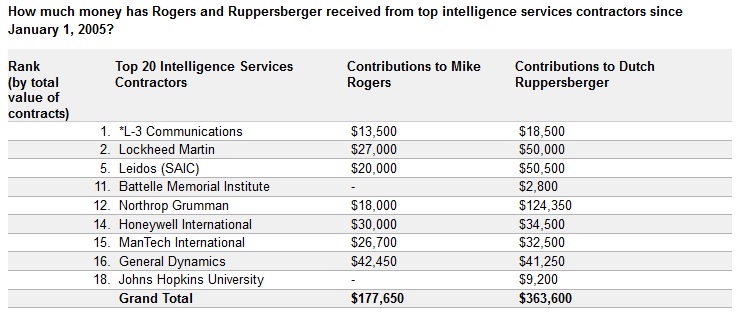
Representative Dutch Ruppersberger has received more than $363,000 in campaign contributions from intelligence contractors since 2005.
This article, written by Eric Boehm, appeared on Watchdog.org on March 26.

One of the two representatives pushing a new bill to supposedly rein in America’s overzealous electronic spooks has received more campaign contributions from intelligence contractors than any other member of Congress.

Representative Dutch Ruppersberger (D-Md.) announced he would co-sponsor a bill with House Intelligence Committee Chairman Mike Rodgers (R-Mich.) to end the National Security Agency’s bulk collection of telephone data, but the effort has drawn less-than-enthusiastic reviews from civil liberties watchdogs.

Ruppersberger, whose Congressional district includes the NSA headquarters in Fort Meade, Md., has received more than $363,000 in campaign contributions from intelligence contractors since 2005.
That’s $140,000 more than any other member of Congress, according to a new report from MapLight, a nonprofit that tracks political spending.

He’s working with Rogers, an ardent defender of the American spying regime who first denied, then defended, the existence of NSA spying programs after they were made public in June by Edward Snowden. Since then, he has argued for legislation that would make those activities legal rather than trying to shut them down.

Rogers has received $177,000 from intelligence contractors since 2005, according to MapLight.
It’s no surprise their bill hasn’t received a warm reaction this week.

Though the bill would stop the NSA from collecting bulk telephone records of Americans, it would allow intelligence agencies to access telephone service providers’ records without judicial oversight.

The bill’s modest improvements to the phone records program are not worth demolishing the important judicial role in overseeing these programs,” said Michelle Richardson, legislative counsel with the American Civil Liberties Union.

Richardson said the bill is using the momentum in favor of reforms to actually expand government power.

Ruppersberger and Rodgers are hardly the only members of Congress to get wads of campaign cash from the companies who make a living off America’s spy programs.

Contractors handed out more than $3.7 million in campaign contributions since 2005 – and that’s just to members of Congress who sit on the House and Senate Intelligence Committees, according to MapLight.
chart from MapLight
MapLight
The United States spends more than $52 billion annually on its intelligence budget, according to a Washington Post report. But it’s a “black budget,” meaning the numbers are off-the-record for national security purposes, of course.
As much as 70 percent of the intelligence budget is used to pay private contractors, including the usual suspects like Lockheed Martin, General Dynamics, Northrop Grumman and other companies deeply embedded in the military-industrial complex, according to The Post.
Some of that money ends up finding its way back to the pockets’ of members of the very same committees who are supposed to have Americans’ backs by keeping an eye on the intelligence community.
chart from MapLight
MapLight
From 2005 through 2013, members of the House Intelligence Committee got more than $2.1 million from intelligence contractors, while members of the Senate Intelligence Committee hauled in $1.5 million. Contributions were evenly divided between Republicans and Democrats.

Unless those members are willing to bite the hands that feed, it could squash the notion that President Barack Obama’s plans to limit domestic spying will stand a chance of passing Congress.

Simultaneous to the Roders-Rubberberger bill, Obama this week called for ending the NSA program that collects Americans’ phone data in bulk. (??)  Phone records would remain with service providers instead of spy agencies and would be kept on file for only 18 months instead of five years (which is how long the NSA keeps them). Spy agencies would need judicial approval before being able to access those records.
(Editor: The Collection of 350 million American's phone conversations is UnConstitutional, not just
access to those illegally acquired wiretaps. Mr. President)

His proposal got better reviews from the ACLU and other pro-reform groups like the Electronic Frontier Foundation, because it keeps judicial oversight as part of the process.

In a statement released through his lawyer, Snowden said the President’s announcement was a “turning point.”

“It marks the beginning of a new effort to reclaim our rights from the NSA and restore the public’s seat at the table of government,” he said.

________________________________________________________________________________

Ruppersberger: Obama made ‘big mistake’ in handling phone surveillance controversy

By Mark Smith in 2013
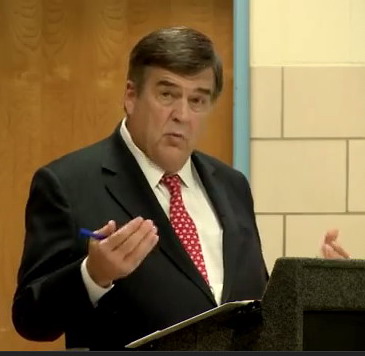
U.S. Rep. Dutch Ruppersberger

U.S. Rep. Dutch Ruppersberger

Congressman Dutch Ruppersberger, ranking Democrat on the House Intelligence Committee, called Edward Joseph Snowden, who recently leaked classified information about the National Security Agency, “a legend in his own mind,” and said President Obama made “a big mistake” in saying he had informed Congress about the surveillance of phone records, when he actually had not.

Ruppersberger’s remarks came during an address Wednesday at the annual meeting of the Fort Meade Alliance, a business group supporting economic activity around Fort Meade, home of NSA.
According to a statement from Obama, “Now, the programs that have been discussed over the last couple of days in the press are secret in the sense that they’re classified, but they’re not secret in the sense that, when it comes to telephone calls, every member of Congress has been briefed on this program. With respect to all these programs, the relevant intelligence committees are fully briefed on these programs.”

Ruppersberger began his remarks at the Hilton BWI Airport by discussing the actions of Snowden, a one-time Arundel High School student and former Booz Allen Hamilton employee.

Ruppersberger said President Obama made “a big mistake” in telling the American people that he apprised “every member of Congress” about the breach. “And he didn’t,” Ruppersberger said. But he said the NSA program is “not going to go away” and that it is a necessary element of protecting U.S. interests.

Other members of Congress had also criticized Obama for his statement.

Ruppersberger spoke to the Fort Meade Alliance audience after an address by the keynote speaker, NSA Director of Installations and Logistics Harvey Davis. Davis spoke in place of the scheduled speaker, NSA Deputy Director Chris Inglis, who was called away on official business.

Mark Smith is editor of the Business Monthly

Wednesday, March 26, 2014

CWA Fights for Fair Elections in NY

New York State Can Lead on Campaign Finance Reform

Share This Article: Facebook Twitter More...

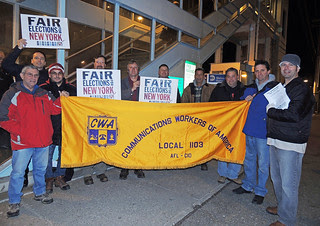
4_New_York_Public_Financing Members of CWA Local 1103 leaflet commuters in State Senator Gregg Ball's district, urging support for campaign finance reform.

CWA activists and coalition allies have been working hard to bring campaign finance reform to New York State. For the first time, Governor Cuomo has included campaign finance reform in his proposed state budget, an important step. The New York State Assembly also continued its long-time support of public financing that would use state funds to match campaign contributions from small donors in its version of the budget. The State Senate's budget also references a new campaign finance system, including public financing.

CWA activists and allies in New York State are rallying and calling their state senators, pushing the Senate to pass public financing in the final budget that's due April 1. Governor Cuomo must also prioritize the reforms. This week, members of CWA Local 1168 have been getting calls into the office of State Senator Mark Grisanti (R) to correct misinformation he cites to oppose public financing.

"We're telling Senator Grisanti that we're health care workers from his district and we care a lot about this issue. We know that hospitals and the nursing home industry make big contributions, and we want our concerns about patient safety and working conditions heard as well," said Sarah Buckley, legislative-political action director, Local 1168.

CWA Local 1103 members leafleted train stations in Senator Gregg Ball's district, asking constituents to contact the Senator to urge his support for public campaign financing.

Public financing gives ordinary citizens a greater voice in the political process because they won't be shut out by big contributions from wealthy and corporate donors. Candidates who opted to rely on small donations from individuals would be eligible for a 6 to 1 match. There would be real limits on amounts each donor could give and funds budgeted to enforce the rules.

Small donor matching in NYC has successfully boosted accountability, improved transparency, cut down corruption and lifted up the voices of ordinary citizens, setting the stage for new-Mayor Bill de Blasio's election over other candidates favored by corporate interests.

Learn more at http://fairelectionsny.org/.

Monday, March 24, 2014

Bill Maher on Framing Your Message

Bill Maher explains the power of language framing 

and how Democrats can use it


On Friday night, Bill Maher explained how Democrats must win back the language framing from the Republicans.
Being a Republican means starting with a bedrock principle, like rich people shouldn't pay taxes, or black people shouldn't vote.  (audience laughter)  And then, figuring out how to sell it to low-information voters, otherwise known as Americans.  Did I say "don't tax rich people"?  I meant "encourage the job creators".  Did I say "don't let black people vote"?  I meant "clamp down on voter fraud".  Did I say "bring back slavery"?  I meant "phase out race-based freedom quotas".  (audience laughter and applause)
Video and full transcript below the fold.

And finally, New Rule: Democrats need to stop despairing about the gloomy midterm predictions, and realize there's actually a glimmer of hope, and it has to do with suicide.  Let me finish.  For decades now, liberals pushed the issue of assisted suicide, and it got nowhere.  Then, they started to call it "aid in dying", and its approval shot up 20 points and it's now legal in 5 states.  That's the power of language.  And if they took the word "dying" out altogether and called it "early retirement"?  (audience laughter)  It would probably win over 10 more states.  If they called it "death by chocolate", they could get all 50!  (audience laughter and applause) Now, that success and the success that Democrats had in rebranding gay marriage as "marriage equality" means they have finally caught on to what Republicans learned a long time ago from their guru on words, deranged madman/friend of the show Frank Luntz.

Frank is the genius right-wing wordsmith who taught Republicans to, instead of saying "estate tax", say "death tax".  Instead of saying "poor people", say "the takers".  Instead of saying "ridiculous toupee", say "healthy head of natural human hair".  (audience laughter)
And what Democrats need to do is start out-Luntzing the Republicans on all the issues.  What's the difference between "drilling for oil" and "energy exploration"?  Nothing, except one sounds like something assholes do, and one sounds like Indiana Jones.  Health care reform?  Everyone likes that.  "Government takeover of health care".  What are you, Hitler?  What's the difference between creationism and intelligent design?  Not IQ points.  (audience laughter)
Being a Republican means starting with a bedrock principle, like rich people shouldn't pay taxes, or black people shouldn't vote.  (audience laughter)  And then, figuring out how to sell it to low-information voters, otherwise known as Americans.  Did I say "don't tax rich people"?  I meant "encourage the job creators".  Did I say "don't let black people vote"?  I meant "clamp down on voter fraud".  Did I say "bring back slavery"?  I meant "phase out race-based freedom quotas".  (audience laughter and applause)
Republicans are always confident they can move the needle on any issue because, A) they know they have the right words to make the hamster hit the pedal.  And B) they have the discipline with those words.  Perhaps you noticed how everyone on the right universally decided at the exact same moment that Obama's "weakness" is what "emboldened" Putin to take Crimea.  And that's not a matter of great minds thinking alike, because for that, you would need great minds.  (audience laughter and applause)
No, that's because once the word is decided on, every single Republican, from the presidential contenders on down to the feces-throwers on hate radio (audience laughter), all chant it like Rain Man over and over until it's beaten into our skulls.
Now I have no hope the Democrats will ever get that organized.  But they could at least keep up the winning streak in the word game.  Starting with, liberals must stop saying they "believe" in climate change or "believe" in evolution.  Evolution is; it's not matter of believing in it.  (massive audience cheering and applause)
I don't believe that water boils at 212°; that's how hot it is when it happens!  It's not ideology, it's soup!  (audience laughter)  But most of all, just remember, you win the word game, you win the issue.
Jesus was for feeding the poor.  Rename food stamps: "Christ coupons".  (audience laughter and applause)  Marijuana legalization should be called "creating green jobs".  (audience laughter and applause)  Abortion is a "natal do-over".  (audience groans)  And illegal aliens are "refried Americans".  (audience groans)
And solar energy has always sounded way too gay for rednecks.  Instead, say "invade the Sun and take its oil"!  (audience laughter and applause)
 Let's not forget Professor George Lakoff who started "Framing" political issues

Thursday, March 20, 2014

Outlawing Union Picketing is UnConstitutional

Tennessee Attorney General: 

Bill Banning Union Picketing is UnConstitutional


PICO RIVERA, CA OCTOBER 4, 2012 - Walmart employees strike out side of a Walmart store in Pico Rivera, California on Thursday October 4, 2012. The employees accuse Walmart of unlawful retaliation against workers who speak out for change at the company. Th
Soon to be banned in Tennessee?
 
A Republican bill to criminalize union picketing has been moving through the Tennessee State House, with a committee vote coming up soon. But it may be running into a snag: Tennessee Attorney General Robert Cooper says the bill violates the First Amendment.
“HB1688 presents a content-based restriction upon speech. It would criminalize ‘any form of mass picketing activity in the context of a strike, lockout, or other labor dispute’,” the opinion says.
It notes the bill "includes labor-dispute-specific proscriptions on conduct that do not apply in non-labor contexts. Furthermore, the injunction provision of HB1688… would establish a different standard for business and private-property owners who are the targets of labor-related mass picketing.”
The question, of course, is whether likely UnConstitutionality is enough of a reason for Tennessee Republicans to back off of limiting speech because they don't like who's speaking, or what they're saying.    An early response from state Rep. Jeremy Durham, the bill's sponsor, suggests he's not backing down without a fight.