Thursday, March 3, 2016

War Hawk Clinton's Dirty Hands in Libya

Even critics understate how catastrophically bad the Hillary Clinton-led NATO bombing of Libya was

The NY Times reports on Clinton's war leadership don't go far enough. Hillary's disaster in Libya should haunt her
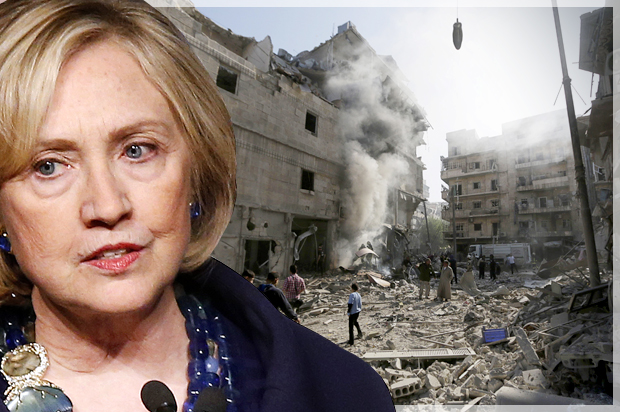

Even critics understate how catastrophically bad the Hillary Clinton-led NATO bombing of Libya was
The New York Times published two lengthy pieces this week detailing Hillary Clinton’s role in the 2011 NATO bombing of Libya. Both are important documents, and provide much insight into how, as secretary of state for the Obama administration, Clinton played a uniquely hands-on role in the war.

Sec. Clinton pressured a wary President Obama to join France and the U.K. in the war, the Times reported. Vice President Biden, National Security Adviser Tom Donilon and Defense Secretary Robert Gates, among others, opposed the war effort. Numerous government officials recalled that her hawkish enthusiasm was decisive in the “51-49 decision.”

The Times spoke of “Clinton’s deep belief in America’s power to do good in the world,” but did not stress that this belief is rooted in an aggressive militarism. It did quote French President Sarkozy, who fondly remembered how the Secretary of State “was tough, she was bullish,” but the Times’ reporting understated Clinton’s belligerence.

At 13,000 words in length combined, the articles are important contributions to the historical record. Yet although they are critical of Clinton and her leadership in the conflict, they fail to acknowledge the crimes of U.S.-backed rebel groups, and ultimately underestimate just how disastrous the War was, just how hawkish Hillary is and just how significant this will be for the future of the United States — not to mention the future of Libya and its suffering people.

The U.S. President does not have as much control over economic and social issues as many pundits, analysts and even voters often insist. One must not forget that the head of State does not control the Congress, or the Judiciary. But the President does have enormous power when it comes to international affairs, diplomacy and War. This makes foreign policy one of the most crucial issues in any Presidential campaign.

Clinton’s leadership in the catastrophic War in Libya should ergo constantly be at the forefront of any discussion of the Presidential primary.

Throughout the campaign, Clinton has tried to have her cake and eat it too. She has flaunted her leadership in the War as a sign of her supposed foreign policy experience, yet, at the same moment, strived to distance herself from the disastrous results of said War.

Today, Libya is in ruins. The seven months of NATO bombing effectively destroyed the government and left behind a political vacuum. Much of this has been filled by extremist groups.

Millions of Libyans live without a formal government. The internationally recognized government only controls the eastern part of the country. Rivaled extremist Islamist groups have seized much of the country.

Downtown Benghazi, a once thriving city, is now in ruins. Ansar al-Sharia, a fundamentalist Salafi militia that is designated a terrorist organization by the U.S., now controls large chunks of it. ISIS has made Libya home to its largest so-called “caliphate” outside of Iraq and Syria.

Thousands of Libyans have been killed, and this violent chaos has sparked a flood of refugees. Hundreds of thousands of Libyan civilians have fled, often on dangerous smuggling boats. The U.N. estimates more than 400,000 people have been displaced.

A disjointed peace process, mediated by the U.N. and other countries, drags on, with no signs of the War ending anytime soon.

Hillary has, understandably, said little of these consequences. Yet, in debate after debate, with her call for more aggression on Syria and Iran, Clinton has only continued to demonstrate that she is an unabashed War hawk.

Perhaps unsurprisingly, then, looking back, the facts show that she did not just push for and lead the War in Libya; she even went out of her way to derail diplomacy.

Little-discussed secret audio recordings released in early 2015 reveal how top Pentagon officials, and even one of the most progressive Democrats in Congress, were so wary of Clinton’s warmongering that they corresponded with the regime of Libyan dictator Muammar Qaddafi in hopes of pursuing some form of diplomacy.

Qaddafi’s son Seif wanted to negotiate a ceasefire with the U.S. government, opening up communications with the Joint Chiefs of Staff. Clinton later intervened and asked the Pentagon to stop talking to the Qaddafi regime.

Rep. Dennis Kucinich wrote a letter to Clinton and Obama in August 2011, warning against the War. “I have been contacted by an intermediary in Libya who has indicated that President Muammar Gadhafi is willing to negotiate an end to the conflict under conditions which would seem to favor Administration policy,” the Democratic lawmaker said. His plea was ignored.

A Pentagon intelligence official told Seif Qaddafi that his messages were falling on deaf ears. “Everything I am getting from the State Department is that they do not care about being part of this,” he explained.

“Secretary Clinton does not want to negotiate at all,” the U.S. intelligence official added.

And not negotiate is indeed what she did. In fact, after Qaddafi was brutally killed — sodomized with a bayonet by rebels — Clinton gloated live on TV, “We came, we saw, he died!”

The Pentagon’s correspondence with Libya before and during the war has rarely been mentioned in media reports (it is not discussed in either of the two New York Times pieces) since the Washington Times originally reported it.

The irony in the media coverage of Libya is that the right-wing media, which tends to be more pro-War, has actually been more careful and diligent in its assessment of Clinton’s legacy in Libya. In a dogmatic bipartisan political system, perhaps these kinds of double standards have come to be expected.

Those to the left of the Democratic Party certainly took notice too, nonetheless. Jacobin, a firmly leftist magazine, published one of the most careful and scathing critiques of Clinton’s role in the war. Journalist and author David Mizner meticulously detailed the uncomfortable facts in a piece appropriately titled “Worse Than Benghazi.”

Hillary’s War in Libya is the real Benghazi scandal. As Salon has previously reported, mere hours after Clinton’s day-long Benghazi interrogation by Republicans in October, at least six Libyans were killed and dozens more were wounded when militants in Benghazi fired rockets at a protest against a U.N. proposal for a unity government.

Wednesday, March 2, 2016

Break Up the Monster Banks

Why the Next President Must Reform Wall Street

Tuesday, 01 March 2016 00:00By Deena Zaidi, Truthout | News Analysis
The New York Stock Exchange on Wall Street, New York City. Many of the reforms suggested by Bernie Sanders address the issues of the 2008 financial crisis, including the issue of banks being too big to fail.The New York Stock Exchange on Wall Street, New York City. Many of the reforms suggested by Bernie Sanders address the issues of the 2008 financial crisis, including the issue of banks being "too big to fail." (Photo: meagankirk / Shutterstock.com)
"The business model of Wall Street is fraud. It's fraud. I believe that corruption is rampant, and the fact that major bank after major bank has reached multibillion-dollar settlements with the United States government when we have a weak regulatory system tells me that not only did we have to bail them out once, if we don't start breaking them up, we're going to have to bail them out again, and I do not want to see that happen..."—Bernie Sanders in a one-on-one debate with Hillary Clinton.
Some of the many reforms suggested by Sen. Bernie Sanders in the 2016 presidential race focus on Wall Street reforms. Along with bridging the wealth inequality gap, he talks about taking some stringent steps to regulate some of the biggest banks by breaking them up.
Here are a few of the reforms proposed by Bernie Sanders that could be a concern to some of the most powerful on Wall Street.
A 21st Century Glass-Steagall Act
Sanders proposes to break up big banks that are "too big to fail" by supporting a "21st Century Glass-Steagall Act." In the February 4 Democratic debate, he said, "If Teddy Roosevelt were alive today, a good Republican by the way, what he would say is: Break them up; they are too powerful economically; they are too powerful politically."
Many economists believed that the integration of commercial banking with investment banking, which was allowed under the repeal of the Glass-Steagall Act, deepened the 2008 crisis. The repeal of the Glass-Steagall Act was called the Gramm-Leach-Bliley Act. The Glass-Steagall Act was passed in 1933 in response to a number of bank failures that happened after the Great Depression. It separated commercial banking activities from risky investment banking activities. But the act was repealed in 1999 under President Bill Clinton after $300 million worth of lobbying efforts. He believed that the act was "no longer appropriate to the economy in which we live. It worked pretty well for the industrial economy ... But the world is very different."

Some of the biggest banks, like JPMorgan Chase, are already 80 percent bigger than they were since they were last bailed out.

After the repeal, the investment banks resorted to risky trading, since such activities remained largely unregulated. These non-bank financial institutions were known as "shadow banks" and were not subjected to traditional banking regulations. They remained in the shadows of the traditional banking system and channeled funds from savers to investors through a range of funding techniques. The shadow banks earned enormous profits from reckless derivatives trading, and their interlinkages with commercial banks and insurance institutions made the risk systemic in nature. Another act that left the multitrillion-dollar derivatives market unregulated was the Commodity Futures Modernization Act, which was signed into a law in 2000. The act allowed inclusion of some of the most complicated derivatives, like mortgage-backed securities and credit-default swaps. In a loosely regulated environment, these risky products brought in lots of uncertainty to the financial system.
Eventually, the banks became so leveraged and huge that in the event of a failure, they posed a huge systemic threat to the entire economy. The estimated value of the derivatives holdings on banks' balance sheets had expanded from $88 trillion in 1999, to a whopping $672 trillion by 2008. During the subprime mortgage crisis, the banks were bailed out with taxpayers' money to prevent financial contagion from spreading to the entire financial system. In 2015, Forbes reported that according to the special inspector general for the Troubled Asset Relief Program (TARP), the total commitment of the US government was $16.8 trillion, out of which $4.6 trillion had already been paid out. TARP was created by the US Treasury to stabilize the economy and prevent any foreclosures in the wake of the 2008 financial crisis.
In 2014, The New York Times reported that US banks still held huge amounts in derivative trading. "American banks have nearly $280 trillion of derivatives on their books, and they earn some of their biggest profits from trading in them," the Times reported. Some of the biggest banks, like JPMorgan Chase, Bank of America and Wells Fargo, are already 80 percent bigger than they were since they were last bailed out.
Reforming the Wall Street Business Model
In a one-on-one debate with Hillary Clinton on February 4, 2016, Sanders highlighted the seriousness of the banking scandals not being treated as criminal offenses. He said, "Kid gets caught with marijuana, that kid has a police record. A Wall Street executive destroys the economy, $5 billion settlement with the government, no criminal record."
The 2008 financial crisis left many scarred due to the greed of the most powerful in the financial system, but post-2008, the banking system witnessed a series of banking crimes. Banking scandals like money laundering, insider trading and foreign exchange rigging involved some of the biggest banks. The concerned CEOs and the involved bank executives either voluntarily stepped down or were sacked in an event of fraud detection. In August 2015, Tom Hayes, a former trader at UBS and Citigroup, was sentenced to 14 years in prison for his alleged role in what was known as the Libor scandal.
Hayes was convicted of attempting to fraudulently manipulate the London interbank offered rate, or Libor, which is the interest rate that banks charge one another for loans in the London market, according to Bloomberg. Galleon Group hedge fund founder Raj Rajaratnam made $63.8 million in illicit profit from 2003 to 2009. He traded in stocks such as eBay Inc., Goldman Sachs Group Inc. and Google Inc., and was sentenced in 2012. The New York attorney has identified 70 additional hedge funds, but the prosecution for them has been very slow.
As of May 2015, global banks have paid more than $9 billion in fines, with many traders and brokers being fired, barred and forced to resign. Many of the banking crimes were related to subprime mortgage lending. In a recent settlement, the world's largest mortgage lender, Wells Fargo, agreed to pay $1.2 billion for engaging in reckless lending under a Federal Housing Administration program.
Reforming the Credit Rating Agencies
Sanders proposes to turn credit rating agencies into nonprofit organizations and make them independent from the shadow of Wall Street. Credit rating agencies (CRAs) give ratings to financial products and sovereigns and these ratings help investors decide which product is safe for investing. Hence, the role of CRAs remains crucial to the economy and investors.
Many of the CRAs were involved in providing inaccurate ratings to products that turned toxic during the 2008 financial collapse. The CRAs knew about the risk of the speculative mortgage-backed derivatives, but still gave them AAA ratings. Currently, the "big three" CRAs - Standard & Poor's (S&P), Fitch Ratings and Moody's Investors Service - control 95 percent of the credit ratings market, with very little competition from any major player in the market.
Sanders aims to make the CRAs independent of Wall Street and to do away with the "issuer-pays model" under which the CRAs operate. The model allows a bond's issuer to pay an agency or agencies for initial ratings and for ongoing ratings. The big three CRAs were criticized for behaving as monopolies during the crisis and providing investors with biased ratings that were inaccurate and lacked transparency. In 2015, a lawsuit alleged that S&P issued inflated ratings that misrepresented securities' true credit risks. Many investors, mostly federally insured financial institutions, lost billions of dollars on collateralized debt obligations (CDOs). Finally, S&P agreed to pay $77 million, in addition to being banned for one year from rating commercial mortgage-backed securities.
Many of the suggested Sanders reforms address the issue of the 2008 financial crisis, including the issue of banks being "too big to fail." A document signed by 170 of the nation's top economists has supported the Wall Street reforms proposed by Sanders. In the document, they write, "The only way to contain Wall Street's excesses is with reforms sufficiently bold and public they can't be watered down. That's why we support Senator Sanders's plans for busting up the biggest banks and resurrecting a modernized version of Glass-Steagall."
The Importance of Community Banks
The 21st Century Glass-Steagall Act and breaking up big banks will surely also encourage the growth of a traditional community banking system that has been adversely affected by the rise of "too-big-to-fail" banks (that have easy access to huge funds). Community banks are roughly defined as small banks that carry an asset size of less than $10 billion. They are vital to local communities as they work on building long-term relationships with their customers. Community banks focus on the needs of local families, businesses and farmers, and provide small loans for local and agricultural businesses. A 2015 Harvard University study found that they provide 77 percent of agricultural loans and 50 percent of small business loans.
But the 2008 crisis and implementation of strict regulations under Dodd-Frank have put this important sector under immense pressure. The cost of sustenance in the current banking environment under expensive regulations has become a challenging factor for many community banks, resulting in mergers or shutdowns. Community banks have seen a decline of 12 percent in their shares of assets since the introduction of Dodd-Frank regulations in 2010. This section of the small banking system had little role to play in the 2008 financial crisis, yet it had to face the repercussions in the form of stringent banking rules. According to the Federal Reserve Bank of Kansas City, "community banks are not major participants in large-dollar wholesale payments systems" and hence "they pose little or no systemic risk to the overall financial system." Sanders' approach toward big banks and breaking them up will help bring back the traditional community banking system and promote healthy and fair competition in the industry.
Breaking up big banks, instating a 21st Century Glass-Steagall Act, restructuring the rating methodology of credit rating agencies and holding bankers accountable for their banking crimes are likely to address some relevant and pending issues on Wall Stree

Trump is Blowback from Phony GWOT

Blowback: Donald Trump Is the Price We Pay for the "War on Terror"

Tuesday, 01 March 2016 00:00By Mike Lofgren, Truthout | News Analysis
Donald Trump, a Republican presidential hopeful, during a campaign event at Radford University in Radford, Va., Feb. 29, 2016. (Photo: Damon Winter / The New York Times) Donald Trump, a Republican presidential hopeful, during a campaign event at Radford University in Radford, Virginia, February 29, 2016. (Photo: Damon Winter / The New York Times)
The people can always be brought to the bidding of the leaders. That is easy. All you have to do is tell them they are being attacked and denounce the pacifists for lack of patriotism and exposing the country to danger. It works the same way in any country.—Hermann Göring, in an interview by Gustave Gilbert, April 18, 1946
The "war on terror" is the longest continuous war in US history. Taxpayers have ponied up over $4 trillion to wage it. Yet the consensus of our intelligence community is that we are more in danger than ever. Did we spend more than $4 trillion to make ourselves less safe? Let us unpack the contradictions.
Terrorism in the United States is statistically a negligible cause of mortality: One is about as likely to die from being crushed by a flat-screen TV, and more likely to diefalling in the bathtub than from terrorism. Imagine if we had spent $4 trillion to cure cancer or heart disease. Nevertheless, nearly every word US government officials have uttered about the matter during the last 15 years has been designed to instill dread of terrorism in the population. And it has worked.
Voters in the Republican primary in South Carolina declared terrorism to be their foremost concern, eclipsing a stagnant, low-wage economy; deteriorating living standards leading to an actual increase in the death rate of GOP voters' core demographic; and the most expensive and least available health care in the "developed" world. The operatives of the national security state must have been rubbing their hands with glee: Through relentless conditioning, their agenda is now the creed of a numerically significant and highly motivated segment of the electorate.
But there was a flaw in their calculation. Those voters who felt most strongly about terrorism chose Donald Trump, who comfortably won the primary. The national security state, which is a subset of the corporate state, doesn't want Trump. They prefer to maintain the present corporate oligarchy that offers a façade of democratic process by putting forward safe, obedient, pre-programmed candidates. Since the "war of terror" began, this charade has worked rather efficiently: Bush or Kerry, Obama or McCain, Obama or Romney. And this year it was to be Jeb Bush or Hillary Clinton. Or, in a pinch, a second-stringer like Marco Rubio.

Trump's proposed tax policy is such a giveaway to the rich that it would make the Bush tax cuts look like fiscal rectitude.

Our rulers may have overplayed their hand. Their implementation of a psychological shock doctrine has unhinged a sizable percentage of the American people, although the full implications were not evident for years. First, the shock of 9/11. To divert Congress and the public from the simplest explanation as to why it happened - that George W. Bush sat in Crawford, Texas, during the entire month of August 2001 and did precisely nothing - the national security complex concocted a tale of the fearsomeness and ubiquity of terrorism. Then, the fearmongering over Saddam Hussein's nonexistent weapons of mass destruction, followed by a futile and intractable war. Then the crash of 2008, engineered by the same corporate mindset that dominates the national security state, only it is located on Wall Street rather than in the Pentagon. A numbing fear of unemployment and foreclosure gripped millions.
The fear apart, I was surprised by how passively Americans appeared to respond to that trifecta of shocks. After the horrific bungling and shabby lying attendant to the US invasion of Iraq, Democratic voters lined up like iron filings obeying a magnet to coronate a dud like John Kerry, who voted for the war. Likewise, Republicans in droves supported the warmongering John McCain and the rapacious corporate predator Mitt Romney. Democrats might think they have reason to be excused for being deceived by Obama's sonorous rhetoric - provided they hadn't checked his 2008 vote on the FISA Amendments Act, or the fact that John Brennan, who had separated from Bush's CIA, proceeded to attach himself, limpet-like, as a national security adviser to then-Sen. Barack Obama's presidential campaign.

As much as the Republican Party created Trump, it shares parentage with the transpartisan national security complex.

But the chickens finally came home to roost. What we now have, it appears, is not the public finally wising up en masse and realizing they'd been played for chumps by the corporate oligarchy and their political marionettes. No, a sizable chunk of them have lurched headlong in the opposite direction; they are sick of the charade of managed democracy, so why not try a little fascism, straight-up and without all those boring impediments like a bill of rights or checks and balances? This flight from reason is both a symptom of, and a reaction to, the underlying pathologies of the last decade and a half.
The slick operators at the CIA, Wall Street and the Kennedy School of Government did their job a little too well. It will be hard for some State Department spokesman to piously lecture other countries about human rights when a President Trump institutes a torture regime that will make George W. Bush look like the Marquess of Queensbury. Maybe he'll televise the torture sessions as the next reality TV hit.
Canadian psychologist Robert Altemeyer estimates that about a fifth of the US population consists of authoritarians. These are people who practice the creed of kiss up, kick down, by which they vent their spite on those they fancy below them while attaching themselves to a bullying, charismatic leader figure. Twenty percent isn't a majority, but combined with the fact that they are easily mobilized, there are also millions of low-information voters, unbelievably misguided people (who overlap with authoritarians), and human drones who robotically cast votes strictly by party label. Those add up to numbers that can swing an election.
Beyond those groups, I have run into a surprising number of gullible cynics not attached to either party. They persuade themselves that because Trump is the first prominent Republican to debunk the trance-like belief among the faithful that Bush was somehow not president on 9/11, it means Trump's views on the Middle East are more reasonable than the GOP norm and therefore worthy of their vote. Meanwhile, on the economic front, Trump has sneered at Republican free trade theology, but his proposed tax policy is such a giveaway to the rich that it would make the Bush tax cuts look like fiscal rectitude: Trump would literally wreck the government's finances. The selective amnesia of these gullible cynics is striking; they remind me of children playing with fire. I wonder how many of them there are in the country.

I'd estimate the odds at about fifty-fifty that this country ends up with something resembling a fascist political system.

It has finally become conventional wisdom among centrist pundits that the Republican Party (and its associated media-entertainment complex) created Trump, however much the party detests his business model. I agree with that view, but there is an aspect of the media-entertainment complex that they may be missing: It seems to have created a new voting demographic, which, with Trump, will be unprecedentedly strong. There probably has always been a relatively fixed percentage of hostile paranoiacs in the general population, but in the past they were isolated, politically unmobilized and doubtful that others shared their worldview. Twenty years of Rush Limbaugh, Fox News and other broadcast effluvia have handed them an insular group identity, stoked their rage and mobilized them.
But as much as the Republican Party created Trump, it shares parentage with the transpartisan national security complex. Politicians, generals, CIA directors, think tank warriors and terrorism "experts" have been dinning a message of fear into our heads for a decade and a half, a fear that works on many voters like catnip on a feline.
The fear, of course, can only be exorcised by a policy of nonstop militarism. Congratulations, patricians of the Beltway: However disdainful you are of the vulgarian Trump, you helped put him where he is today. After all, as the media incessantly reminded us, South Carolinians worship the military - and those same South Carolinians broke for Trump, because they want their militarism pure and untainted by the base metal of establishment hypocrisy about being a peace-loving people.
I'd estimate the odds at about fifty-fifty that this country ends up with something resembling a fascist political system, if not in 2017, then at some point in the next decade. We may never hear it called that: The prestige media have up to now mostly maintained an embargo on words like "fascist" or "authoritarian"; it will be fascinating to see at which point in the coming year - if at all - the embargo is lifted. No, we won't have black uniforms and goose-stepping. In the US cultural vernacular, it would be more like Lee Greenwood played on an endless loop, with patriotic ceremonies even more lugubrious and hypocritical than the ones now at professional sporting events.
I have occasionally heard it objected that Trump's gestalt is not fascist but populist. This belief betrays a confusion of ends and means. Fascism is a political and economic system; populism is a rhetorical style and campaigning technique designed to gain and maintain power by appealing to mass longings that do not normally see expression in formal political systems. Policies like mass deportation, torture, killing hostages, and so forth, are hard to assemble under the umbrella of populism. They would be awfully difficult to link with the 19th-century Populists, for example, but they readily fit under most definitions of fascism.
It is difficult to convey the sheer animal excitement at a Trump rally. And one thing that has gotten insufficient notice is how his followers threaten, or actually use, violence against protesters while Trump stands on the stage, arms folded, chin thrust out, glowering. Occasionally, as in Nevada, he utters threats of violence himself. Where, skeptics ought to ask themselves, have they seen this grainy newsreel footage before? 
Copyright, Truthout. May not be reprinted without permission.

MIKE LOFGREN

Mike Lofgren is a former congressional staff member who served on the House and Senate budget committees. His new book, The Deep State: The Fall of the Constitution and the Rise of a Shadow Government, appeared January 5, 2016.


    Tuesday, March 1, 2016

    SOCIALISM for BERNIE SANDERS

    Sanders and the S Word

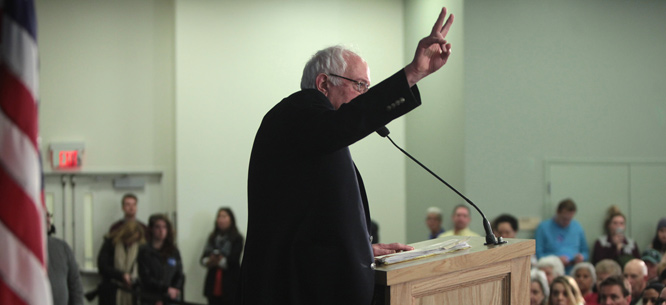
    Bernie Sanders speaking in Hooksett, New Hampshire, January 21 (Gage Skidmore / Flickr)
    Last November, Bernie Sanders told an enthusiastic audience packed into the largest hall at Georgetown University what “democratic socialism” means to him. He drew largely on the examples of two presidents, a civil rights leader, and a Pope—not one of whom identified himself as a socialist. Sanders praised Franklin Roosevelt for creating jobs and enacting Social Security and hailed Lyndon Johnson for initiating Medicare and Medicaid. He cited Martin Luther King, Jr.’s conviction that true freedom requires economic security. He quoted Pope Francis’s censure of “the worship of money.” Then Sanders repeated his familiar attack on the “billionaire class” and his call for universal health care and an end to tuition at public colleges.
    One can easily imagine a liberal stalwart like Senator Elizabeth Warren or Senator Sherrod Brown making the same speech, yet without embracing the “S” word. Why does the white-haired firebrand from Vermont insist on identifying himself with socialism, a political faith that has never been popular in the United States?
    I have never met or spoken to Bernie Sanders. So I can only speculate about his reasons. But they probably have a lot to do with the surprising influence of democratic socialists in modern U.S. history and his desire to be part of that long, if largely unheralded, tradition.
    Until Sanders, the most popular American socialist was Eugene Victor Debs—a charismatic orator and erstwhile union leader whom Sanders respected so much that, in 1979, he made an earnest audio documentary about him. Unlike his latter-day admirer, Debs ran for president—five times!—as the nominee of an actual Socialist party. He never won more than 6 percent of the popular vote, but Debsian Socialists headed several major unions, did much to organize the broad coalition that almost kept the United States out of World War I, and launched the movement for birth control. Their prominence in social movements spurred progressive officeholders like Theodore Roosevelt and Woodrow Wilson to advocate economic and political reforms, in part to stop the radicals from gaining more support from the discontented.
    In the early 1960s, Sanders joined the Young People’s Socialist League (“Yipsel” to aficionados of the left) as an undergraduate at the University of Chicago even though its parent party was nearly moribund. The Socialists had even stopped running their own candidates for president; liberal Democrats had adopted some of their proposals (like Social Security and protection for union organizing) and captured nearly all of their voters.
    But several prominent Americans who had once been active Socialists continued to advance the party’s ideals. Walter Reuther headed the United Auto Workers, perhaps the nation’s most powerful union and a key financial supporter of the civil rights movement. Both A. Philip Randolph, who inspired the 1963 March on Washington for Jobs and Freedom, and Bayard Rustin, the organizational mastermind behind it, had also been Socialists. The man who gave the unforgettable, final speech at that march of a quarter-million people had never been a card-carrying socialist, But Martin Luther King, Jr. did often express his admiration for the welfare states of Scandinavia and publicly advocated “a massive program by the government” to aid working people of all races. Echoing a familiar socialist theme, King argued that the only way to defeat racism would be to forge a class alliance of African Americans with poor whites so “confused . . . by prejudice that they have supported their own oppressors.” Meanwhile, Michael Harrington, a rising leader in what remained of the Socialist Party, became famous for writing The Other America, the eloquent book that inspired the War on Poverty.
    Thus, for the young Bernie Sanders, to embrace socialism meant joining an enduring tradition even if the organization of that name in the United States was slowly dying. Under the name of Social Democracy, that tradition was prospering throughout northern and western Europe. It was also thriving in Israel, governed since independence by the Labor Party; Sanders worked on a kibbutz there after college.
    In the black freedom and antiwar movements he joined back home, hardly anyone objected to the ideals of socialism. But few activists still believed in Debs’s dream that Americans would someday come to their common senses and elect socialists to govern the nation.
    In a way, Bernie Sanders has devoted his long political career to proving them wrong. First as mayor of Burlington, then as congressman and senator from Vermont, and now as a surprisingly competitive candidate for president, he has preached the same gospel as did Debs and Randolph, Harrington and King: the tiny elite which Franklin Roosevelt called the “economic royalists” dominates both the workplace and the marketplace; its wealth and power subverts democracy and fuels inequality of all kinds. Sanders appropriates the words and legacy of FDR and LBJ to demonstrate that his socialism is as American and as legitimate as their liberalism—only more consistent in its critique and more uncompromising in pursuit of its goals.
    The ease with which Sanders talks about socialism today is also indebted to the conservatives he despises. The grassroots right turned the word into a ubiquitous accusation against the president he hopes to succeed. Since he came into office, Barack Obama’s ideological adversaries have called him many things. But “socialist” heads the list. A quick search for the president’s name and the “S” word turns up thousands of images of Obama with hammer and sickle, Obama reviewing troops in Red Square, Obama embracing Karl Marx, and so on. Unsurprisingly, many young people with no memory of the Cold War reflected that if a president they like is a “socialist,” perhaps that’s not such a bad thing after all. Bernie Sanders has benefited from that linguistic irony.
    In any European nation, to call someone a socialist is not a slur but a simple political fact. By running as a Democrat, Sanders has paradoxically gained more attention for socialism and its history in the United States than if he had remained an independent party of one, known mostly to his fellow leftists. He remains a long shot to win the presidency. But if he loses, he can take solace in the response Debs often made to people who asked why they should “throw away” their votes on a radical: “better to vote for what you want and not get it than to vote for what you don’t want and get it.”

    Michael Kazin is co-editor of Dissent.