Wednesday, August 27, 2014

Elizabeth Warren Far More Progressive than Killary Klingon

Clinton vs. Warren: Big Differences, Despite Claims to the Contrary


By David Sirota


Hillary Clinton’s political allies want Democratic primary voters to believe that the former secretary of state is just like populist Massachusetts Senator Elizabeth Warren, and they’ve been claiming that there are no differences between the two possible presidential contenders. There’s just one problem: That’s not true.

Clinton last week filled in for George W. Bush at an Ameriprise conference, continuing a speaking tour that is raking in big money from Wall Street. One of her aides later downplayed the idea that Clinton’s relationship with the financial sector could be a political liability for her, should she face Warren in the 2016 Democratic presidential primaries. The aide defiantly insisted that the two are exactly the same.

“Ask any so-called ‘left’ or ‘liberal’ critic of Hillary to name a single vote or position (on) which Elizabeth Warren and Hillary would disagree,” said the Clinton strategist to The Hill newspaper.
OK, fine. I’ll take the challenge - there are many differences between these two politicians.

For example, in her book, “The Two Income Trap,” Warren slammed Clinton for casting a Senate vote in 2001 for a bankruptcy bill that ultimately passed in 2005. That legislation makes it more difficult for credit card customers to renegotiate their debts, even as it allows the wealthy to protect their second homes and yachts from creditors. According to a 2009 study by the Federal Reserve Bank of New York, the bankruptcy bill’s provisions changing debt payback provisions played a central role in the foreclosure crisis, as the new law forced homeowners to pay off credit card debts before paying their mortgage.

“As first lady, Mrs. Clinton had been persuaded that the bill was bad for families, and she was willing to fight for her beliefs,” Warren wrote. “As New York’s newest Senator, however, it seems that Hillary Clinton could not afford such a principled position. ... The bill was essentially the same, but Hillary Rodham Clinton was not.”

Additionally, Warren has been a critic of so-called free trade deals, which create regulatory protections for patents and copyrights, but remove such protections for workers, consumers and the environment. Clinton, by contrast, was a key backer of NAFTA and voted for various free trade pacts during her Senate tenure.

Clinton was also a prominent supporter of the 1996 welfare reform legislation that made it more difficult for poor families to receive government benefits. With a new study from the Center on Budget and Policy Priorities showing that law coinciding with a rise in extreme childhood poverty, Clinton’s position may open her up to criticism from Warren, who has positioned herself as a champion of the poor.

There is also Clinton’s vote for the Iraq War. During her 2012 Senate campaign, Warren was an outspoken critic of the War. As a Senator, Warren is a co-sponsor of a new bill to repeal the original authorization for war in Iraq that Clinton supported.

Clinton, of course, has attempted to distance herself from her previous positions. In 2008, she said, “I should not have voted for that bankruptcy law.” That year, she also said she believes the NAFTA free trade model needs to be “adjusted.” And in her 2014 book, “Hard Choices,” Clinton says of her Iraq War vote: “I wasn’t alone in getting it wrong. But I still got it wrong. Plain and simple.”

The reversals certainly position Clinton closer to the base of the Democratic Party. But, as then-Sen. Barack Obama’s criticism of Clinton on these issues proved in 2008, her retrospective apologies and admissions do not necessarily wipe the record clean for Democratic voters, especially when she’s raking in hundreds of thousands of dollars from financial firms.
If she does face Warren in 2016, Clinton’s record will likely once again be center stage, regardless of the recent contrition.

David Sirota is the best-selling author of the books “Hostile Takeover,” “The Uprising” and “Back to Our Future.” Email him at ds@davidsirota.com, follow him on Twitter @davidsirota or visit his website at www.davidsirota.com.

Governments Reject Regulators Questions About Hedge Funds

Journalists on the 

Government's Blacklist

American Redaction. (Image: <a href="https://www.flickr.com/photos/truthout/6163866838" target="_blank"> Jared Rodriguez / t r u t h o u t</a>)American Redaction. (Image: Jared Rodriguez / t r u t h o u t)DAVID SIROTA ON BUZZFLASH AT TRUTHOUT
As states move to hide details of government deals with Wall Street, and as politicians come up with new arguments to defend secrecy, a study released earlier this month revealed that many government information officers block specific journalists they don't like from accessing information.

The news comes as 47 federal inspectors general sent a letter to lawmakers criticizing "serious limitations on access to records" that they say have "impeded" their oversight work.
The data about public information officers was compiled over the past few years by Kennesaw State University professor Dr. Carolyn Carlson. Her surveys found that 4 in 10 public information officers say "there are specific reporters they will not allow their staff to talk to due to problems with their stories in the past."
"That horrified us that so many would do that," Carlson told the Columbia Journalism Review, which reported on her presentation at the July conference of the Association for Education in Journalism and Mass Communication.
Carlson has conducted surveys of journalists and public information officers since 2012. In her most recent survey of 445 working journalists, four out of five reported that "their interviews must be approved" by government information officers, and "more than half of the reporters said they had actually been prohibited from interviewing [government] employees at least some of the time by public information officers."
In recent years, there have been signs that the Federal government is reducing the flow of public information. Reason Magazine has reported a 114 percent increase in Freedom of Information Act rejections by the Drug Enforcement Agency since President Obama took office. The National Security Agency has also issued blanket rejections of FOIA requests about its metadata program. And the Associated Press reported earlier this year that in 2013, "the government cited national security to withhold information a record 8,496 times - a 57 percent increase over a year earlier and more than double Obama's first year."
Those revelations foreshadowed a recent letter from more than half of the government's inspectors general saying that Federal agencies' move to hide information from them represents a "potentially serious challenge to the authority of every Inspector General and our ability to conduct our work thoroughly, independently, and in a timely manner."
In that letter, the inspectors general assert that agencies are saying information is "privileged" and therefore must be kept secret.
That is one of many increasingly creative rationales that public officials are now citing as reason to keep government information secret.
In Chicago, for example, officials in Mayor Rahm Emanuel's administration rejected a request for documents about an opaque $1.7 billion fund that is often used for corporate subsidies, some of which have flowed to the mayor's political donors. In a letter explaining the rejection, the officials said it would take too much staff time to compile the data and that therefore the request was "unduly burdensome."
Likewise in Rhode Island, Democratic State Treasurer Gina Raimondo rejected a newspaper request for information about the state's hedge fund contracts on the grounds that she wanted fund managers to "keep this information confidential to help preserve the productivity of their staff and to minimize attention around their own compensation."
That denial was one of many similar rejections from states seeking to keep the details of their Wall Street deals secret.
Carlson's polls from 2014 show that three-quarters of journalists surveyed now agree that "the public is not getting the information it needs because of barriers agencies are imposing on journalists' reporting practices."
That's the whole point of government secrecy, of course - and the ramifications are predictable. In an information vacuum, the public is being systematically divorced from public policy, which is exactly what too many elected officials want.

COPYRIGHT 2014 CREATORS.COM
---
David Sirota is a staff writer at PandoDaily and the best-selling author of the books "Hostile Takeover," "The Uprising" and "Back to Our Future." Email him at ds@davidsirota.com, follow him on Twitter @davidsirota or visit his website at www.davidsirota.com.

Education Reformers Omit Effect of White Supremacy

Elite Attackers of Public Schools Don't Admit the Impact of Economic Inequality, Racism on Education

Wednesday, 27 August 2014 09:56By Mark Naison, Haymarket Books | Book Excerpt
2014 827 stu st(Image: Nick Thompson)Wayne Au, editor of Rethinking Schools and co-editor of Pencils Down: Rethinking High-Stakes Testing and Accountability in Public Schools, writes of the book, Badass Teachers Unite: "In this powerful collection of essays, education activist and historian Mark Naison offers teachers, parents, students and anyone else concerned with the health of public schools in this country some invaluable tools in the fight against corporate education 'reform.' 

Badass Teachers Unite is a clarion call for all of us to reclaim public education in the name of social justice."

Naison's broadside attack on the co-opting of public schools is in the same vein as Jose Vilson's This Is Not a Test: A New Narrative on Race, Class and Education (previously featured as a Truthout Progressive Pick).

Education Reformers and the New Jim Crow
If somebody told me 15 years ago, when I was spending many of my days working with community groups in the Bronx and East New York, dealing with the consequences of the crack epidemic, that you could solve the problems of neighborhoods under siege by insulating students in local schools from the conditions surrounding them and by devoting every ounce of teachers' energies to raising their test scores, I would have said, "What planet are you living on?" Students were bringing the stresses of their daily lives into the classroom in ways that no teacher with a heart could ignore, and these stresses created obstacles to concentrating in school, much less completing homework. People living in middle-class communities couldn’t imagine these forces. To be effective in getting students to learn, teachers had to be social workers, surrogate parents, and neighborhood protectors, as well as people imparting skills. At times, the interpersonal dimensions of their work were more important than the strictly instructional components.

The leaders of the education reform movement, from Secretary Arne Duncan - to the head of Teach for America, to Michelle Rhee, to the heads of almost every urban school system - regard discussions of neighborhood conditions as impediments to the quest to achieve educational equity and demand that teachers shut out the conditions they are living in. Teachers must now inspire, prod and discipline their charges to achieve results on standardized tests that match those of their middle-class counterparts living in more favorable conditions.

The position they are taking, that schools in depressed areas can be radically improved without doing anything to improve conditions in the neighborhoods they are located in, flies in the face of the common sense of anyone who lives or works in such communities, so much so that it represents a form of collective madness! 

The idea that an entire urban school system (not a few favored schools) can be uplifted strictly through school-based reforms, such as eliminating teacher tenure or replacing public schools with charter schools, without changing any of the conditions driving people further into poverty is contrary to anyone’s lived experience and has in fact, never been accomplished anywhere in the world. 
Let me break down for you what the no excuses approach to school reform 
means in commonsense terms.

Basically, reformers propose to raise test scores and radically improve graduation rates in urban school systems without doing anything to:

1. Reduce homelessness, residential instability and housing overcrowding  as factors in student’s lives.
2. Deal with hunger, poor diet and obesity as factors impeding education performance.
3. Challenge racial profiling and police violence in student’s lives, not 
only in their neighborhoods, but in the schools.
4. Deal with unemployment, underemployment and wage compression
 as factors in the lives of students and their families.
5. Deal with the impact of the prison industrial complex on students and
 their families, particularly the psychic and economic stress of having close
 relatives in prison and having them be unemployable when they return.
6. Deal with the trauma of domestic violence and peer violence as it impacts
 students’ lives and their educational performance.
7. Deal with the way students are profiled by police, store owners, and ordinary  citizens when they leave their neighborhoods and go into downtown business districts or middle-class neighborhoods.

Essentially, reformers are asking everyone involved with schools in 
under-resourced communities, especially teachers and administrators, 
to block out all the conditions that Michelle Alexander has highlighted
 in her book The New Jim Crow. Not only will this approach fail miserably, 
it gives a free pass to economic and political elites whose policies helped 
create the very conditions that lock people into poverty.

No wonder billionaires love these policies. It takes the onus off of them for concentrating so much of the nation’s wealth in the top 1% of the population. 
No wonder politicians love it. It absolves them of responsibility for building the largest prison system in the industrialized world, filling it with poor people and people of color, and creating huge police forces and drug 
enforcement policies that assure such prisons are filled.

Essentially, current school reform policies represent a brilliant tactic 
to avoid dealing with the real causes of poverty and 
inequality in society, while finding a convenient scapegoat 
in public school teachers and their unions. These policies
 are transparent, ill considered and immoral. And over time, people in the communities most targeted by these reforms will 
rise up in protest.

Copyright of Mark Naison (2014). Not to be reprinted without permission of the publisher, Haymarket Books.

MARK NAISON

Mark Naison is, professor of African American studies and history at Fordham University, is author of many books and articles including Communists in Harlem During the Depression and White Boy: A Memoir. The founder of the Bronx African American History project, Naison has emerged in the past five years as a passionate defender of America's public school teachers and students.     
     

    Tuesday, August 26, 2014

    Carbon Tax Now

    A Carbon Tax Is Absolutely Essential


    By The Daily Take Team, The Thom Hartmann Program | Op-Ed

    On Monday, America's largest wireless provider announced that it will be making a $40 million investment in solar power at eight of its facilities across the United States.

    (Editor:  Also Verizon is world's largest SURVEILLANCE PROVIDER to NSA, CIA)

    According to a press release from Verizon, new solar installations at facilities in California, Maryland, Massachusetts, New Jersey, and New York will nearly double the amount of energy that Verizon gets from solar power.

    Speaking about the $40 million investment, Verizon's chief sustainability officer James Gowen told Bloomberg that, "Solar is a proven technology. It didn't hurt that the technology is getting better and prices are coming down."

    Last year, Verizon announced a similar $100 million investment in solar power and fuel cell technologies.

    These types of investments in clean and green forms of renewable energy from major US corporations couldn't come sooner.

    That's because new research suggests that climate change and global warming are happening a lot faster than we first thought.

    According to new data from a European space probe, our planet's two largest ice sheets - in Greenland and Antarctica - are melting at unprecedented speeds.

    The CryoSat-2 space probe has discovered that the ice sheets in Greenland and Antarctica are losing a stunning 120 cubic miles of ice each year.

    That's A LOT of ice that's going from being frozen ice up on land into being river water flowing into the rising oceans.

    But more importantly, the rate of sea ice loss from Greenland and Antarctica has more than doubled since 2009, which shows just how fast the processes of global warming and climate change have become.

    Speaking about the new and alarming data, Mark Drinkwater, mission scientist for the European Space Agency's CryoSat mission, said that, "These results offer a critical new perspective on the recent impact of climate change on large ice sheets. This is particularly evident in parts of the Antarctic peninsula, where some of the more remarkable features add testimony on the impact of sustained peninsula warming at rates several times the global average."

    And, it's not just the sea ice in Greenland and Antarctica that's melting at astonishing rates.

    Arctic sea ice is melting at unprecedented rates too.
    In fact, as Gaius Publius pointed out over at America Blog, just about every reputable projection on the loss of Arctic sea ice has been wrong.
    The lack of sea ice cover in the Arctic that we're seeing today wasn't supposed to happen for 20+ more years according to 13 of the most accurate models.
    With more and more of our planet's ice cover melting away at unprecedented rates, the question becomes: "Have we reached a tipping point?"

    Have we reached the point where we can no longer hope to slow down or even stop the processes of climate change and global warming, and where do we have to prepare for the ongoing and worsening sea level rises on our coastlines?

    The fact is, despite this new and alarming data from the CryoSat-2 probe, we still don't if we've passed a tipping point or not.

    So, with that being the case, we need to slow down climate change and global warming, to protect our planet's ability to support human life.
    One of those actions that we can take today is to put a carbon tax in place.
    Putting a price on carbon encourages less fossil fuel extraction and a rapid move to clean and green energy.

    With even a modest carbon tax - that doesn't even end the subsidies to the big oil, coal, and gas companies - fossil fuels instantly become more expensive than renewables like wind and solar.

    A report put out by the Citizens Climate Lobby shows that a $10 carbon tax would cut greenhouse gas emissions by around 28 percent of 2005 levels.
    That's 11 percent more than the cut proposed by the EPA in the Clean Power Plan it announced back in June.

    In our documentary Carbon, the first part of a four part series on climate change by Leonardo DiCaprio and yours truly that was released last week, some of the world's leading climatologists and scientists talk about the importance of a carbon tax.

    They make it clear that, if we want to save our planet and the human race from the greatest threat we've ever faced, a carbon tax is absolutely essential.
    It's that simple.

    To find out more about the dangers of climate change, and the importance of a carbon tax, head over to Green World Rising.

    Obama Avoids Congress, Escalates Attacks on ISIS

    US Launches Reconnaissance 

    Flights over Syria

    Drones and NSA intelligence-gathering team based in Baghdad lay groundwork for extending air strikes against Islamic State militants in Syria.
    by Matthew Weaver and Martin Chulov
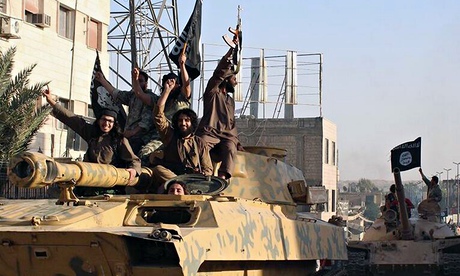
    Islamic State fighters in Raqqa, Syria
    Islamic State fighters parade in the group’s stronghold of Raqqa in north-eastern Syria. Photograph: Uncredited/AP
    The US has begun reconnaissance flights over Syria in preparation for a possible cross-border expansion of its aerial campaign against Islamic State militants in Iraq.
    The flights, involving both manned aircraft and drones, began on Tuesday, an official confirmed to AP, after they were approved by the US president, Barack Obama, over the weekend.  (But not by Congress)
    Obama has been reluctant to take military action in Syria, but the flights are being seen as laying the groundwork for extending US air strikes against Islamic State militants (Isis) into the group's stronghold of Raqqa in north-eastern Syria, where it has been leading the fight against the regime of Bashar al-Assad in a civil war that has killed almost 200,000 people.
    On Tuesday, Obama warned that defeating ISIS would not be easy, but he vowed to pursue the killers of American journalist James Foley.
    "America does not forget, our reach is long, we are patient, justice will be done," Obama told veterans gathered at a convention of the American Legion in Charlotte, North Carolina. "Rooting out a cancer like ISIS won't be easy and it won't be quick," he said,
    Up to 150 US intelligence operatives have been sent to Baghdad over the past nine months in response to the growing threat posed by Isis, Iraqi officials have told the Guardian. Almost all of the US operatives are connected to the National Security Agency (NSA) and have been tasked with monitoring the phone calls and email traffic of Jihadist networks.
    Most of the officials arrived early this year, soon after the insurgents seized Fallujah and Ramadi, two Sunni cities west of Baghdad that throughout the US occupation were both strongholds of the Sunni-led insurgency.
    Sources in Iraq and elsewhere in the region say the US presence had helped Iraqi forces target Isis militants with air strikes in western Anbar province in late December. But the intelligence-gathering effort has also extended into Syria, where Isis maintained a command and control centre in the eastern city of Raqaa until mid-June.
    Isis has proven to be disciplined in its communications, with senior leaders completely avoiding telephones, email, or anything that the most powerful signals intelligence networks in the world could intercept. Even rare correspondence from the Jihadists has proven difficult to track, with the senders using software to hide their tracks.
    The White House refused to publicly discuss reconnaissance flights, but did not deny the reports. Spokesman Josh Earnest said the US was willing to take military action to protect US citizens "without regard to international boundaries".
    He added: "We are not interested in trying to help the Assad regime," but acknowledged that "there are a lot of cross-pressures here".
    Britain's foreign secretary, Philip Hammond, took a similar line last week in the wake of the murder of the American journalist James Foley. He said: "We may very well find that we are fighting, on some occasions, the same people that [Assad] is but that doesn't make us his ally. It would not be practical, sensible or helpful to even think about going down that route."
    The irony that the US only a year ago considered – but ultimately rejected – conducting air strikes against Syrian government forces was not lost on the regime.
    Assad's foreign minister, Walid al-Muallem, highlighted the possible shifting of international alliances in the region by offering Syrian cooperation in the fight against Isis. But he warned the US against carrying out air strikes on its territory without consent from Damascus. "Any strike which is not coordinated will be considered as aggression," he said.
    Muallem revelled in the awkward position the west now finds itself in on Syria, claiming Damascus had repeatedly warned of the nature of the opposition to the Assad government but "no one listened to us".
    He condemned Foley's killing in the "strongest possible terms" but asked: "Has the west ever condemned the massacres by the Islamic State againt our armed forces or citizens?"
    Officials told the New York Times that the US had not consulted Damascus about the surveillance flights. On Monday, Obama held a meeting with his military commanders and his defense secretary, Chuck Hagel, to discuss the possibility of expanding the US's campaign against ISIS, which began with air strikes in Iraq on 8 August.
    General Martin Dempsey, the chairman of the joint chiefs of staff, has already conceded the fight against Isis will need to be extended across the border.
    "Can they be defeated without addressing that part of their organization which resides in Syria? The answer is no," he said last week. "That will have to be addressed on both sides of what is essentially at this point a nonexistent border."
    Former state department Middle East analyst Aaron David Miller said the Obama administration appeared to have accepted Assad was going to survive in Syria, even as it considered providing military help to moderate opponents of his regime.
    Writing in Foreign Policy magazine, he saids: "The battlefield will be expanded; air strikes in Syria will happen. Does it all lack for strategy?   Is it a prescription for mission creep? Yes and yes. But blowing up a bunch of very bad people feels good. And whether you approve or not, it's coming."
    Editor: Not without a CONGRESSIONAL AUTHORIZATION of WAR.  Email and Call Barack - stop undermining our noble, honored, and precious US CONSTITUTION.